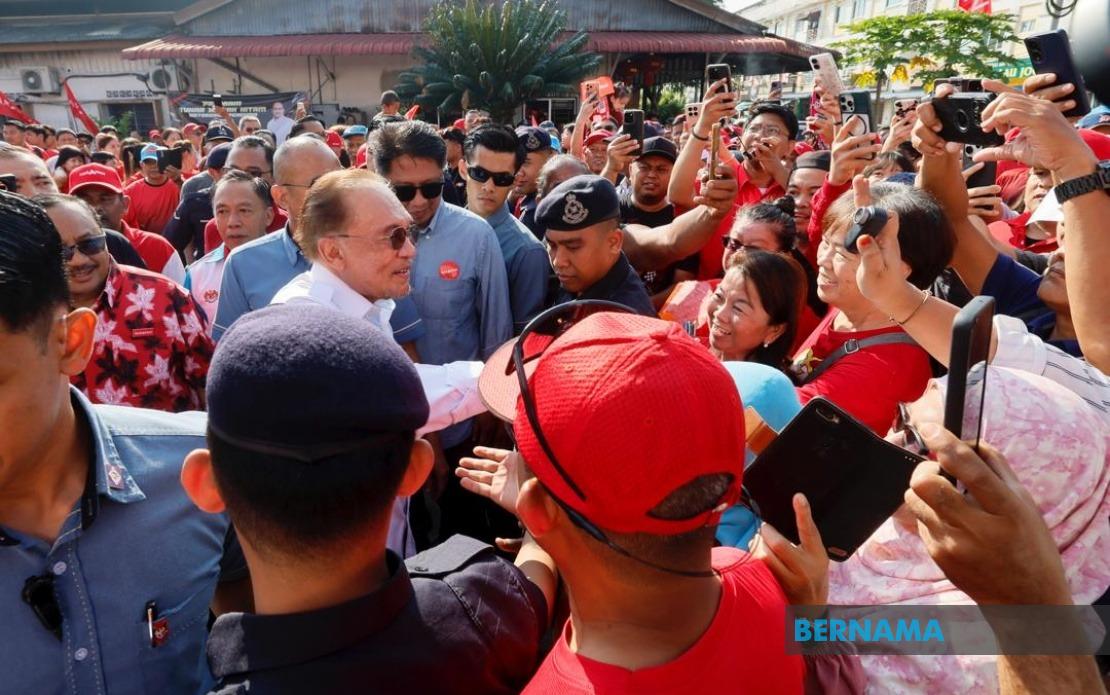
Prime Minister Datuk Seri Anwar Ibrahim's campaign appearance in Johor on July 5 has energized the Pakatan Harapan (PH) machinery operating across multiple constituencies in the state, particularly as the coalition intensifies its final push before the July 11 state election. The visit to Simpang Renggam, which encompasses the Machap and Layang-Layang state assembly seats, demonstrated the importance PH places on these battleground areas and underscored its commitment to mobilizing grassroots support during the final week of campaigning.
Nur Hafiz Roslan, the PH candidate contesting Machap, emphasized that Anwar's hands-on engagement transcended the typical symbolic campaign visit. The Prime Minister's direct interaction with campaign operatives and voters conveyed a strategic messaging directive that their efforts must remain anchored in genuine service delivery rather than partisan antagonism. Anwar reiterated to the assembled candidates and volunteers that their mission centers on enhancing community welfare, and he specifically reminded them to approach all campaign activities with the intention of performing righteous deeds that benefit the constituents they hope to represent. This framing of electoral work within a moral and service-oriented framework proved instrumental in refocusing campaign energy during what is traditionally a critical juncture when worker fatigue can undermine field operations.
The message delivered by the PKR president carried particular weight given the competitive nature of Johor's political landscape. Rather than inviting divisive rhetoric, Anwar's guidance stressed that PH's presence in Simpang Renggam and its associated constituencies should emphasize constructive engagement with all community segments, setting a tone that distinguishes the coalition's approach within a crowded electoral battlefield. Nur Hafiz underscored this commitment by pledging that services delivered by PH-backed candidates would remain free from prejudicial treatment, a pledge that addresses longstanding voter concerns about equitable governance across demographic lines. The candidate affirmed that both his campaign in Machap and that of his PH colleague Guna Balakrishnan in Layang-Layang would operate with renewed determination following the Prime Minister's visit.
Guna Balakrishnan, the PH candidate for Layang-Layang, highlighted how the Prime Minister's direct involvement strengthened his capacity to build meaningful connections with local residents. Although Guna noted that grassroots enthusiasm had already manifested in encouraging community responses, he recognized that sustaining and expanding this support required deliberate, intensive outreach efforts that cannot be treated as secondary priorities. Significantly, Anwar transmitted a conditional governance commitment during their meeting: should Guna secure the electoral mandate, the Prime Minister emphasized that constituency development and tangible improvements to the local community must become paramount obligations. This direct linking of campaign promises to explicit accountability measures signals PH's attempt to anchor electoral promises within a framework of measurable delivery expectations.
The tangible scale of engagement became evident during the 'PMX Santai Sarapan Bersama Masyarakat' programme, where more than 1,000 residents converged to interact with the Prime Minister in an informal setting. The deliberate choice of a casual, accessible format—rather than a formal rally structure—facilitated intimate exchanges between Anwar and constituents, allowing voters to assess candidates within a relaxed atmosphere that stripped away procedural rigidity. This approach proved particularly effective in generating positive sentiment among undecided voters and consolidating support among wavering PH sympathizers who valued personal accessibility and authentic engagement from political leadership.
For residents like Chuan Chee Mei, a 48-year-old Simpang Renggam voter, Anwar's visible commitment to candidates and community participation substantially reinforced confidence in extending electoral support to PH contenders. The Prime Minister's demonstrated enthusiasm for backing his party's candidates, combined with his willingness to participate in community-centered events, translated into renewed voter conviction regarding the seriousness of PH's local engagement. Such personal validation from senior leadership often proves more persuasive than policy documentation or campaign materials, particularly when voters seek reassurance that their chosen representatives retain backing from central party structures.
Noor Takiyudin Salleh, a 38-year-old voter, similarly registered the strategic value of Anwar's approachable demeanor and high-profile attendance. The substantial turnout of over 1,000 residents conveyed visible momentum and suggested organizational competence, factors that many voters interpret as indicators of broader party strength and viability. The accessibility of the Prime Minister—his willingness to engage in an informal breakfast programme rather than maintaining hierarchical distance—aligned with contemporary voter preferences for political leaders who demonstrate genuine connection to community concerns rather than projecting aloof authority. This populist accessibility, combined with demonstrated support for grassroots candidates, constructed a persuasive narrative regarding PH's electoral viability and governance philosophy.
The competitive context surrounding the Johor state election adds substantial significance to these campaign dynamics. With 172 candidates vying across 56 state seats, the election represents a highly fragmented contest in which marginal performance variations can determine outcomes across multiple constituencies. PH's strategy of deploying the Prime Minister to high-stakes constituencies reflects clear recognition that certain seats remain genuinely competitive and require intensive senior-level engagement to consolidate support. The July 11 polling date and the scheduled July 7 early voting period compress the remaining campaign window, making leadership visibility and momentum-building activities critical components of final-stage electoral strategy.
For Malaysian political observers and Southeast Asian analysts monitoring state-level electoral dynamics, Anwar's campaign approach illuminates broader patterns within Malaysian politics regarding the continued centrality of leadership personality and direct voter engagement. While institutional party machinery remains important, the visible commitment of senior leaders to specific constituencies—particularly during critical electoral moments—generates disproportionate impact on voter sentiment and organizational morale. The Prime Minister's visit to Johor demonstrates how personal political capital can be strategically deployed to reinvigorate campaign operations, strengthen candidate confidence, and provide reassurance to voters regarding party commitment and post-election governance intentions.
The implications extend beyond immediate electoral calculations in Machap, Layang-Layang, and Simpang Renggam. PH's willingness to invest prime ministerial time and attention in these constituencies signals internal confidence regarding competitive positioning and reflects calculated judgments about which races warrant maximum resource deployment. Such strategic allocation decisions shape broader perceptions regarding party momentum, candidate viability, and overall electoral confidence—perceptions that ripple across the broader Johor electorate and potentially influence voting behavior in less-visited constituencies. As the election cycle progresses through its final week, the cumulative impact of leadership engagements across multiple constituencies will substantially condition the ultimate electoral outcome and post-election governance legitimacy.

