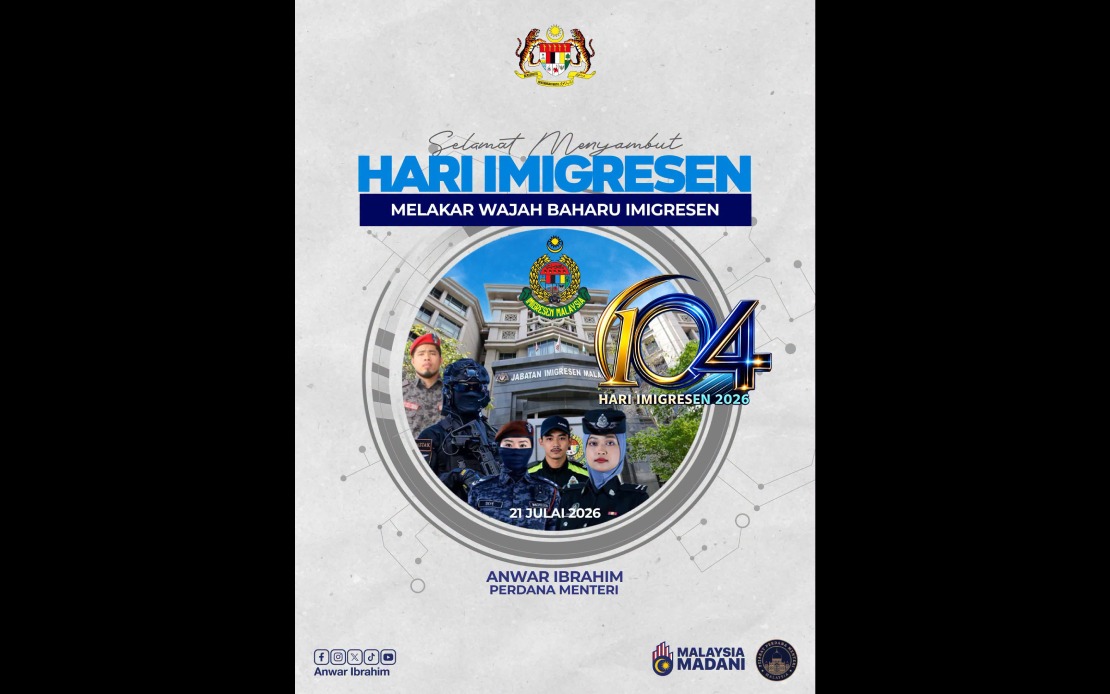
Prime Minister Datuk Seri Anwar Ibrahim has made a direct appeal to the Immigration Department's workforce to discharge their duties with absolute integrity and to firmly reject all manifestations of misconduct and corrupt practices. The call came during his public address marking Immigration Day, reflecting the government's sustained focus on strengthening institutional accountability within Malaysia's border management apparatus.
Anwar's statement underscores a persistent challenge facing the immigration sector globally—the vulnerability of border agencies to corrupt schemes that undermine sovereignty and public trust. Border control functions inherently create opportunities for irregularities, ranging from document falsification to bribery, which can compromise national security. By singling out the Immigration Department for this moral exhortation, the Prime Minister signals that eliminating such practices remains a government priority.
Beyond the anti-corruption message, Anwar articulated a more expansive vision for the department's identity and purpose. He stressed that JIM personnel must simultaneously cultivate compassion alongside their enforcement responsibilities—a deliberate effort to reframe immigration work as not merely restrictive but fundamentally service-oriented. This dual emphasis reflects evolving global standards in immigration administration, where agencies are expected to balance security with human-centred approaches.
The 2026 Immigration Day theme, "Charting a New Face for Immigration," carries symbolic weight that aligns with Anwar's messaging. The phrase suggests institutional renewal and modernisation, implying that the department is undergoing transformation in both operational practices and values. For Malaysian readers, this messaging matters because it directly affects the experiences of citizens, tourists, and migrant workers navigating the country's borders.
Efficiency and professional courtesy represent additional pillars Anwar outlined, recognising that public perception of immigration services hinges on tangible interactions at counters and checkpoints. Long delays, discourteous treatment, and opaque procedures have historically frustrated travellers and investors. By elevating these service standards in a public address, the Prime Minister creates accountability expectations that ripple through departmental hierarchies.
Anwar's reference to safeguarding national sovereignty connects immigration integrity to broader security architecture. A corrupt immigration system becomes a liability in counter-terrorism and transnational crime prevention efforts. When immigration officers are susceptible to bribery, high-risk individuals can potentially enter or exit Malaysia undetected, threatening public safety and regional security cooperation. This geopolitical dimension is particularly relevant in Southeast Asia, where transnational crime and irregular migration remain significant challenges.
The Prime Minister's invocation of "elevating Malaysia's name on the world stage" reveals awareness that the country's international reputation is shaped by how visitors experience its immigration processes. Countries with efficient, transparent immigration systems attract greater business investment and tourism revenue. Conversely, persistent corruption scandals can deter legitimate travel and investment, inflicting economic costs. For a middle-income nation competing for regional economic prominence, maintaining immigration system integrity is thus an economic matter as well as an ethical one.
Anwar's public platform for this message—a Facebook post reaching millions directly—reflects contemporary political communication strategies that bypass traditional media filters. This approach ensures the message reaches JIM personnel while simultaneously signalling to the broader public that the government takes these issues seriously. The informal yet official nature of the medium conveys accessibility without diminishing the message's weight.
The appeal arrives at a moment when Malaysian immigration agencies, like their counterparts throughout Asia, face mounting operational pressures. Rising irregular migration flows, document fraud sophistication, and resource constraints create environments where corners might be cut or rules bent. Anwar's timely reminder serves as institutional reinforcement against normalisation of misconduct, even as systemic pressures mount.
For Malaysian businesses and citizens, the outcomes of departmental integrity efforts translate into smoother border transactions, reduced processing fees paid to corrupt middlemen, and more reliable visa and permit processing. Residents of Southeast Asian nations relying on regular Malaysia transit particularly benefit from trustworthy immigration administration. The statement thus addresses audiences far beyond the department itself—acknowledging interconnected expectations spanning government, business, civil society, and the travelling public across the region.

