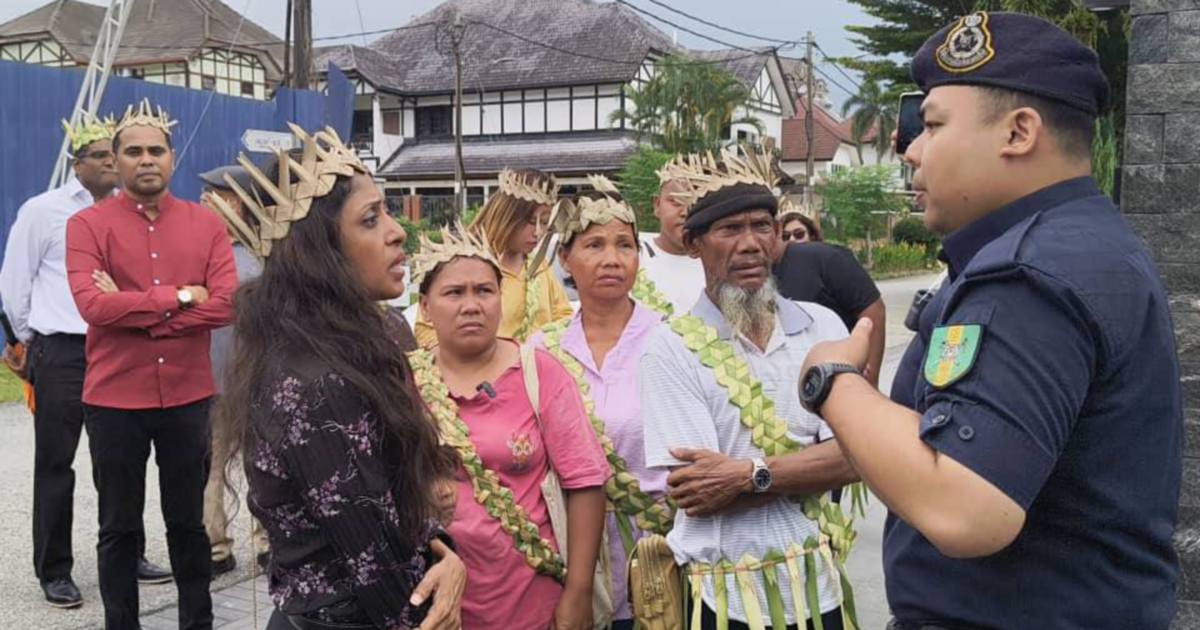
The indigenous community of Kampung Sungai Cot in Maran, Pahang, has received a formal commitment from Prime Minister Datuk Seri Anwar Ibrahim to escalate their unresolved ancestral land claim to state authorities, offering a glimmer of hope after years of administrative delays and legal obstacles. During an engagement in Kajang, Anwar assured the families that he would personally intervene by bringing their grievance before the Pahang state government, signalling that the matter may finally gain traction at the highest levels of federal governance.
The dispute surrounding Kampung Sungai Cot represents a broader challenge facing Malaysia's Orang Asli communities, who have historically struggled to have their customary land rights formally recognised and protected under the country's legal framework. These indigenous groups have inhabited their ancestral territories for generations, yet formal documentation and state acknowledgement of their claims remain inconsistent across the peninsula. The case of Maran's Orang Asli families exemplifies the gap between informal occupation and statutory recognition, a tension that has created prolonged uncertainty for communities seeking security and development opportunities on their traditional lands.
The significance of Anwar's intervention lies in the nature of land governance in Malaysia, where state governments retain substantial authority over land matters under the Federal Constitution. Pahang, as the relevant state authority, holds decisive power over land allocation, title registration, and recognition of native customary rights. Without state-level cooperation and action, even sympathetic federal gestures carry limited practical weight. By pledging to engage directly with Pahang's leadership, Anwar has indicated awareness that resolving the Kampung Sungai Cot matter requires navigating the complex federal-state relationship that often impedes indigenous land resolution.
Orang Asli communities across Peninsular Malaysia have faced decades of displacement pressures from state development projects, logging operations, agricultural expansion, and urban encroachment. Many groups lack formal title documentation for lands they have occupied and managed according to customary practice. The absence of clear statutory recognition has left indigenous families vulnerable to dispossession when their territories are earmarked for commercial or infrastructural purposes. Kampung Sungai Cot's protracted dispute must be understood within this wider context of systemic vulnerability affecting the peninsula's approximately 180,000 Orang Asli people.
The Orang Asli Development Department, which coordinates federal policy towards indigenous communities, has limited enforcement capacity to compel state governments to recognise native customary rights. This institutional constraint reflects a longstanding structural challenge in Malaysian indigenous affairs: federal commitment to Orang Asli welfare often runs parallel to, rather than overriding, state-level land and resource policies. Anwar's promise therefore represents an attempt to leverage executive authority and federal-state political channels to break through deadlock rather than relying on conventional bureaucratic processes that have evidently proved ineffective for Kampung Sungai Cot.
The families' extended struggle has likely involved repeated petitions to state authorities, attempts at legal proceedings, and representations through various federal agencies without achieving satisfactory resolution. Such prolonged stalling erodes community confidence in institutional remedies and can exacerbate social tensions. The Prime Minister's direct involvement potentially provides both symbolic validation of the community's grievance and practical access to high-level decision-makers who may accelerate administrative processes or facilitate negotiations between Orang Asli representatives and Pahang officials.
Southeast Asian experience with indigenous land rights demonstrates that sustainable resolution typically requires several concurrent elements: formal state recognition of customary tenure, statutory protections against unilateral dispossession, consultation mechanisms for development decisions affecting traditional territories, and capacity-building support enabling communities to participate effectively in modern land governance. Malaysia's approach has historically emphasised individual titling rather than collective or customary rights recognition, creating a structural misalignment with Orang Asli social organisation and land-use patterns. Any genuine breakthrough in the Kampung Sungai Cot case would necessarily involve reconsidering these underlying frameworks.
The timing of Anwar's pledge reflects broader political dynamics within Peninsular Malaysia, where indigenous vote populations in several constituencies hold non-trivial electoral significance. Demonstrable action on long-pending Orang Asli grievances carries political resonance alongside genuine human rights dimensions. Whether the federal intervention produces substantive outcomes—such as land surveys, statutory recognition, or compensation arrangements—will significantly influence whether the Kampung Sungai Cot case becomes a model for addressing similar disputes or merely another instance of promises that exceed implementation.
For the Maran community, the coming weeks and months will prove critical in determining whether executive attention translates into concrete progress. Successful outcomes would likely involve formal engagement between Pahang authorities and Orang Asli representatives, possibly incorporating neutral mediators or technical experts in land demarcation. The Prime Minister's credibility on indigenous issues, and broader perceptions of government responsiveness to marginalised communities, will be shaped partly by how thoroughly this intervention is pursued and what tangible results emerge.

