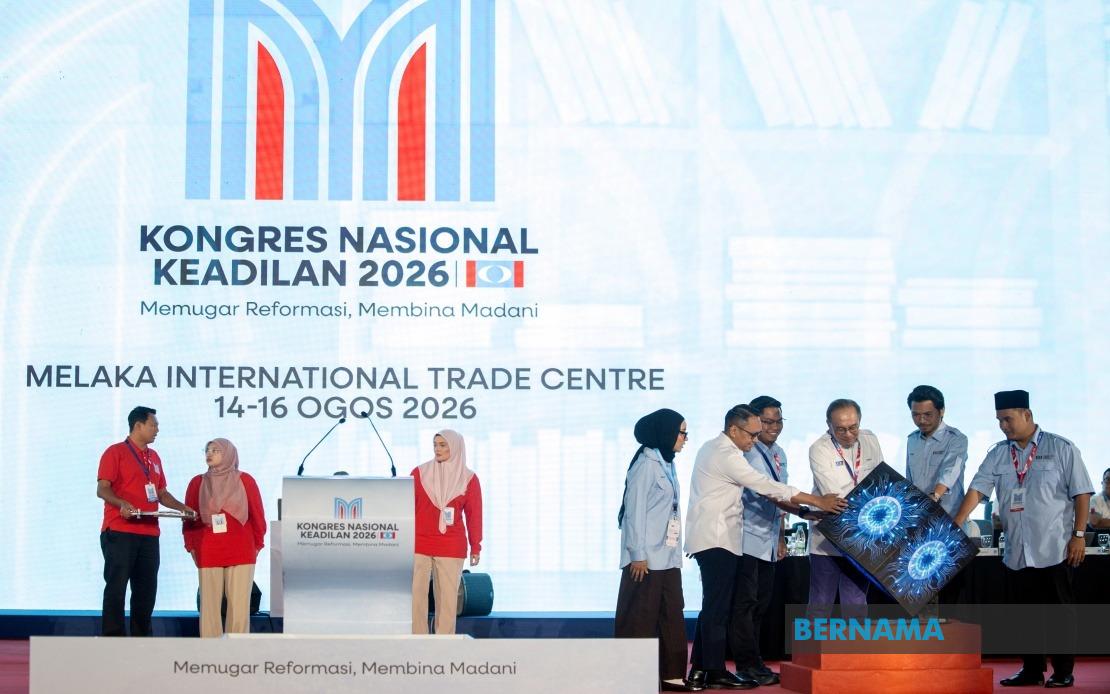
Prime Minister Datuk Seri Anwar Ibrahim has unveiled a comprehensive ideological manual authored by the leadership of Angkatan Muda Keadilan (AMK), the youth wing of Parti Keadilan Rakyat, during a ceremony in Melaka. The 113-page publication, crafted by AMK chief Muhammad Kamil Ahmad Munim and executive committee member Ashraf Ahmad Hadi, represents an effort to crystallise contemporary thinking within PKR's younger ranks on navigating Malaysia's complex contemporary challenges. The launch marks a significant moment for the ruling coalition party as it attempts to consolidate its ideological foundations among an increasingly important demographic bloc.
In his remarks at the event, Anwar characterised the publication as arriving at a particularly opportune moment, one that aligns with the party's broader adoption of renewed strategic directions. Beyond viewing it as a mere technical document or a transient political messaging exercise, the Prime Minister framed the manual as part of a larger civilisational project—one fundamentally concerned with reimagining national development through a more humanistic lens. This framing suggests PKR's leadership recognises a growing demand among younger voters and party members for ideological coherence and philosophical grounding, particularly as Malaysia navigates post-pandemic economic uncertainties and evolving social expectations.
Central to Anwar's message was a pointed reminder directed at AMK members themselves. He underscored that the authority and platform granted to young people in contemporary Malaysia should not be interpreted as licence for complacency or superficial celebration of minor victories. Rather, the Prime Minister emphasised that such opportunity carries weighty moral and spiritual obligations, functioning as a test of individual integrity and commitment to collective good. This rhetoric reflects a broader concern within PKR's hierarchy about ensuring that younger party members maintain ideological discipline and avoid the cynicism or careerism that can afflict established political movements.
Anwar stressed the extraordinary demands confronting Malaysia's younger generation as they assume greater responsibility for national affairs. Constructing a nation attempting to overcome historical injustices and systemic inefficiencies demands, in his assessment, more than conventional bureaucratic competence. Rather, it necessitates what he termed extraordinary creativity, intellectual courage, and spiritual resilience. This formulation echoes themes that have characterised Anwar's public statements throughout his political career, blending pragmatic governance language with appeals to moral and spiritual renewal—a combination that continues to resonate with portions of Malaysia's educated middle class and reform-minded constituencies.
The manual functions primarily as an educational instrument designed to inculcate ideological consistency among AMK cadres. By encouraging members to engage seriously with the history of PKR's political struggle, understand the intellectual foundations of the party's platform, and grasp the substantive meaning embedded within the concept of "Reformasi," the publication aims to create a generation of party activists capable of articulating coherent policy positions and engaging in principled political discourse. In an era characterised by social media fragmentation and simplified political messaging, such efforts to promote deeper ideological engagement among party members represent a counter-current to prevailing trends.
The timing of the publication's launch carries additional significance within Malaysia's evolving political context. PKR continues to navigate complex coalition dynamics within the federal government, managing relationships with other component parties while addressing internal factional pressures. A strengthened ideological framework among younger members could potentially enhance the party's cohesion and provide young activists with clearer guidance on reconciling particular interests with broader party strategy. Additionally, as Malaysia approaches future electoral cycles, investing in youth cadre development through educational materials represents a long-term organisational strategy.
For Malaysian political observers and analysts, the emphasis on "Reformasi"—a concept that defined PKR's emergence during the late 1990s political upheaval—signals the party's continued attempt to leverage its historical narrative of opposition to authoritarianism and corruption. However, deploying such terminology while holding executive power and participating in governing coalitions presents inherent tensions. The manual must negotiate between preserving the movement's reformist credentials and acknowledging the practical constraints of political governance. This balancing act remains central to PKR's broader project of establishing itself as a mainstream governing force rather than merely as a force for protest and opposition.
Anwar's characterisation of the initiative as contributing to national renewal rather than merely serving partisan objectives reveals how PKR leadership attempts to frame party-building activities as consonant with broader national interest. By presenting ideological development of young members as part of Malaysia's larger project of moral and institutional reconstruction, Anwar positions PKR's interests as aligned with national interests—a rhetorical move that carries both persuasive power and inherent vulnerability to accusations of partisan self-interest.
The manual's existence also reflects recognition within PKR that intellectual infrastructure matters for political sustainability. While charismatic leadership and electoral success provide essential foundations, long-term political movements require documented ideological frameworks that younger members can study, internalise, and transmit to subsequent generations. The 113-page volume represents an attempt to provide such institutional memory and intellectual continuity, ensuring that PKR's ideological identity survives generational transitions and remains distinct from rival political formations.
Looking forward, the efficacy of this publication will depend substantially on how thoroughly it circulates within AMK networks, how effectively party leadership integrates its contents into training programmes, and whether younger members genuinely engage with its intellectual substance or treat it as obligatory reading with limited practical application. The manual's ultimate impact on PKR's organisational development and electoral prospects will become apparent only as its ideas diffuse throughout the party's rank-and-file and influence the political behaviour of Malaysia's younger activists and voters.

