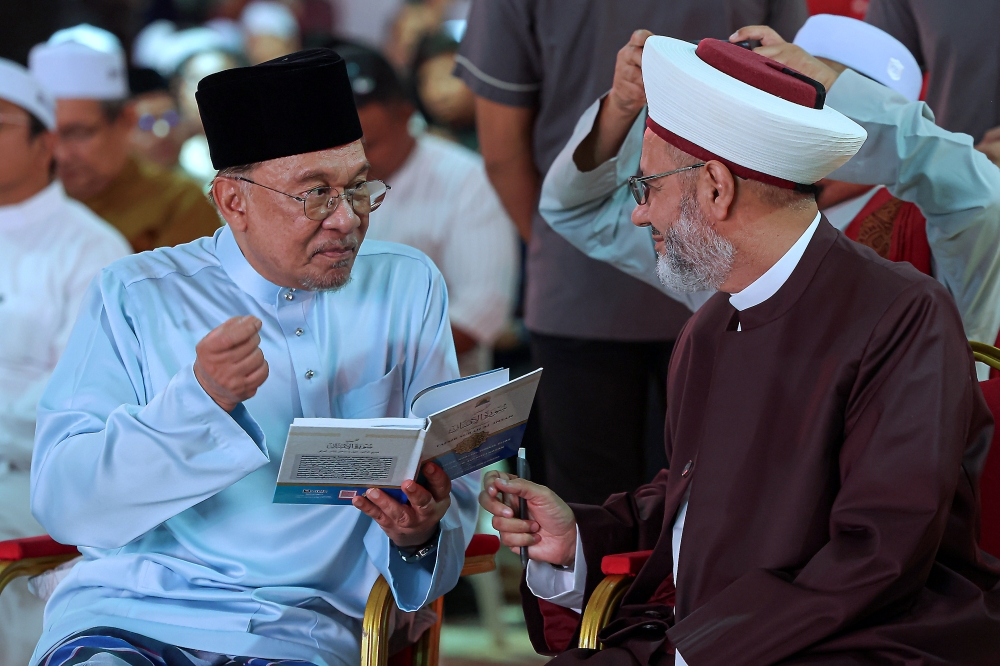
Prime Minister Datuk Seri Anwar Ibrahim has publicly commended Grand Imam Ahmed Al-Tayyeb of Al-Azhar as a prominent global champion for religious moderation and tolerance. Anwar's remarks underscore Malaysia's alignment with international efforts to promote Islam as a faith centred on balance, dialogue, and respect for diverse belief systems—a positioning that has become increasingly central to the country's diplomatic and domestic messaging.
Al-Azhar, one of Islam's oldest and most prestigious theological institutions based in Cairo, has long occupied a unique position as a bridge between Islamic scholarship and contemporary global challenges. Grand Imam Al-Tayyeb, who has led the institution since 2010, has worked to reshape its public role, emphasizing the compatibility of Islamic teachings with human rights, gender equality, and peaceful coexistence. Anwar's endorsement reflects Malaysia's broader strategic interest in aligning itself with moderate voices within the Islamic world, particularly as regional and global tensions around religion and identity persist.
The Prime Minister's recognition of Al-Tayyeb carries symbolic weight in Southeast Asia's largest Muslim-majority nation. Malaysia has positioned itself as a model of religious pluralism and interfaith cooperation, hosting significant Christian, Buddhist, Hindu, and other faith communities alongside its Muslim majority. By highlighting a respected Islamic scholar who advocates moderation, Anwar reinforces the government's narrative that Islam and democratic values, religious diversity, and development are entirely compatible. This messaging is crucial for Malaysia's international standing and for managing domestic religious sensitivities.
Al-Tayyeb's tenure at Al-Azhar has been marked by visible shifts in the institution's public diplomacy. He has engaged directly with Pope Francis, participated in the Document on Human Fraternity signed in Abu Dhabi in 2019, and consistently condemned sectarian violence and extremism in the name of religion. These actions have positioned him as a counterweight to radical interpretations of Islam that dominate some global conversations about the faith. For Malaysian policymakers, such figures provide external validation that their own emphasis on moderate Islam reflects broader international consensus among Islamic scholars and leaders.
Anwar's specific commendation of Al-Tayyeb also occurs within Malaysia's own complex religious landscape. The country has experienced periodic tensions over issues including interfaith activities, the status of Islam in the constitution, and the authority of Islamic courts. By publicly celebrating a Grand Imam known for progressive stands on tolerance and human rights, Anwar sends a signal to Malaysia's non-Muslim communities and international observers that the government prioritizes inclusive governance. Simultaneously, he demonstrates to conservative Islamic constituencies that moderation itself is rooted in classical Islamic scholarship, not a foreign imposition.
The timing of such recognition matters. Global discourse around Islam has been shaped significantly by security threats from extremist groups claiming Islamic justification, migration and integration debates in Western countries, and broader civilizational narratives that sometimes pit Islam against secular democracy. Prominent Muslim leaders and scholars who robustly challenge these binaries become valuable diplomatic assets for Muslim-majority countries seeking to influence how Islam is perceived and discussed internationally. Al-Tayyeb's work fits this need precisely.
Malaysia's elevation of Al-Tayyeb as a moderation icon also reflects pragmatic concerns about radicalization at home. The country has experienced domestic terrorism linked to extremist groups, and counterradicalization remains a government priority. By associating with and praising international Islamic figures committed to countering violent extremism, Anwar's administration strengthens its own credibility on these issues. It also provides ideological ammunition for countering those within Malaysia who might argue that moderation constitutes a betrayal of Islamic principles.
Furthermore, this diplomatic posturing aligns with Malaysia's broader foreign policy orientation toward the Muslim world and the Global South. As the country navigates complex relationships with Gulf states, Middle Eastern powers, and other Muslim-majority nations, identifying with respected Islamic voices helps manage these relationships. Al-Tayyeb's influence extends across the Arab world and into Asia, making him a figure of genuine significance in Islamic institutional hierarchies. Anwar's recognition helps position Malaysia within networks of moderate Islam that include Egypt, the UAE, and other actors increasingly defining their Islamic identities through interfaith engagement and opposition to sectarianism.
The Grand Imam's emphasis on education as a tool for promoting moderation particularly resonates with Malaysia's own development priorities. Al-Azhar's educational role extends across the Arab world, and its commitment to teaching Islam alongside modern sciences and critical thinking influences how Islam is understood by millions of students. For Malaysia, which has sought to strengthen its own Islamic institutions—including the International Islamic University and state-level Islamic councils—this model of combining traditional scholarship with contemporary engagement proves instructive.
Anwar's comments also reflect generational shifts within Malaysian leadership. As the country's Prime Minister, he brings decades of experience in Islamic intellectual circles and government. His public embrace of figures like Al-Tayyeb represents a deliberate choice to position Malaysia at the forefront of what might be called institutional Islam—the vision offered by established scholars and formal religious structures—rather than allowing the global narrative around Islam to be dominated by extremists or by secular critics dismissing Islam as inherently incompatible with moderation. This distinction carries implications for how Malaysia approaches everything from education policy to international relations.
Looking forward, such endorsements help establish frameworks within which Malaysia can address its own challenges around religious identity, social cohesion, and international positioning. By consistently championing figures like Al-Tayyeb, Anwar signals to domestic and international audiences that Malaysia's vision of Islam remains firmly rooted in scholarship, dialogue, and respect for human dignity. This positioning becomes increasingly important as global debates around religion, identity, and governance continue to intensify, and as Southeast Asia's role in shaping Islamic thought and practice grows more prominent.

