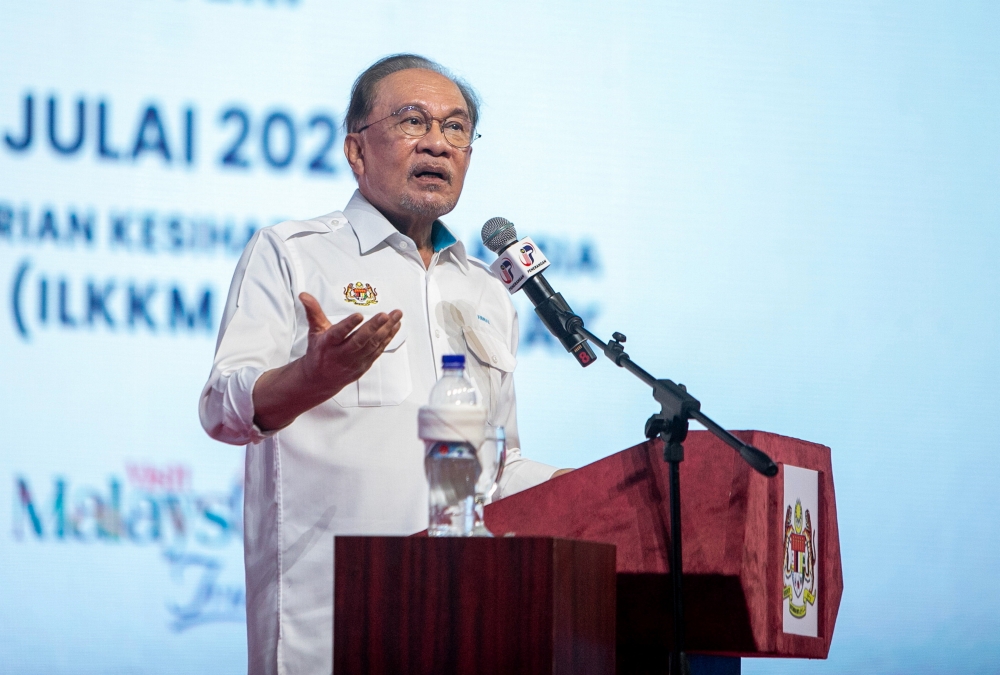
Prime Minister Datuk Seri Anwar Ibrahim has mounted a robust defence of the government's approach to fuel pricing, framing the issue as a critical matter of fiscal sustainability rather than mere administrative convenience. Speaking in Kajang, Anwar positioned the current policy framework as a necessary restraint on escalating public expenditure, directly addressing public criticism that questions why ordinary Malaysians must bear the burden of market-rate fuel costs while the state shoulders other obligations.
The prime minister's remarks underscore a fundamental tension in Malaysian politics: the desire to provide affordable essentials to citizens must be weighed against the government's capacity to fund such programmes without mortgaging the nation's financial future. Anwar's framing suggests that the administration views fuel subsidies not as a moral imperative but as a policy instrument with genuine consequences for broader economic health. His warning against "piling on debt" reflects anxiety within the cabinet about Malaysia's debt-to-GDP ratio and the constraints this places on policy flexibility.
This position represents a departure from decades of Malaysian governance tradition, where fuel subsidies were considered a quasi-permanent feature of the social contract between government and citizens. The pivot towards cost-reflective pricing—allowing international market movements to influence domestic pump prices—has been gradual but consistent across administrations, yet remains politically fraught. Anwar's explicit articulation of the trade-off between subsidies and fiscal discipline suggests the government is attempting to build a more coherent public narrative around its pricing decisions rather than simply implementing technical adjustments.
The fiscal mathematics underpinning Anwar's position are considerable. Malaysia's historical commitment to fuel subsidies created vast contingent liabilities during periods of elevated international oil prices, straining the federal budget and crowding out investments in infrastructure, healthcare, and education. By allowing prices to fluctuate closer to global benchmarks, the government reduces the temptation to accumulate additional borrowing when crude prices spike unexpectedly. This protective mechanism becomes increasingly valuable as Malaysia navigates post-pandemic fiscal recovery and seeks to maintain investment-grade credit ratings.
Yet the prime minister's framing also reveals the political difficulty of the position. The implicit question—"Who will pay for it?"—acknowledges that someone must absorb the cost of fuel. If not consumers at the pump, then taxpayers through general revenue, or workers through wage compression, or future generations through reduced public investment. Anwar's rhetorical move attempts to shift the burden of justification from the government to critics, challenging them to specify which alternative they would prefer. This represents a more sophisticated political argument than simple technocratic explanation.
The timing of Anwar's remarks reflects ongoing sensitivity about cost-of-living pressures across Malaysia. Fuel prices remain deeply symbolic in Malaysian political discourse, touching on questions of fairness, equity, and the state's role in cushioning citizens from economic shocks. By articulating concerns about debt accumulation, Anwar attempts to connect fuel policy to macroeconomic stability and long-term prosperity—a linkage that may resonate with middle-class voters concerned about Malaysia's competitive position in Southeast Asia but may prove less persuasive to lower-income groups experiencing immediate budget pressures from energy costs.
The government's fiscal position has improved marginally since the height of the pandemic, yet Malaysia remains constrained relative to several regional peers in its capacity for expansionary spending. Public debt levels, while declining from recent peaks, remain elevated by historical standards and by comparison to some neighbouring economies. This constrains the government's ability to absorb large subsidies while simultaneously investing in the digital infrastructure, skilled workforce development, and research capabilities that economists argue are essential for Malaysia's medium-term growth trajectory.
Anwar's defence of the fuel pricing policy also implicitly signals that the government is unlikely to reverse course substantially in response to public pressure. This suggests confidence that the administration believes it can manage political fallout from higher fuel prices better than it could manage the fiscal consequences of renewed large-scale subsidisation. The statement may therefore signal to investors and credit rating agencies that Malaysia intends to maintain fiscal discipline, potentially supporting exchange rate stability and borrowing costs.
The prime minister's remarks must also be understood within the context of regional comparisons. Several Southeast Asian economies have experimented with fuel price deregulation or partial subsidy withdrawal, with varying success. Indonesia's experiences with gradual subsidy removal in the 2000s provide a relevant case study—one in which initial political turbulence eventually gave way to acceptance, as citizens recognised that the fiscal space released by subsidy restraint enabled other investments. Thailand and the Philippines have pursued hybrid approaches involving price caps and targeted support for vulnerable groups rather than universal subsidies.
For Malaysian readers concerned about household budgets, Anwar's argument essentially rests on a bet that maintaining fiscal discipline now will generate sufficiently robust economic growth and public service delivery in future periods to more than compensate for current price adjustments. Whether that bet proves sound will depend on implementation of companion policies—ensuring that any freed fiscal space genuinely funds productive investments rather than being consumed by current expenditure—and on external economic conditions that may well prove beyond Malaysia's control.

