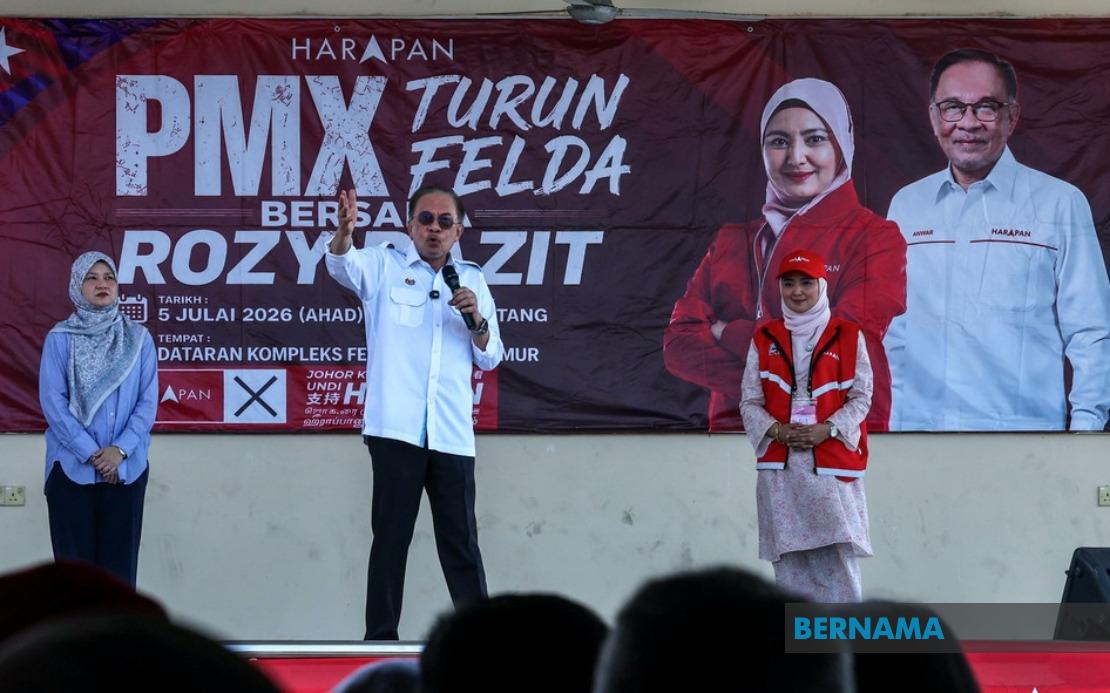
Prime Minister Datuk Seri Anwar Ibrahim has committed to addressing a pressing issue that has vexed Malaysia's agricultural sector for decades: the shortage of housing sites for children of FELDA settlers. Speaking at a community engagement session in Segamat, Anwar emphasised that finding a workable solution for the second generation represents a key policy priority for his administration, one he intends to see through during his tenure as Prime Minister.
The housing shortage affecting FELDA settlers' descendants stands as one of the most persistent grievances within Malaysia's agricultural communities. Originally established to provide land and opportunity to smallholder farmers, the FELDA scheme has created a complex situation where succeeding generations face limited access to land and housing within their settlement areas. The lack of formal allocation for children of original settlers has forced many young people to migrate to urban centres, undermining the sustainability of these rural communities and creating tension between state and federal authorities over responsibility for resolution.
Anwar's commitment reflects an awareness that the issue cannot be dismissed as merely technical or administrative. The problem has festered across multiple administrations, creating accumulated frustration among FELDA communities. By publicly positioning himself as committed to settling the matter during his premiership, Anwar is signalling political will at the highest level. This approach differs from previous handling, where the issue remained largely confined to state-level discussions or ministry-level committees without decisive action.
However, the Prime Minister was careful to frame the resolution within existing constitutional and administrative boundaries. Land administration and infrastructure provision fall under state jurisdiction in Malaysia's federal structure, meaning any solution requires sustained cooperation between Putrajaya and individual state governments. This constitutional reality means that progress depends not on federal authority alone, but on political alignment and goodwill at the state level. For Selangor, where Segamat's Buloh Kasap constituency is located, this involves collaboration between the state government led by Menteri Besar Datuk Seri Amirudin Shari and federal authorities.
The presence of multiple senior officials at the Dataran Putra Felda Palong Timur gathering underscores the government's desire to demonstrate cross-party and cross-ministerial consensus on the issue. Education Minister Fadhlina Sidek and Deputy National Unity Minister and Segamat MP R. Yuneswaran flanked Anwar, alongside Amirudin, signalling that this is not a narrow federal concern but a broader governance priority involving education, national unity, and parliamentary representation. The composition of attendees suggests that the government intends to mobilise multiple portfolios toward identifying practical solutions.
The FELDA settler community has become increasingly vocal about the second-generation housing problem, particularly as land prices in surrounding areas have risen and young families find themselves unable to establish themselves within their heritage communities. Many settlers purchased their plots and built homes with expectations that their children would similarly benefit from the scheme, only to discover that land allocation mechanisms were never designed to accommodate generational succession on a systematic basis. This gap between expectation and reality has bred resentment that extends beyond housing into broader questions about social equity and governmental responsiveness to rural constituencies.
For Malaysian governance more broadly, the issue illustrates tensions inherent in managing large-scale social programmes across federal and state boundaries. FELDA was conceived as a transformative initiative to address landlessness and rural poverty, yet its long-term sustainability now hinges on solving problems that transcend the original scheme's design parameters. Anwar's statement suggests a recognition that pragmatic solutions may require reformulating how land and housing are allocated within FELDA areas, potentially including new mechanisms for identifying available sites or facilitating transitions that benefit second-generation settlers without disadvantaging original settlers.
The timing of this commitment, delivered during a meet-the-people programme, indicates the government's intent to translate high-level political commitment into concrete action. Such gatherings serve both to demonstrate direct engagement with grassroots communities and to gather specific intelligence about local grievances that can inform policy design. By hearing directly from FELDA residents about their circumstances, decision-makers can better calibrate solutions to reflect actual conditions rather than relying solely on bureaucratic assessments.
Regional observers will note that FELDA communities represent a significant voting bloc, particularly in states like Selangor, Pahang, and Johor. The political economy of addressing their grievances shapes how parties position themselves in competition for rural and semi-rural support. Anwar's explicit commitment acknowledges this reality while framing the issue in terms of social justice and governmental obligation, rather than transactional politics. This rhetorical positioning may appeal to constituencies frustrated by years of unfulfilled promises on the housing question.
Moving forward, the practical challenge lies in translating Anwar's pledge into concrete policy mechanisms. Solutions might encompass identifying underutilised land within existing FELDA schemes, facilitating land-banking arrangements, or adjusting legal frameworks governing site allocation. Each approach carries implications for land values, existing settlers' interests, and fiscal commitments. The involvement of the minister responsible for FELDA affairs, whom Anwar mentioned as a key partner, will be essential in developing and implementing detailed proposals that navigate these competing considerations.

