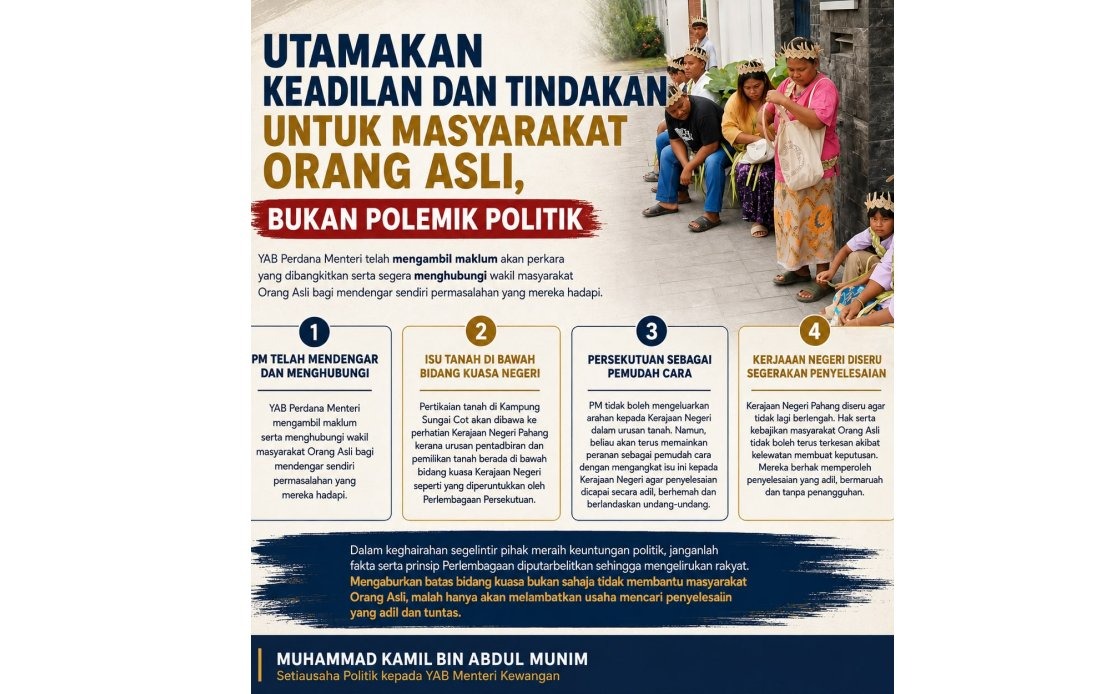
Prime Minister Datuk Seri Anwar Ibrahim has committed to playing an active facilitating role in resolving the contentious land dispute affecting the Orang Asli community in Kampung Sungai Cot, located in Maran district, Pahang. Through his political secretary Muhammad Kamil Abdul Munim, Anwar signalled that he would escalate the matter to the Pahang State Government to ensure a resolution that upholds both fairness and legal compliance. The Prime Minister has already taken the initiative to personally engage with community representatives, listening directly to the hardships and challenges they face regarding their land claims and housing security.
The statement from Muhammad Kamil underscores a delicate constitutional position that defines the federal government's limited role in land administration. Under the Malaysian Federal Constitution, matters concerning land ownership and administration fall squarely within state authority, leaving the Prime Minister without direct power to impose decisions on Pahang's government. However, Anwar has made clear that his constitutional constraints do not translate into indifference. Rather, his approach involves diplomatic engagement and advocacy, leveraging the federal government's capacity to encourage state-level action through dialogue and pressure.
This distinction between authority and responsibility reflects a nuanced understanding of Malaysia's federal structure that sometimes confuses both the public and political actors. Land rights remain perhaps the most sensitive constitutional matter in Malaysia, with states jealously guarding their prerogatives over allocation, ownership, and dispute resolution. For indigenous communities like the Orang Asli, this jurisdictional complexity often means that their grievances become trapped between federal and state bureaucracies, each pointing to the other as responsible. Anwar's intervention attempts to bridge this gap by acknowledging both the constitutional reality and the moral imperative to assist a marginalised group.
The Prime Minister's engagement with Kampung Sungai Cot reflects growing pressure on the federal government to address persistent disparities affecting indigenous communities across Malaysia. The Orang Asli have historically occupied disadvantaged positions regarding land tenure, economic opportunity, and political voice. Land disputes involving their settlements frequently stem from competing claims by developers, state governments, or neighbouring communities, often resolved in ways that disadvantage indigenous residents. The Maran case represents one of many such conflicts simmering across the peninsula, making it symbolically important for the government's credibility on indigenous affairs.
Muhammad Kamil's statement also carries an implicit rebuke directed at political actors seeking to exploit the Kampung Sungai Cot situation for partisan gain. He cautioned against distorting constitutional principles or misrepresenting federal limitations in ways that mislead the public about what the Prime Minister can and cannot accomplish. This language suggests that opposition figures or other political rivals have criticised Anwar for insufficient action, arguing that he should override state authority or invoke emergency powers to resolve the dispute. Such criticism, whether fair or exaggerated, reflects broader anxieties about the Orang Asli's vulnerability to political instrumentalisation.
The call for Pahang to act swiftly carries considerable weight, even without federal enforcement mechanisms. A directive from the Prime Minister's office carries political significance that state governments cannot entirely dismiss. Pahang's leadership faces reputational consequences if seen as dragging its feet on an indigenous rights matter that has attracted national attention. The federal government's willingness to publicly align itself with the Orang Asli community signals that Putrajaya considers this a priority, creating political cost for state inaction. Such pressure, while subtle, constitutes a real form of influence within Malaysia's federal system.
Anwar's earlier Facebook statement reiterated his intention to raise the matter with Pahang's administration, emphasising publicly what Muhammad Kamil elaborated in formal discourse. This dual communication strategy—addressing both the general public via social media and official stakeholders through government channels—demonstrates the government's intention to maintain sustained focus on the issue. It also reflects modern political communication, where prime ministers communicate directly with citizens on matters of public concern, rather than relying exclusively on traditional media or parliamentary forums.
The welfare of indigenous communities represents an increasingly salient issue within Malaysian politics and governance discussions. As Malaysia seeks to refine its development model and address historical inequities, questions about Orang Asli land rights and community autonomy have gained prominence in civil society discourse and parliamentary debates. The Kampung Sungai Cot case, therefore, serves as a barometer for how federal and state governments navigate the tension between development pressures and indigenous rights protection. The resolution—or lack thereof—will signal the government's commitment to balancing economic growth with social justice for Malaysia's most vulnerable populations.
For Southeast Asian observers, Malaysia's handling of indigenous land disputes carries broader implications. The region contains numerous Orang Asli and indigenous minority communities facing similar pressures from urbanisation, resource extraction, and state land policies. How Malaysia's federal structure manages these conflicts through constitutional channels, rather than through emergency measures or authoritarian overrides, offers lessons about pluralistic governance in diverse societies. Anwar's framing of the issue—respecting constitutional limits while asserting moral responsibility—represents one model for how democracies can navigate indigenous rights without destabilising federal structures.
Looking forward, the actual resolution of the Kampung Sungai Cot dispute will determine whether Anwar's facilitating approach translates into concrete outcomes for the community. Mere engagement and dialogue, while preferable to indifference, ultimately satisfy residents only if they culminate in restored land access, secure tenure, or alternative justice that recognises indigenous claims. The Prime Minister's public commitment creates accountability—failure to produce results within reasonable timeframes will invite criticism that his intervention amounted to performative gestures rather than substantive problem-solving. This reality underscores that Anwar's federalist position, though constitutionally sound, must eventually deliver tangible improvements for Kampung Sungai Cot residents to vindicate his chosen approach.

