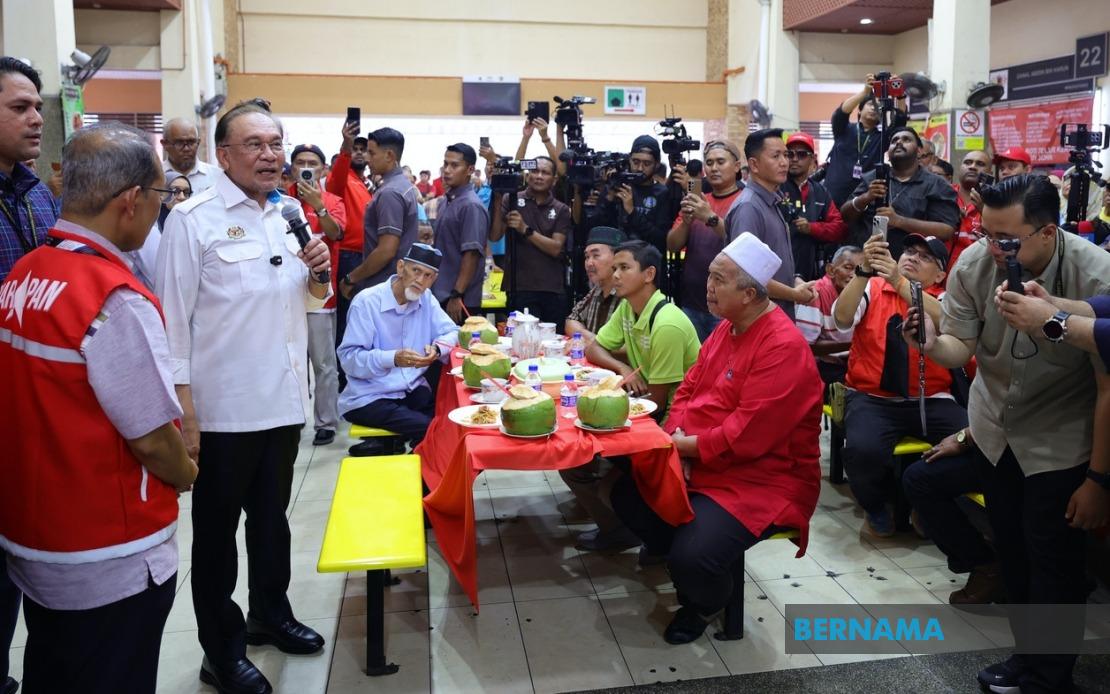
Prime Minister Datuk Seri Anwar Ibrahim has made a direct appeal to voters in Negeri Sembilan, asking them to reaffirm their support for Pakatan Harapan in the forthcoming state election. Speaking during a series of campaign events in the state capital Seremban, Anwar framed the electoral choice as fundamentally about preserving political continuity and the institutional momentum that the ruling coalition has built over the past three years. The timing of his intervention underscores the federal leadership's investment in the outcome of the contest, with the Prime Minister himself taking to the campaign trail to shore up support for the coalition's candidates.
Anwar, who serves as both Prime Minister and chairman of Pakatan Harapan, articulated a clear rationale for voter support centred on the relationship between state and federal governance. He contended that a decisive mandate for the coalition would facilitate seamless coordination between the Negeri Sembilan state government and Putrajaya, thereby accelerating the implementation of development projects and welfare initiatives that depend on multi-level cooperation. This framing speaks to a broader concern within the federal administration about the risks posed by fragmented governance structures, where opposition control of state machinery can impede national policy implementation and create administrative friction.
The case for continuity, as presented by Anwar, draws heavily on the track record of incumbent Menteri Besar Datuk Seri Aminuddin Harun. According to the Prime Minister, the state has enjoyed three years of political stability under Aminuddin's stewardship, achieved through cross-party cooperation and a shared commitment to development priorities. This characterisation of the Negeri Sembilan government as a model of stable, consensus-driven administration contrasts implicitly with the political volatility that has characterised other states and the federal level in recent years. The implicit message is that voters should prioritise predictability and institutional strength over the uncertain outcomes that might flow from electoral upheaval.
However, Anwar's messaging also incorporated an acknowledgment of imperfection, a rhetorical strategy designed to deflate criticism while maintaining the case for renewed support. He conceded that the state administration's policies and performance are not flawless, but framed this not as grounds for rejection but rather as an invitation for continued engagement and constructive feedback. This approach attempts to occupy middle ground: neither claiming perfection nor inviting wholesale judgment on the basis of shortcomings. It is a calibrated message intended to acknowledge legitimate grievances while channelling them toward reform within the existing framework rather than wholesale political change.
The election mechanics underscore the scale of Pakatan Harapan's ambitions in Negeri Sembilan. The coalition is contesting all 36 state seats, deploying a carefully balanced slate of candidates drawn from its three component parties. The distribution reflects internal power-sharing arrangements: PKR fields 16 candidates, DAP contributes 11, and Amanah puts forward nine. This composition reveals both the coalition's internal dynamics and its strategic calculations about voter receptivity to different parties across different constituencies. The diversity of party representation is intended to signal inclusivity and broad-based coalition strength, while also managing intra-coalition tensions around candidate allocation.
For Malaysian and Southeast Asian observers, the Negeri Sembilan contest carries significance beyond its immediate state-level implications. State elections in Malaysia frequently serve as mid-term assessments of federal government performance, with voters using them to signal approval or dissatisfaction with the national administration's direction. The contest comes at a moment when the Anwar-led government has been in office for less than two years, still within the initial honeymoon period but also facing the first serious tests of its capacity to deliver on campaign promises. A strong performance by Pakatan Harapan in Negeri Sembilan would provide the federal leadership with renewed confidence and momentum, while a disappointing result could prompt recalibration of political strategy and policy priorities.
The Election Commission has scheduled polling day for August 1, with early voting to take place on July 28. This timeline compresses the campaign period, placing emphasis on the effectiveness of ground mobilisation and the resonance of campaign messaging. For Pakatan Harapan, the challenge is to translate Anwar's appeal for stability and continuity into sufficient voter support to secure the overwhelming majority that would demonstrate unambiguous public endorsement. The coalition's decision to contest all 36 seats signals its confidence, but also raises the stakes: any performance significantly below expectations could be interpreted as erosion of its base.
The broader context for this contest includes the ongoing political realignment within Malaysian politics. The rise and fall of various political vehicles, the fragmentation of the opposition following UMNO's shift in alignment, and the continuing evolution of Malay-Muslim political preferences have created a fluid electoral landscape. Negeri Sembilan, with its relatively balanced demographic profile and mixed urban-rural composition, may provide early indicators of how these currents are moving. The state has historically been competitive, and its outcome could influence calculations about electoral viability in other states and at the federal level.
Anwar's emphasis on the need for voters to "give our candidate the chance to serve" reflects an understanding that public opinion is not fixed but rather responsive to direct appeals from political leadership. His presence in Seremban and his engagement with campaign logistics signal that the federal leadership regards this state election as consequential enough to warrant direct intervention. This personalisation of the campaign around the Prime Minister himself is a double-edged strategy: it elevates the stakes and focuses attention on Anwar's political standing, but it also ties the outcome more directly to his credibility and the federal administration's prospects.

