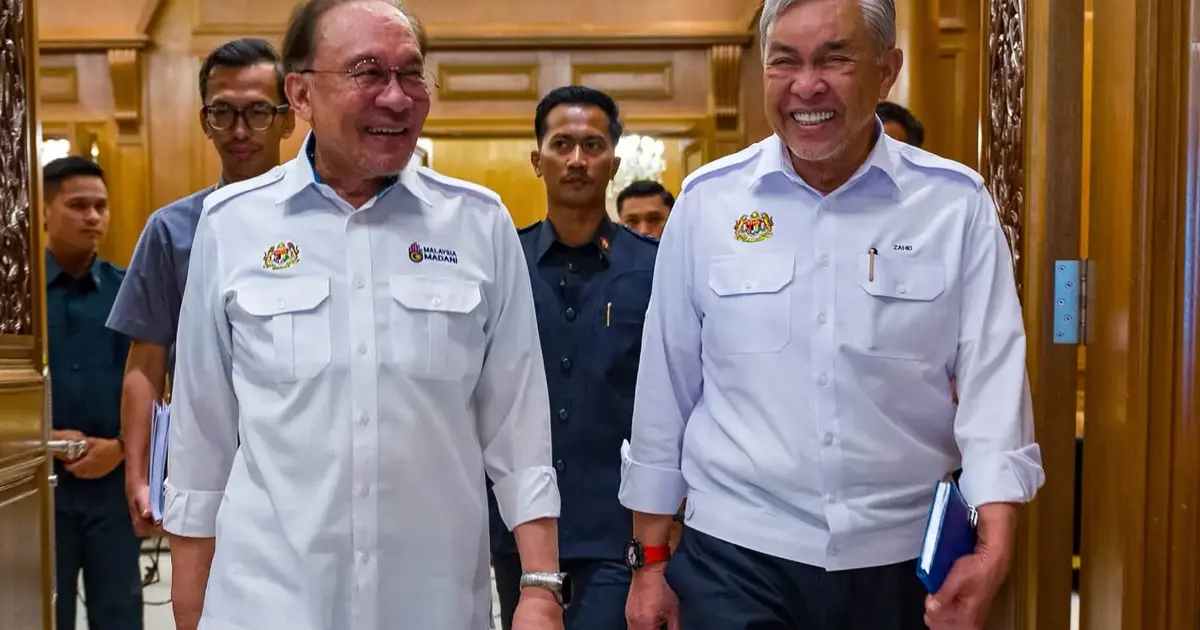
Malaysia's political leadership moved swiftly to contain brewing tensions within the ruling coalition, with Prime Minister Anwar Ibrahim and Barisan Nasional chairman Ahmad Zahid Hamidi appearing publicly together in a carefully choreographed show of solidarity. The joint appearance came just hours after Zahid's provocative suggestion that Anwar possessed the unilateral authority to dismiss the eight ministers representing BN within the federal cabinet, a remark that threatened to expose fractures in the delicate balance underpinning the Pakatan Harapan-BN alliance.
Zahid's earlier comment, made with apparent casualness, carried significant undertones regarding the power dynamics within Malaysia's coalition government. By suggesting that Anwar could remove BN ministers without consequence if displeased with their performance, the BN leader appeared to test the boundaries of ministerial autonomy whilst simultaneously drawing attention to his party's diminished leverage compared to the dominant PKR faction. The remark, ostensibly aimed at emphasising accountability, instead highlighted the structural vulnerabilities that smaller coalition partners face when governing alongside larger groupings.
The timing of Zahid's intervention proved particularly sensitive given ongoing scrutiny of cabinet performance and ministerial conduct across multiple portfolios. By framing the issue as one of prime ministerial prerogative rather than BN's right to protect its representatives, Zahid inadvertently underscored the coalition's internal hierarchies. His words suggested that BN's presence in government remained contingent upon Anwar's satisfaction, a characterisation that could undermine morale among grassroots party members already feeling sidelined in major policy decisions.
Anwar's response through the subsequent public appearance indicated a preference for de-escalation over confrontation. Rather than engaging directly with Zahid's implicit challenge, the prime minister chose to demonstrate through visual messaging that the partnership remained intact and functional. This diplomatic approach reflects Anwar's broader strategy of maintaining coalition stability whilst consolidating his political position—a balancing act that requires managing competing interests within Pakatan Harapan whilst preventing BN from feeling so marginalised that it withdraws from government.
The incident underscores the perpetual negotiation required to sustain Malaysia's current governing arrangement. Formed from necessity rather than ideological alignment, the coalition unites parties with fundamentally different visions and interests. For smaller partners like BN, which commands only eight ministerial positions despite its historical dominance in Malaysian politics, the challenge lies in demonstrating relevance whilst lacking the numerical strength to dictate terms. Zahid's intervention appeared designed to remind Anwar that BN retains the option to withdraw, thereby returning Malaysia to the political uncertainty that plagued the nation before their union.
The public unity display serves multiple audiences simultaneously. To grassroots party members, it signals that leadership remains committed to the coalition project. To international observers and business communities watching Malaysian political stability, the smiling appearance suggests that recent tensions remain manageable rather than existential. To opposition parties seeking to exploit coalition weaknesses, it conveys that criticism has not yet driven a wedge deep enough to fracture the alliance.
Malaysia's coalition dynamics reflect broader patterns visible across Southeast Asia's multi-party democracies, where achieving stable governance often requires constructing unwieldy alliances between ideologically divergent partners. Thailand, Indonesia, and the Philippines have all grappled with comparable challenges of maintaining coalition cohesion whilst managing the competing demands of coalition members with vastly different political bases and policy preferences. Malaysia's experience demonstrates both the possibilities and limitations of consensus-based governing arrangements in the region.
For Malaysian businesses and investors assessing political risk, such moments of tension followed by quick reconciliation offer mixed signals. Whilst the apparent ease with which Anwar and Zahid restored a public veneer of unity might suggest the coalition possesses genuine resilience, the underlying fragility exposed by Zahid's comment suggests that more serious disputes could rapidly escalate. The coalition's longevity ultimately depends on all parties maintaining sufficient political value to justify their continued participation, a calculation subject to constant revision as electoral dynamics shift.
The incident also illuminates the constraints facing Anwar despite his position as prime minister. His inability to simply dismiss critical coalition partners without triggering governmental collapse means that even his substantial executive powers remain circumscribed by the political mathematics of parliament. This reality shapes decision-making across cabinet meetings and policy implementation, effectively distributing executive authority among coalition partners rather than concentrating it wholly in the prime ministerial office.
As Malaysia navigates the path toward the next general election, likely within the next two years, the coalition's capacity to absorb internal tensions will face mounting pressure. Electoral calculations increasingly preoccupy individual coalition partners, creating incentives for public displays of strength that might emphasise their distinct identities rather than unified governance. The smiling public appearances will likely give way to more intense jostling for credit and ministerial position allocations as parties position themselves for electoral competition. The challenge for Anwar and Zahid lies in managing this transition without allowing legitimate coalition tensions to metastasise into genuine political crisis.

