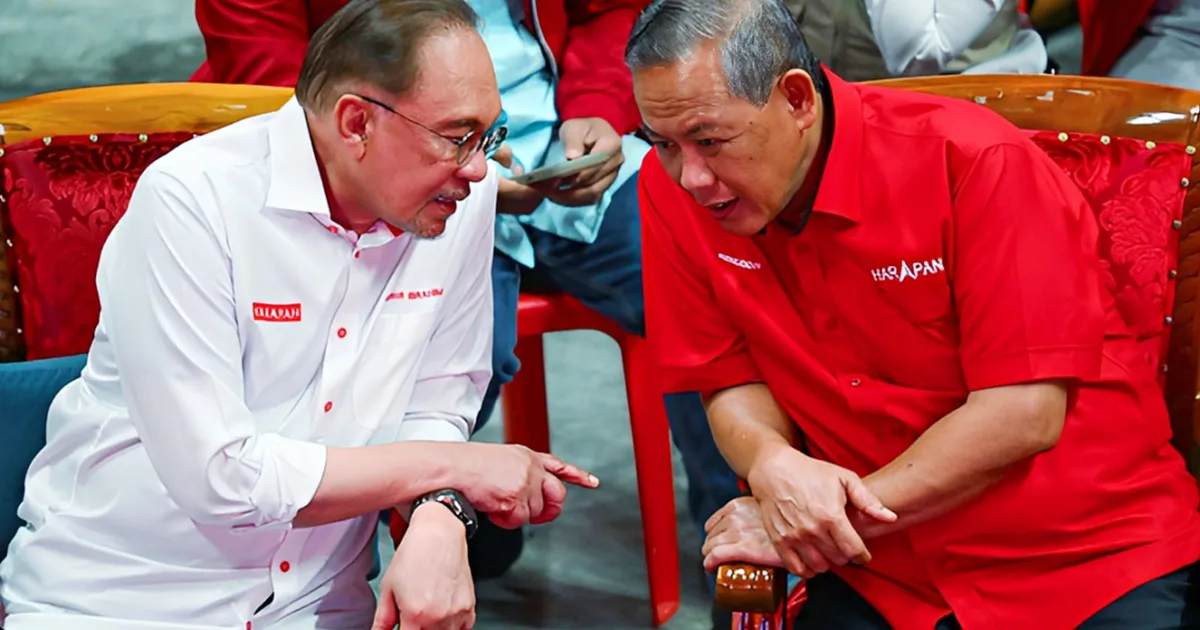
Prime Minister Anwar Ibrahim has reaffirmed that former Negeri Sembilan menteri besar Aminuddin Harun continues to play a vital role in the People's Justice Party despite recent electoral setbacks, emphasizing that his particular qualities make him invaluable for the development of incoming party talent. The PKR president's remarks underline ongoing tensions within Malaysia's political landscape, where managing defeat and maintaining party unity have become increasingly central to organizational stability and long-term viability.
Anwar's comments spotlight Aminuddin's conduct following the most recent state elections, where the PKR-backed administration lost control of Negeri Sembilan. Rather than seeking scapegoats or fracturing the party through recriminations, Aminuddin chose to absorb responsibility and pivot toward constructive engagement, a demeanor that Anwar identifies as particularly instructive for rising politicians who may struggle with electoral disappointment. This approach contrasts sharply with patterns observed elsewhere in Malaysian politics, where electoral defeats frequently trigger internal blame-shifting, desertion to rival camps, or public disavowal of party leadership.
The emphasis on Aminuddin's mentoring potential reflects deeper challenges confronting PKR as it balances the demands of governing at federal and state levels while simultaneously rebuilding party infrastructure following recent losses. Younger cadres within the party require experienced figures who can demonstrate how to navigate adversity while preserving party discipline and institutional loyalty, qualities that become scarcer during periods of political retrenchment. Aminuddin's willingness to step back from executive responsibility without demanding compensation or external vindication supplies precisely this kind of demonstration effect.
Anwar's public endorsement serves multiple strategic functions beyond mere commendation. By explicitly recognizing Aminuddin's continued relevance, the PKR president signals to party members that demonstrated resilience and dignified acceptance of setbacks remain valued within the organization, potentially encouraging similar conduct among other leaders facing difficult circumstances. This becomes particularly important as PKR navigates the complex task of rebuilding credibility in states where electoral performance has disappointed party loyalists.
The mentoring function Anwar identifies also addresses a structural vulnerability in Malaysian political parties, where institutional knowledge and leadership experience often concentrate among a narrow elite. When seasoned figures withdraw entirely from active participation following electoral defeats, emerging leaders lose access to practical wisdom about crisis management, coalition maintenance, and long-term strategic thinking. Aminuddin's continued engagement in informal mentorship roles ensures that such knowledge remains accessible to younger cadres who may otherwise repeat mistakes or fail to appreciate institutional continuity.
Anwar's framing emphasizes character and comportment as much as political acumen, suggesting that PKR values members who can absorb disappointment without fracturing party cohesion. This reflects a broader preoccupation within the coalition government, where stability depends significantly on preventing individual leaders from weaponizing electoral setbacks against party machinery or exploiting defeat as justification for crossing to opposition benches. Aminuddin's example becomes a counterweight to centrifugal pressures that threaten PKR's internal coherence.
The recognition also implicitly addresses criticism that PKR has struggled to manage succession and leadership transition, particularly at state levels where recent electoral outcomes have been mixed or negative. By positioning Aminuddin as a mentor rather than a retiring elder, Anwar maintains continuity of experienced guidance while avoiding the appearance of rewarding electoral failure with prominent executive positions. This delicate balance becomes increasingly important as PKR prepares for subsequent electoral cycles and seeks to prevent perception of accountability erosion.
For Malaysian readers, Anwar's remarks illuminate ongoing challenges within the ruling coalition regarding how to maintain party discipline and member loyalty during inevitable periods when electoral fortune recedes. PKR's experience in managing Aminuddin's transition from executive responsibility to mentorship function offers instructive lessons for political parties across the spectrum navigating similar situations. The stakes extend beyond organizational optics to include the substantive question of whether Malaysia's parties can develop institutional cultures that value graceful adaptation to political change.
Anwar's affirmation also reflects recognition that Aminuddin's political capital and reputation, despite electoral setbacks, retain considerable value for the party. The former menteri besar's networks, policy expertise, and demonstrated commitment to PKR principles continue to offer strategic advantages that extend beyond formal administrative positions. Leveraging these assets through informal mentorship channels allows the party to extract maximum benefit while managing political narratives around accountability and performance.
Looking forward, Aminuddin's mentoring role may prove decisive in shaping how emerging PKR leaders confront their own electoral challenges and potential defeats. The example of responding to disappointment with constructive engagement rather than destructive recrimination could establish behavioral norms that strengthen party institutional resilience across cycles of electoral fortune and misfortune. In Malaysian politics, where party fragmentation and defections frequently accompany electoral setbacks, such cultural reinforcement carries substantial significance for long-term organizational stability and effectiveness.

