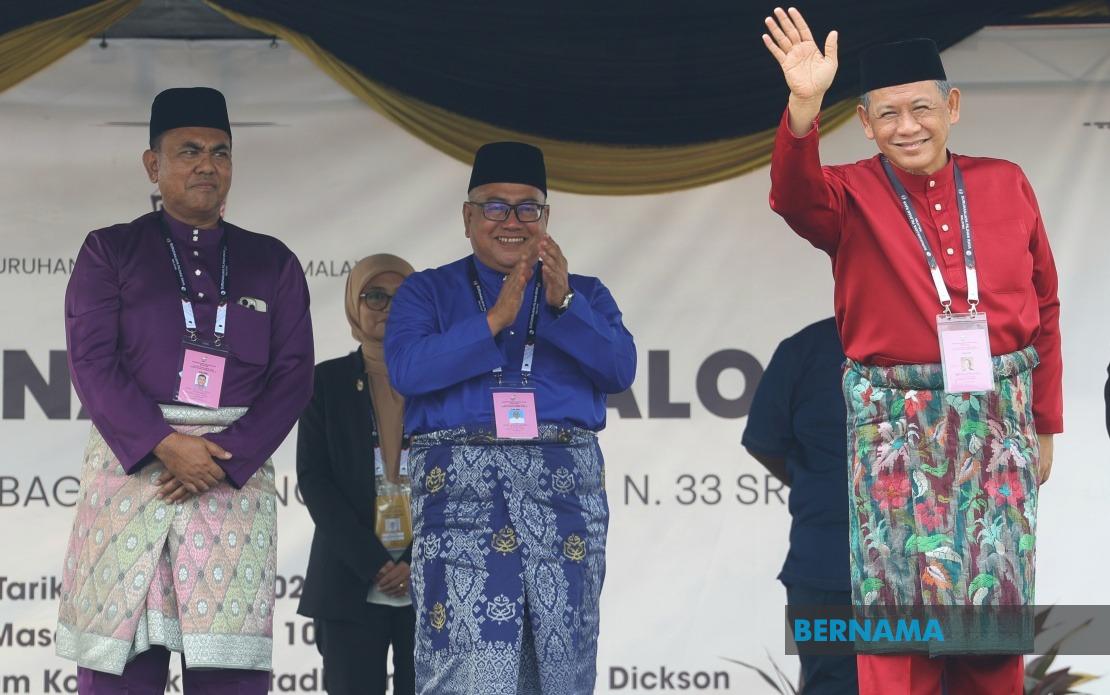
Negeri Sembilan's political battle is shaping up as more contested than anticipated, with Menteri Besar Aminuddin Harun of Pakatan Harapan confronting a split opposition vote in his defence of the Linggi seat. The candidate announcement on July 18 revealed that he will compete against Datuk Mohd Faizal Ramli, the incumbent representing Barisan Nasional, alongside Bersatu's Datuk Zamri Md Said. This three-way contest illustrates the fragmented state of Malaysian politics, where the traditional BN-PH binary no longer holds sway and newer political configurations reshape competition at the grassroots level.
The nomination process concluded at the Port Dickson District Administration Complex, where returning officer Nurhazelin Makli released the full slate of candidates contesting the 16th Negeri Sembilan state election. The Linggi constituency carries particular significance as Aminuddin, as the sitting Menteri Besar, relies on this seat to maintain his political standing in the state legislature. Any loss here would substantially weaken his governance mandate, making the three-cornered contest a genuine threat to his leadership position.
Elsewhere in the state, competition patterns reveal how differently voters in various constituencies face electoral choices. In Sri Tanjung, the incumbent Dr G. Rajassekaran of PH must defend against BN's A. Achutan and Bersatu's Leevineshwaraan Murugan, suggesting that Bersatu is mounting a broader challenge across multiple seats rather than concentrating its efforts. Similarly, the Lukut seat presents a complex arrangement where PH incumbent Choo Ken Hwa confronts Perikatan Nasional's Sathes Kumar Nilameham and independent candidate Teo Seng Lee, indicating that the PN machinery remains active in state-level contests despite its reduced national profile.
The Bagan Pinang constituency presents a distinct dynamic, with PAS incumbent Abd Fatah Zakaria defending his seat against PH challenger Nasir Raman and Bersatu's Sheikh Junaidy Jamaludin. This particular race carries implications for Islamic party strategies in state elections, where PAS continues to contest separately from its formal allies at the federal level. Chuah offers one of the few straightforward contests, pitting PH incumbent Yew Boon Lye directly against BN's Pau Jeou Ching in what amounts to a traditional two-party race.
The Election Commission has established August 1 as polling day, with early voting scheduled for July 28, providing military and police personnel an opportunity to cast ballots before the general voting. This scheduling reflects logistical considerations for uniformed personnel who may be on deployment across the peninsula. The early voting window also reduces pressure on polling stations during the main election day, a practical measure adopted in several recent Malaysian elections.
The electorate participating in this state election spans nearly 900,000 registered voters, comprising 867,151 ordinary voters, 16,884 military personnel and their families, and 5,455 police officers and their families. This represents a substantial segment of Negeri Sembilan's population, and turnout patterns will significantly influence whether PH can retain control of the state government or whether the fragmented opposition can unite sufficiently to challenge the coalition's hold on power. The composition of the voter base, with military and police participation, introduces a traditionally more conservative element to the state's electoral dynamics.
The multi-cornered contests evident across several constituencies raise questions about tactical voting and coalition-building that emerged from the 2022 general election's competitive landscape. Voters must now navigate more complex ballots, where their choice cannot assume alignment with broader national political trends. The presence of Bersatu candidates across numerous seats reflects the party's strategy to position itself as an alternative force in state politics, separate from both PH and traditional BN politics, though this fragmentation of the non-PH vote could ultimately benefit the incumbent coalition.
For Malaysian political observers and those tracking Southeast Asian electoral trends, Negeri Sembilan's election serves as a barometer for post-2022 politics. The state has historically been politically moderate, avoiding the intense polarization witnessed in Selangor or Johor, making it a relatively cleaner test of voter sentiment regarding governance performance and coalition management. How voters respond to the choices presented will offer insights into whether coalition politics remains viable or whether Malaysian voters are increasingly comfortable with more fractious political arrangements.
The three-cornered nature of many contests may suppress overall campaign visibility for individual candidates, as campaign resources become dispersed and media attention divides among multiple competitors. This fragmentation could suppress voter engagement in constituencies lacking clear binary choices, potentially affecting turnout patterns. Conversely, voters seeking genuine alternatives to the incumbents now have more explicit options than past electoral cycles provided, which may energize participation among those dissatisfied with both PH governance and traditional opposition politics.
As August 1 approaches, campaign activities will intensify across all constituencies, with particular focus on seats where margins appear tight or where demographic shifts might swing results. The Negeri Sembilan election will provide the first substantial state-level test of voter sentiment since the 2023 general election, offering clues about electoral momentum entering the final years of the current parliamentary term. Results here could influence calculations within coalitions regarding preparedness for future electoral contests and the viability of current political alliances at the state government level.

