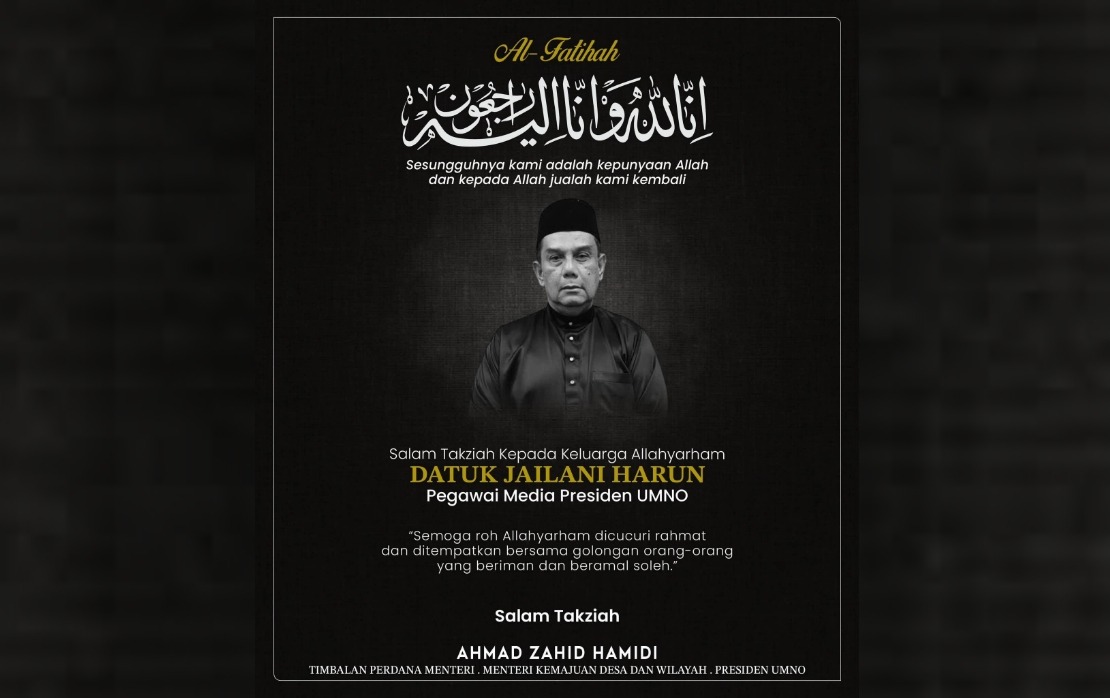
Deputy Prime Minister Datuk Seri Dr Ahmad Zahid Hamidi has expressed his condolences following the death of Datuk Jailani Harun, a respected former journalist who served as a media officer at the UMNO President's Office. The loss of Jailani, who died at Serdang Hospital on July 7, marks the passing of a figure who had maintained a close association with Malaysia's ruling political establishment over an extended career spanning multiple decades in communications and journalism.
Ahmad Zahid, who also holds the position of UMNO president, paid a final visit to Jailani at Serdang Hospital in the early hours of the morning on which the 66-year-old passed away. The deputy premier's personal visit underscored the depth of his relationship with the deceased and reflected the significance Jailani commanded within UMNO circles. In reflecting on that encounter, Ahmad Zahid characterised Jailani as a figure whose personal qualities had earned widespread regard and affection among those who knew him professionally and personally.
In a statement shared on Facebook, Ahmad Zahid portrayed Jailani as an individual distinguished by his kindness, humility, and the respect he had accumulated throughout his working life. The deputy prime minister's emotional recounting of his hospital visit conveyed a sense of personal loss, noting the poignancy of witnessing Jailani's condition deteriorate in what would prove to be his final hours. Ahmad Zahid acknowledged that despite maintaining hope for a recovery, events ultimately unfolded according to divine will.
The timing of Jailani's passing carries particular weight given his long involvement with UMNO's communications apparatus. Throughout his career, Jailani had occupied a position of trust within the party's senior leadership structure, serving in a capacity that required discretion, political acumen, and the ability to navigate Malaysia's complex media landscape. His role as media officer to the UMNO president placed him at the intersection of party management and public messaging, a responsibility that demanded both professional competence and personal integrity.
Jailani's transition from active journalism into party communications work reflected a common trajectory among Malaysian media professionals who move between newsrooms and government or political institutional roles. This pattern speaks to the interconnected nature of Malaysia's political and media ecosystems, where individuals with strong foundational journalism training often find opportunity to apply those skills in strategic communications capacities within political parties and state institutions. Jailani's career path exemplified this established pattern.
Beyond the immediate circle of UMNO leadership, Jailani's death represents a broader loss to Malaysia's institutional memory. Those who spent decades observing political developments, covering significant events, and later participating in how political narratives were constructed and communicated carry invaluable contextual knowledge. The passing of such individuals inevitably diminishes the reservoir of first-hand experience and perspective available to contemporary observers seeking to understand how Malaysian politics and media have evolved.
Ahmad Zahid's invocation of religious sentiment in his public statement reflected customary Malaysian practice regarding mourning and bereavement. The deputy prime minister's prayers for Jailani's forgiveness and placement among the righteous represented standard Islamic expressions of condolence appropriate to the Muslim-majority Malaysian context. Such articulations serve both as genuine spiritual gestures and as culturally resonant public communications that acknowledge shared values within the broader Malaysian community.
The arrangements for Jailani's final rites proceeded according to Islamic tradition, with his burial scheduled for Alam Damai Muslim cemetery in Cheras following the afternoon asar prayer. This location in the Kuala Lumpur suburbs has long served as a resting place for prominent figures from Malaysia's political, business, and professional sectors, reflecting the cemetery's significance as a final destination for individuals of standing within Malaysian society. The timing of burial on the day of death itself follows Islamic practice that emphasises prompt interment.
For UMNO, Jailani's departure removes someone who had witnessed and participated in significant chapters of the party's modern history. His journalism background provided him with a trained perspective on how information flows, narratives develop, and public opinion forms—insights that would have been valuable in his role advising senior party leadership. The loss of such experienced professionals can create gaps in institutional knowledge that take considerable time to fill through the development and mentorship of successor cadres.
Ahmad Zahid's public acknowledgment of Jailani's passing through a formal condolence statement maintained customary protocols regarding how political leaders commemorate departed associates and colleagues. Such statements serve multiple functions within Malaysian political culture: they acknowledge personal grief, honour the deceased's contributions, demonstrate the leader's accessibility and humanity, and reinforce bonds within the party structure through collective recognition of shared loss. The deputy prime minister's willingness to visit Jailani personally during his hospitalisation and subsequently to articulate his sorrow publicly reflected the esteem in which he held the deceased.
The broader significance of Jailani's career and death extends to considerations about generational transition within Malaysian political institutions. As figures who came of age during Malaysia's earlier decades gradually pass from the scene, questions emerge regarding the continuity of institutional cultures, the preservation of important institutional knowledge, and the capacity of succeeding generations to replicate the qualities that earned their predecessors respect and trust. Jailani's life and career represented one such generational bridge that has now been crossed, leaving behind both the memory of his contributions and the challenge of ensuring that the standards he represented remain embedded within the institutions where he served.

