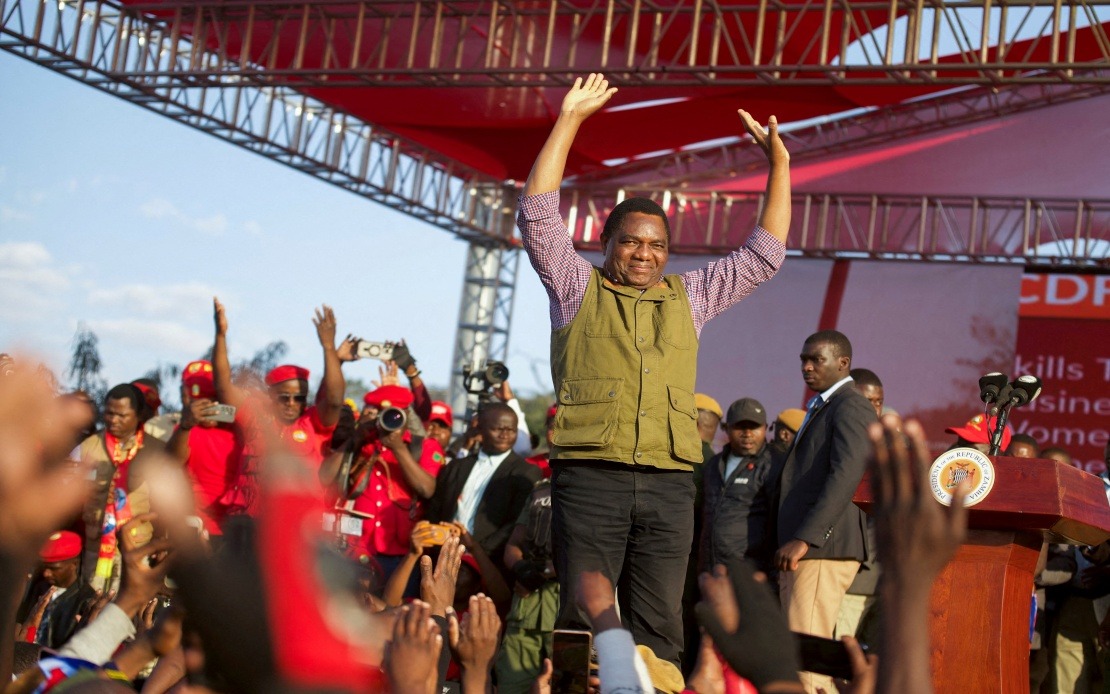
Hakainde Hichilema has secured a second term as President of Zambia following the country's election last Thursday, according to results announced early Tuesday by the Electoral Commission of Zambia. The 64-year-old leader garnered more than 2.9 million votes, decisively surpassing the constitutionally mandated threshold of 50 per cent plus one vote needed to avoid a runoff. His margin of victory signals strong electoral backing for his continued stewardship of the Southern African nation.
Hichilema's main rival in the contest, Brian Mundubile representing the National Restoration Party for Unity and Progress (NRPUP), secured 1.8 million votes, placing him a substantial distance behind the incumbent. The gap between the two candidates underscores the breadth of Hichilema's support across Zambia's diverse regions and voter constituencies. Electoral Commission chairperson Mwanagala Zaloumis declared Hichilema president-elect at the national election centre in Lusaka, the capital, noting that the outcome was already so conclusive that final tallies from remaining polling stations would be immaterial to the final result.
In a statement released on Facebook shortly after his victory was confirmed, Hichilema expressed gratitude to Zambian voters for their continued confidence. He characterised the mandate as an opportunity to serve the nation again, framing his role in terms of public stewardship rather than personal triumph. His measured tone reflected the gravity of leading a nation navigating complex economic and governance challenges amid the broader turbulence affecting Southern African economies.
The result carries significance for regional stability and investor confidence in Zambian governance. Hichilema's re-election provides continuity for his administration's policy direction and signals to international partners that his government has maintained domestic political legitimacy. This matters considerably for Zambia, which has been working to restore financial credibility after earlier debt distress and is dependent on external financing and commodity export revenues.
Celebrations erupted in Lusaka before the official announcement and intensified afterward, with citizens gathering in streets throughout the capital despite the early morning hour and cold weather. The spontaneous nature of the celebrations and the diverse cross-section of people participating suggested the result resonated beyond narrow partisan interest, reflecting a broader desire for political continuity. Collins Maoma, national chairperson of Hichilema's United Party for National Development (UPND), urged the president to maintain the leadership qualities that had earned him voter endorsement, while emphasising that the electorate had once again validated his approach to governance.
The victory comes as Hichilema works to implement his administration's economic and social policy agenda. His government has focused on fiscal discipline, anti-corruption measures, and efforts to improve public service delivery—priorities that resonate with voters concerned about institutional effectiveness and transparent governance. The decisive mandate suggests sufficient electoral patience with these reform efforts, even as they require difficult trade-offs and adjustment periods.
For Malaysian observers and Southeast Asian policymakers, Zambia's election outcome illustrates both the resilience of democratic institutions in Africa and the premium voters place on leadership continuity during periods of economic adjustment. The parallel between Zambia's situation and challenges facing some developing nations in the region—balancing reform imperatives with social stability, managing public expectations during fiscal consolidation, and maintaining investor confidence—offers relevant lessons about the electoral foundations of reform programmes.
The Electoral Commission's willingness to declare results before complete tallying from all 226 constituencies, confident that remaining votes could not alter the outcome, reflects confidence in the data already collected and suggests substantial organisational capacity in administering the election. This operational transparency also contributes to domestic and international confidence in the legitimacy of the result.
Looking ahead, Hichilema's second term will focus on consolidating earlier gains and advancing deeper reforms. His government will need to balance growth-oriented policies with social protection for vulnerable populations, a balancing act that demands both political skill and sustained popular support. The electoral mandate provides political capital for pursuing these objectives, though the underlying economic constraints that have confronted Zambia will require careful management to prevent disappointment among voters expecting visible improvements in living standards.

