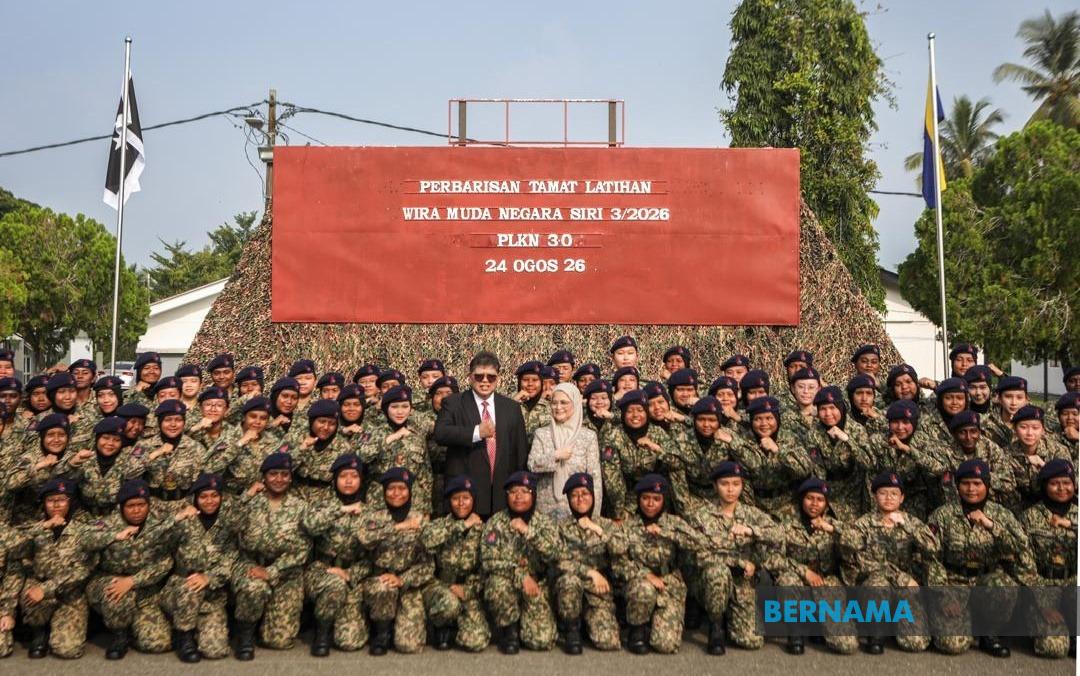
Tan Sri Dr Johari Abdul, Speaker of the Dewan Rakyat, has outlined a blueprint for developing the next generation of leaders in Malaysia, stressing that young people must cultivate three fundamental pillars if they are to emerge as individuals capable of guiding others. Speaking at a closing ceremony for a major national training initiative, Johari articulated a vision that extends beyond traditional notions of leadership confined to politics or military service, instead positioning it as a universal aspiration relevant to every Malaysian youth regardless of their chosen career path.
The Speaker's remarks came during the conclusion of the Wira Muda Negara Training Series 3/2026, held at the National Service Training Branch facility at 504 Territorial Army Camp in Bukit Keteri near Padang Besar. This event marked the culmination of training for nearly 800 young Malaysians who had participated in the National Service Training Programme (PLKN) 3.0, a government initiative designed to instil values, discipline and national consciousness among the country's youth cohort. The programme represents a significant investment in grooming the nation's emerging talent pool, with participants spanning multiple training locations across the peninsula.
According to Johari's framework, aspiring leaders must first identify and articulate their personal vision—the ambitious objectives they wish to accomplish throughout their lives. This foundational step requires introspection and clarity of purpose, enabling young people to move beyond reactive existence towards purposeful goal-setting. The Speaker emphasised that having a meaningful dream provides direction and motivation, transforming abstract ideals into tangible targets that can guide decision-making and resource allocation over the long term. Without such vision, he suggested, individuals drift without purpose, unable to harness their full potential or inspire confidence in those around them.
Beyond vision, Johari identified courage as the second essential component of leadership development. This courage, he argued, encompasses the willingness to initiate change and take decisive action despite uncertainty or potential setback. In the Malaysian context, where conformity and respect for hierarchy remain deeply embedded in social structures, this emphasis on courageous action carries particular weight. The Speaker's message suggests that young Malaysians must move beyond passive acceptance of established norms and demonstrate the bravery to challenge assumptions, propose innovations, and execute plans even when doing so invites criticism or discomfort. This represents a departure from traditional expectations and signals shifting priorities within establishment circles regarding youth empowerment.
The third pillar—knowledge—serves as the stabilising force within Johari's triad. Knowledge functions both as a practical toolkit and as a moral compass, enabling leaders to remain grounded and navigate complexity without becoming derailed by ideological extremism or poor judgment. By emphasising this component, Johari implicitly critiques the notion that charisma or mere ambition suffice for leadership; instead, he advocates for evidence-based decision-making, continuous learning, and intellectual humility. For Malaysian youth, this underscores the value of formal education, professional development, and exposure to diverse perspectives and expertise across their chosen fields.
Johari's exhortation that young people cultivate a "warrior spirit" deserves particular attention in the Malaysian context. His phrasing deliberately transcends the military domain, suggesting that this fighting spirit—characterised by determination, resilience, and unwavering commitment to purpose—should permeate every profession and social role. Whether working in commerce, education, healthcare, technology, or public service, Johari contends that individuals must embody qualities traditionally associated with warriors: discipline, strategic thinking, courage under pressure, and dedication to a cause larger than personal interest. This framing potentially resonates with cultural values emphasising service, duty, and collective advancement that remain influential across Malaysian society.
The training programme itself exemplifies these principles in practice. A total of 795 trainees successfully completed the Series 3/2026 curriculum, distributed across three separate training centres. Female trainee An'nur Najiha Muhammad Shahidan, aged 18 from Ipoh in Perak, received the Wira Muda Ulung Award, recognising outstanding performance and embodiment of the programme's core values. Her selection underscores the inclusive nature of leadership development initiatives, acknowledging that excellence and potential exist across gender lines and geographical boundaries within the Malaysian population.
The logistics of the closing ceremony highlight the scale and coordination required for such national programmes. The National Service Training Department orchestrated simultaneous ceremonies at three separate locations: the 504 Territorial Army Camp hosting 106 female trainees, the 505 Territorial Army Camp in Pahang accommodating 442 male trainees, and the 515 Territorial Army Camp in Kuala Lumpur with 247 female trainees. This distributed approach ensures that young Malaysians from various regions receive comparable training standards and recognition, promoting national cohesion and shared developmental experiences among this cohort.
For Malaysian policymakers and educators, Johari's framework provides a coherent template for youth development beyond the confines of formal schooling. The emphasis on dreams, courage, and knowledge aligns with contemporary international thinking regarding competency-based learning and holistic human development. However, the Malaysian adaptation carries distinctly local flavour, integrating values of service, collective responsibility, and national consciousness that reflect the country's constitutional and social foundations.
The timing of these remarks holds significance as Malaysia continues navigating demographic transitions, technological disruption, and evolving global competition for talent and influence. Youth who internalise Johari's three-pillar framework may prove better equipped to address contemporary challenges ranging from economic competitiveness to social cohesion. By framing leadership as accessible across all sectors rather than concentrated within elite institutions or positions, the Speaker democratises aspiration and suggests that Malaysia's future strength depends on cultivating capable, visionary, courageous individuals throughout its population. The completion of nearly 800 trainees under PLKN 3.0 represents a concrete step toward that broader objective, though the true measure of success will emerge as these young Malaysians transition into their respective fields and apply the principles absorbed during their training experience.

