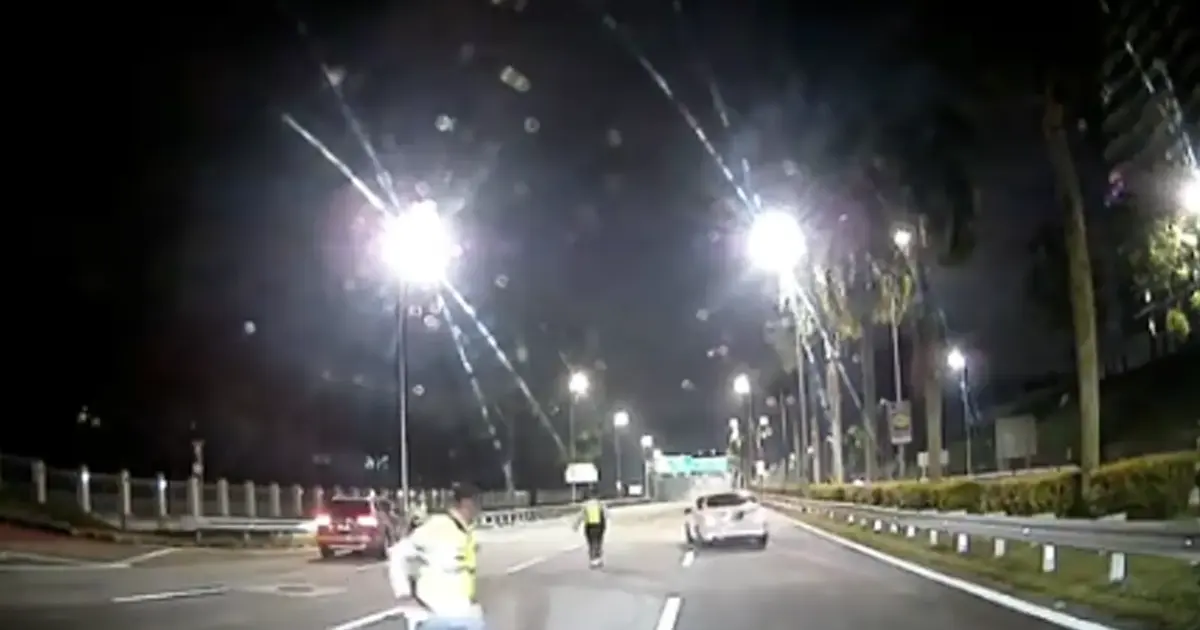
A 20-year-old motorist behind the wheel of a Mercedes-Benz was taken into custody today following a confrontation at a police checkpoint, where he accelerated through the barrier despite officers signalling him to stop. The driver's apparent nervousness and sudden decision to breach the roadblock triggered an immediate response from law enforcement, resulting in charges related to disobedience of police directives.
The incident underscores an ongoing tension between motorists and road safety enforcement in Malaysia, where checkpoints serve multiple purposes ranging from vehicle inspections to documentary compliance checks. Such operations are standard practice across the country, implemented by various enforcement agencies to maintain traffic discipline and intercept vehicles of interest. However, the willingness of some drivers to defy these lawful stops continues to present challenges for officers conducting routine duties.
Police conduct at roadblocks has become a subject of increasing public attention, particularly regarding the procedures used to signal drivers and the escalation protocols when motorists refuse to comply. In this case, the 20-year-old's choice to push through rather than halt suggests either a failure to understand the severity of the situation or a deliberate attempt to evade police scrutiny. The specific charge of failing to comply with a police officer's orders carries significant legal implications under Malaysian law, as such breaches are considered serious matters affecting public order and officer authority.
The circumstances surrounding the driver's apparent nervousness warrant examination. Whether this behaviour reflected anxiety about potential violations, concerns regarding personal safety, or other underlying issues remains unclear. Such psychological factors sometimes influence decision-making at critical moments, though they do not excuse drivers from their fundamental obligation to obey traffic management directives. Law enforcement agencies routinely encounter drivers exhibiting nervous demeanour at checkpoints, and protocols exist to manage these situations professionally while ensuring public and officer safety.
Roadblock operations in Malaysia typically involve officers positioned strategically to inspect vehicles, verify documentation, and identify vehicles with outstanding warrants or suspicious characteristics. The standard procedure requires drivers to slow down, roll down windows, and respond to officer queries. When motorists refuse these basic requirements, as occurred in today's incident, the situation escalates rapidly and can pose danger to both enforcement personnel and other road users. The decision by this particular driver to accelerate through represented a significant departure from expected compliance patterns.
From a broader perspective, incidents of this nature highlight the importance of public education regarding the legal framework governing police authority. Many motorists understand intuitively that fleeing checkpoints is inadvisable, yet some nevertheless attempt to do so, often with minimal justification. This suggests gaps in understanding concerning the consequences of non-compliance and the limited circumstances under which drivers possess legitimate grounds to decline stopping. Education campaigns aimed at normalising checkpoint interactions could potentially reduce such incidents.
The arrest today also reflects the resource allocation decisions made by police forces managing busy highways and urban corridors. Checkpoints require significant personnel deployment and coordination, making them targets for cost-benefit analysis. When drivers regularly breach security lines, the operational effectiveness of these enforcement measures diminishes. The decision to pursue this particular motorist likely involved rapid assessment of the threat level and available resources, with officers prioritising the apprehension over allowing the vehicle to disappear into traffic.
Legal precedent in Malaysia establishes that failing to comply with a police officer's lawful orders constitutes a serious offence. The specific statute invoked typically provides for fines and potential custodial sentences depending on severity and circumstances. Prosecutors will examine factors such as whether the driver's actions endangered lives, whether he deliberately ignored signals, and whether cooperation was possible at any point during the interaction. The Mercedes driver's age may also factor into sentencing considerations, though youth is not typically viewed as a mitigating factor in traffic-related non-compliance cases.
For Malaysian motorists, this incident serves as a reminder of the practical and legal imperatives governing interactions with police enforcement. Roadblocks, while sometimes frustrating, represent a standard mechanism of traffic regulation and public safety management. Drivers who experience anxiety at checkpoints may benefit from understanding that cooperation typically resolves matters more expeditiously than resistance. The brief inconvenience of a checkpoint inspection pales against the consequences of arrest, prosecution, and conviction.
Government authorities continue monitoring patterns of non-compliance with enforcement directives to identify whether specific demographics or geographic areas exhibit particular resistance to traffic regulations. Such analysis informs resource deployment and shapes policy decisions regarding checkpoint frequency and intensity. The arrest of this 20-year-old contributes to an evolving dataset that authorities use to refine their approach to road safety management across the nation.

