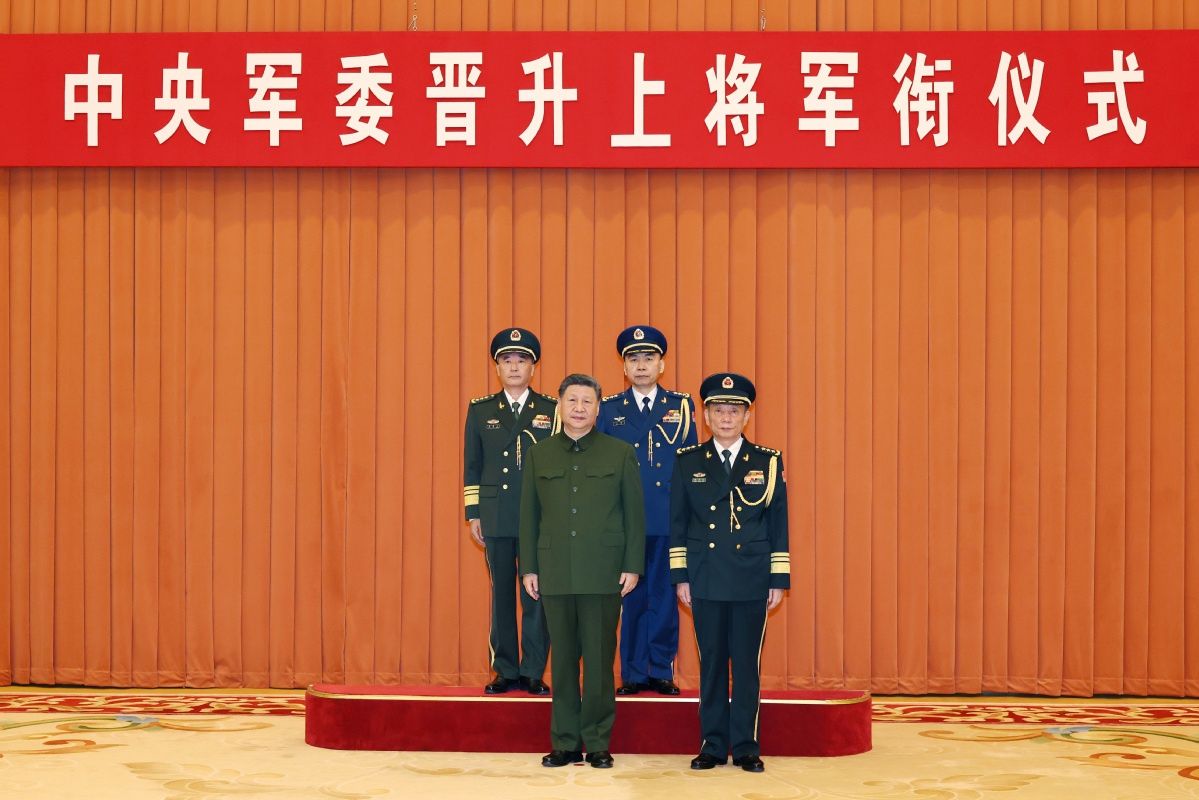
Chinese President Xi Jinping has completed another significant reorganisation of the country's military hierarchy, appointing Zhang Shuguang to lead anti-corruption operations within the armed forces while simultaneously removing his predecessor from the post. The reshuffling, announced through state media at a Beijing ceremony where Xi presided on Friday, underscores the continuing scale of disciplinary action sweeping through China's defence establishment—a campaign that senior analysts describe as the most extensive since the late 1970s. The promotions of both Zhang Shuguang and Wang Gang, the new Air Force Commander, to the rank of general reflect their elevated standing in Beijing's military-political hierarchy, signalling Xi's confidence in their ability to manage sensitive institutional portfolios during an unprecedented period of institutional turbulence.
The elevation of Zhang Shuguang to secretary of the Central Military Commission's discipline inspection commission represents a critical repositioning within China's security apparatus. His appointment comes as his predecessor, Zhang Shengmin, moves laterally to assume the role of vice chairman of the CMC itself—a sideways transition that preserves institutional knowledge while concentrating loyalty to Xi's broader reform agenda. The nature of this swap suggests calculated management rather than punitive action, indicating that Xi's restructuring involves both enforcement mechanisms and the cultivation of trusted personnel within the highest echelons of military governance. For Malaysian observers, the implications touch on broader regional stability questions, as China's military leadership transitions directly influence defence posture, strategic decision-making, and the tone of interactions with neighbouring states across Southeast Asia.
Wang Gang's appointment as head of the People's Liberation Army Air Force marks another critical staffing change within the armed forces. The Air Force controls substantial portions of China's power-projection capability, particularly in maritime contexts that affect regional security around the South China Sea and beyond. Wang's elevation to general rank, combined with his new position commanding one of the world's largest air arms, positions him as a figure of considerable influence over operational planning and strategic initiatives in the Indo-Pacific. The concurrent promotion of multiple officers to China's highest active-service rank suggests Xi is simultaneously consolidating control while elevating individuals he deems ideologically aligned with his vision for military modernisation and party loyalty.
The broader campaign that prompted these changes commenced in mid-2023, months after Xi secured his unprecedented third consecutive term as party chairman—a political achievement that historically has no precedent in modern Chinese governance. This timing is significant: it indicates that securing extended tenure provided Xi with the political capital necessary to pursue aggressive institutional restructuring without facing meaningful internal opposition. Since launching the campaign, Beijing has removed two vice chairmen of the CMC, three additional commission members, a former defence minister, and no fewer than a dozen senior generals commanding major military regions or strategic commands. The scale of these removals substantially exceeds typical military rotation cycles, suggesting systematic targeting of potential rivals or officials deemed insufficiently loyal to Xi's consolidating authority.
Perhaps most revealing of Xi's willingness to pursue purges even against his closest associates has been the investigation into Zhang Youxia, described as Xi's top general and a one-time ally. The decision to investigate Zhang Youxia carries symbolic weight extending beyond simple anti-corruption enforcement: it demonstrates that no position, regardless of historical proximity to Xi himself, provides immunity from scrutiny. This approach mirrors historical patterns of centralisation within Chinese politics, where leaders seeking to consolidate power target not external enemies but trusted lieutenants and potential internal rivals. For Malaysia and other Southeast Asian nations observing China's institutional evolution, Zhang Youxia's fall illustrates the precariousness of military-political positioning at China's apex and raises questions about institutional continuity and predictability in defence decision-making.
Last week's decision to strip six military lawmakers of their seats in China's national parliament—the National People's Congress—extends the purge beyond active-duty military officers into civilian legislative representation. This action suggests the anti-corruption campaign encompasses not only uniformed personnel but also the political-military nexus through which armed forces interests are represented in formal governance structures. The removal of these legislators signals that Xi's consolidation extends into parliamentary channels, ensuring that military representatives cannot operate as independent power centres within legislative deliberations. Such moves raise important questions about institutional checks and balances within China's system, particularly as military interests increasingly concentrate within centralised decision-making channels reporting directly to Xi.
The mechanics of these personnel changes reveal careful attention to narrative framing. By characterising the purge as anti-corruption enforcement rather than political consolidation, Beijing maintains the veneer of institutional legitimacy while fundamentally restructuring power relationships. This rhetorical strategy holds particular importance for regional credibility: neighbouring governments prefer to interpret Chinese institutional changes as responses to institutional dysfunction rather than evidence of personalised autocratic consolidation. For Malaysian policymakers and analysts assessing China's strategic reliability and decision-making rationality, distinguishing between genuine corruption investigations and politically motivated purges remains analytically challenging. The appointment of trusted anti-corruption overseers may signal genuine institutional reform, or may merely constitute a mechanism for controlling information flows and managing the narrative around personnel removals driven by political rather than strictly anti-graft considerations.
The unclear status of former Air Force Commander Chang Dingqiu exemplifies the uncertainty characterising China's current military-political environment. His position remains unresolved despite his removal from the Air Force's top slot, suggesting either continuing investigation, reassignment pending confirmation, or deliberate ambiguity designed to signal his diminished standing. This administrative indeterminacy, multiplied across numerous affected officers, creates an atmosphere of institutional unpredictability within the People's Liberation Army. Such uncertainty potentially affects military morale, operational planning continuity, and the transmission of institutional knowledge between retiring and ascending officer cohorts. For Malaysian military observers and defence analysts, this turbulence raises practical questions about the reliability of communication channels with Chinese counterparts and the stability of established defence relationships during periods of significant internal institutional transition.
Regional implications of these military reshuffles extend beyond internal Chinese governance to affect Southeast Asia's strategic environment. China's military constitutes a critical variable in regional calculations regarding power balances, territorial disputes, and the maintenance of freedom of navigation within contested waters. Leadership transitions within the PLA's command structure, particularly affecting officers overseeing maritime and air operations, necessarily influence how China's military assets are deployed and directed. Malaysia, as a major maritime power with considerable interests in maintaining stable sea lanes and peaceful resolution of territorial disputes, must carefully monitor how Xi's consolidated military leadership translates into operational behaviour. The elevation of figures such as Wang Gang reflects not merely internal Chinese politics but potentially signals shifts in how the PLA will be employed across strategic theatres affecting Malaysian interests.
Xi's consolidation of military authority through selective purging of potential rivals demonstrates the practical mechanics of authoritarian power centralisation. The process operates simultaneously on multiple levels: removing individuals deemed disloyal or unreliable, elevating trusted subordinates to key positions, establishing new oversight mechanisms through figures personally answerable to Xi, and deploying anti-corruption rhetoric to provide institutional legitimacy for fundamentally political reshuffling. This multi-layered approach differs from crude purges in that it preserves institutional continuity while concentrating ultimate decision-making authority within a narrower circle of Xi-loyalists. The implications for regional stability hinge substantially on whether consolidated military authority enables more effective strategic planning or whether factionalised resistance to Xi's approach creates dangerous institutional paralysis or miscalculation risks. For Malaysia and Southeast Asia broadly, understanding the mechanics and motivations behind China's military restructuring remains essential for calibrating appropriate diplomatic and defence responses to China's evolving regional posture.

