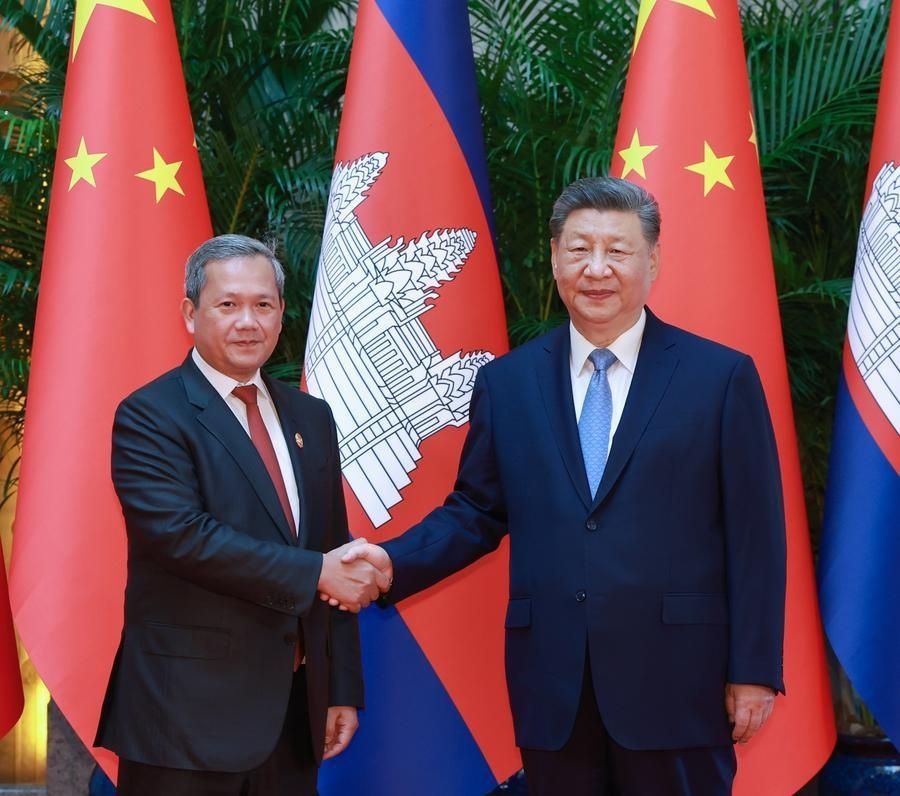
Chinese President Xi Jinping and Cambodian Prime Minister Hun Manet held talks in Shanghai on Friday, with both leaders emphasizing the durability of Beijing and Phnom Penh's relationship and their determination to deepen cooperation across multiple sectors. The meeting, which took place during Hun Manet's participation in the 2026 World Artificial Intelligence Conference and broader state visit to China, underscored the strategic importance Beijing places on its partnership with Cambodia at a time of evolving geopolitical dynamics in Southeast Asia.
Xi described the friendship between China and Cambodia as "ironclad," invoking language that reflects the historical bonds established by earlier generations of leadership while signalling continuity under current administrations. The metaphor carries particular weight in Chinese diplomatic vocabulary, typically reserved for relationships deemed fundamental to Beijing's regional and global interests. By framing the partnership in these terms, Xi was emphasizing that the bilateral relationship transcends temporary fluctuations in international affairs and remains anchored in mutual strategic interests and ideological alignment.
Central to the discussions was what Beijing terms the "Diamond Hexagon" cooperation framework, a multifaceted arrangement designed to expand interaction across economic, security, and cultural domains. Xi called for enriching this framework further, signalling that China views Cambodia not merely as a neighbour but as a crucial partner in realizing its broader vision for Southeast Asian engagement. The framework concept reflects Beijing's preference for structured, comprehensive partnership models that bind nations through interconnected interests rather than single-issue relationships.
The two leaders prioritized accelerating development of the Industrial Development Corridor and the Fish and Rice Corridor, initiatives that seek to integrate Cambodia's agricultural and manufacturing sectors with Chinese supply chains and markets. These infrastructure projects carry significant implications for Cambodia's economic trajectory, positioning the country as a crucial node in China's broader regional integration strategy. For Malaysian observers, the development of these corridors underscores China's systematic approach to deepening economic interdependence with Southeast Asian neighbours, a pattern that has profound implications for the region's economic architecture and trade dynamics.
Xi stressed the importance of upgrading traditional cooperation in electricity and agriculture while fostering emerging industries centred on artificial intelligence and the digital economy. This dual emphasis reflects China's desire to both consolidate existing advantages in Cambodia while positioning the partnership to benefit from future technological advancement. The focus on artificial intelligence cooperation is particularly significant, as it aligns with Beijing's global strategy to establish dominance in AI development and deployment, using partnerships with sympathetic nations to create ecosystems of shared technological advancement.
Security cooperation featured prominently in the bilateral agenda, with Xi emphasizing the need to intensify efforts against cross-border crimes including counterfeiting, smuggling, online gambling, and telecommunications fraud. These challenges represent persistent sources of instability affecting multiple Southeast Asian economies, and coordinated action between Cambodia and China could yield meaningful results. The emphasis on combating telecom fraud, in particular, reflects growing regional concern about scam networks operating across borders, targeting victims throughout Southeast Asia and beyond.
A significant portion of the discussions focused on Cambodia's border dispute with Thailand, with Xi indicating China's readiness to facilitate dialogue between Phnom Penh and Bangkok. By positioning itself as a mediator and peace advocate, Beijing reinforces its image as a stabilizing force in regional affairs while maintaining influence over Cambodia's foreign policy orientation. Xi's statement that China "stands ready to continue playing a constructive role" in resolving the Cambodia-Thailand tensions reflects Beijing's broader diplomatic strategy of positioning itself as essential to regional peace and prosperity.
Hun Manet responded by reiterating Cambodia's unwavering commitment to the one-China policy and pledging deeper political mutual trust with Beijing. His gratitude for Chinese support to Cambodia's development acknowledged the substantial economic and infrastructure investments Beijing has made in the country over recent decades. Cambodia's explicit commitment that its policy of close cooperation with China will remain unchanged "regardless of shifts in the international situation" represents a significant statement of strategic alignment, effectively signalling that no external pressure will alter Phnom Penh's fundamental orientation toward Beijing.
The Cambodian Prime Minister also committed to expanding bilateral trade, advancing major infrastructure projects, and intensifying cooperation on security matters including telecommunications fraud suppression. By echoing China's security priorities and committing renewed resources to combating transnational crime, Hun Manet demonstrated alignment with Beijing's governance concerns. The specific mention of infrastructure cooperation and trade expansion signals Cambodia's continued reliance on Chinese investment and economic opportunity.
For Southeast Asia more broadly, the Shanghai meeting illustrates the deepening structural integration between China and Cambodia across economic, technological, and security dimensions. Unlike transactional relationships that can shift with political winds, the multifaceted nature of China-Cambodia cooperation creates mutual dependencies that tend to reinforce strategic alignment over time. Malaysia and other regional nations must contend with the reality that Cambodia's orientation toward Beijing influences broader Southeast Asian diplomatic dynamics and regional consensus-building within forums like ASEAN.
The emphasis on artificial intelligence cooperation and digital economy development also reflects Beijing's long-term strategic vision for Southeast Asia. By establishing technological partnerships now, China is positioning itself to shape the digital infrastructure and governance frameworks that will define the region's development pathway for decades. This technological dimension adds new layers to traditional bilateral relationships and creates constituencies within Cambodia invested in China's technological ecosystem.
The Cambodia-China relationship, as demonstrated in these Shanghai talks, represents one of Southeast Asia's most strategically consequential partnerships. The multifaceted cooperation framework, combined with Hun Manet's explicit commitment to unwavering alignment regardless of external pressures, establishes a relationship of substantial strategic depth. For policymakers throughout Southeast Asia, including Malaysia, understanding the nature and trajectory of China-Cambodia ties remains essential to navigating regional dynamics and anticipating how decisions in Beijing will reverberate throughout the broader region.

