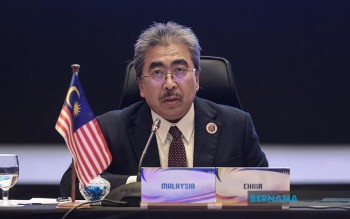
Malaysia's Investment, Trade and Industry Minister Datuk Seri Johari Abdul Ghani has called for fundamental adaptation within the World Trade Organization, warning that without meaningful evolution the multilateral institution risks becoming obsolete in an era of heightened geopolitical rivalry and transformed economic priorities. Speaking at the 39th Asia-Pacific Roundtable in Kuala Lumpur, Johari outlined how the international trading environment has shifted dramatically since the WTO's founding principles took root decades ago, requiring institutional responses that match contemporary realities.
When the WTO was established, the organization reflected a consensus among policymakers that dismantling trade barriers and broadening market access would automatically generate prosperity and strengthen global stability. That foundational logic, rooted in post-Cold War optimism, assumed that deepening economic interdependence would create mutual incentives against conflict. Today's policymakers operate within an entirely altered strategic framework where such assumptions no longer hold sway across major economies. The minister emphasized that the WTO's original mandate, though appropriate for its time, now struggles to address the complexities facing trading nations in the 2020s.
Johari identified several overlapping forces reshaping how governments approach trade policy, with national resilience and supply chain independence increasingly displacing the earlier emphasis on market liberalization as primary policy objectives. Contemporary economic decision-making now prioritizes technological supremacy, the capacity to function autonomously during disruptions, and control over critical production capabilities. These considerations, which barely registered in traditional trade negotiations, now dominate ministerial thinking across developed and developing nations alike. The shift reflects genuine anxieties about vulnerability—countries having witnessed pandemic-related shortages, semiconductor bottlenecks, and weaponized trade restrictions that standard WTO frameworks prove ill-equipped to manage or prevent.
The central debate within trade policy has undergone a profound reorientation, moving away from the traditional question of how far markets should open toward more defensive inquiries about which strategic capabilities warrant protection. This reconceptualization implies that future trade negotiations cannot proceed using the playbook that governed discussions for the preceding three decades. Johari warned that unless the WTO recognizes and accommodates this paradigmatic shift, the institution faces the prospect of gradual irrelevance as member states increasingly circumvent its structures through bilateral arrangements, regional blocs, and unilateral policy tools that better serve their strategic objectives.
Paradoxically, Johari argued, the case for strengthened multilateral institutions has arguably never been more compelling. In an environment of intensifying strategic competition between major powers, clear, predictable, and enforceable trading rules take on heightened importance as mechanisms for reducing uncertainty and managing tensions before they metastasize into broader conflicts. The WTO's dispute settlement function and its role as a venue for negotiating common standards become more valuable, not less, when geopolitical relationships deteriorate. Without functioning multilateral frameworks, economic disputes spiral more readily into security confrontations, and the absence of agreed procedures for managing disagreements elevates the risk that trade tensions escalate into military and diplomatic crises.
Yet this elevated imperative for multilateralism cannot be satisfied by institutions that remain frozen in their original design. The WTO must demonstrate capacity to address discriminatory practices wherever they emerge and adapt its operational approach to reflect how modern economies actually function. Supply chain disruptions, intellectual property disputes, digital commerce complications, and subsidies wrapped in environmental or security justifications represent contemporary challenges that the organization's current mechanisms struggle to process effectively. Malaysian and other developing nations have particular stakes in ensuring the WTO evolves, since smaller economies depend most heavily on transparent, rules-based frameworks to protect themselves against capricious policy shifts by larger trading partners.
Malaysia's official position, as articulated by Johari, reaffirms commitment to the multilateral trading system while insisting that the system itself must undergo substantive transformation. This balanced stance reflects the Southeast Asian nation's strategic position as an economy deeply embedded within global supply chains yet increasingly concerned about vulnerability to disruptions beyond its control. Malaysian policymakers recognize that wholesale rejection of multilateralism would harm the country's interests, yet continuing to operate through outdated structures provides inadequate protection for legitimate national concerns.
The comments came during the 39th Asia-Pacific Roundtable, an annual gathering organized by the Institute of Strategic and International Studies Malaysia on behalf of the broader ASEAN Institutes of Strategic & International Studies network. The conference, running through early July 2026, convenes policymakers, military officials, diplomats, academics, and business leaders to examine pressing geopolitical, economic, and security questions affecting the broader region. With the theme "Accelerating Agency and Action," the forum provides a platform for regional voices to shape discourse on how Asia-Pacific nations should navigate intensifying competition while preserving cooperative frameworks essential for stability.
For Malaysia and other Southeast Asian economies, the intersection of trade reform and strategic autonomy represents a central policy challenge in coming years. The region's prosperity depends substantially on functioning global trading networks, yet contemporary security dynamics increasingly push governments toward reducing dependence on distant suppliers and building more localized production capacity. Johari's remarks suggest Malaysian leadership recognizes that the WTO's future relevance depends on its capacity to accommodate these legitimate strategic concerns rather than insisting on an older model of integration that many nations increasingly view as incompatible with contemporary security imperatives.
The broader debate about WTO reform will shape regional trade negotiations, investment policies, and technology regulations across Asia-Pacific for the foreseeable future. How successfully the organization adapts will determine whether multilateral frameworks continue governing the majority of international commerce or whether the system fragments into competing bilateral and regional arrangements with less predictability and greater scope for powerful nations to impose unilateral conditions.

