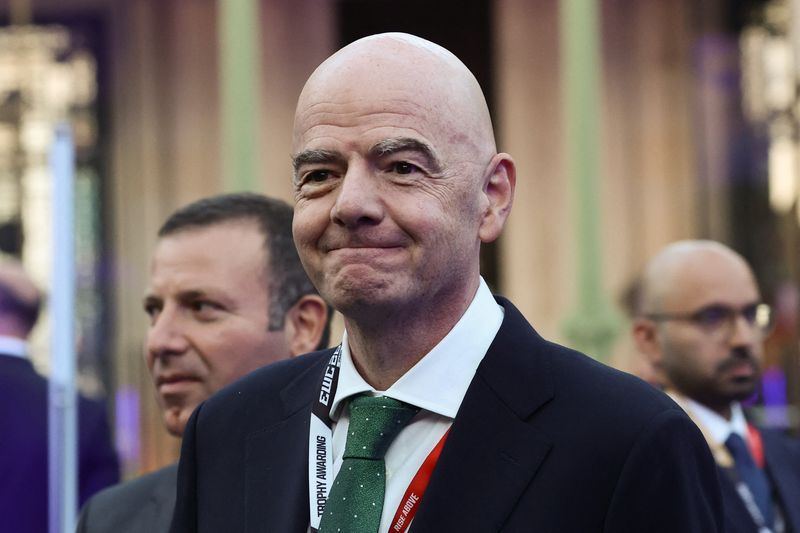
A powerful coalition of football's greatest names stepped into the centre of FIFA's deepening institutional crisis on Monday, issuing a stark rebuke of President Gianni Infantino's leadership and calling for sweeping structural changes at world soccer's governing body. The group—spanning multiple generations, continents, and genders—includes three members of France's 1998 World Cup-winning squad, American women's soccer icon Briana Scurry, England international Lucy Bronze, and a constellation of other decorated former professionals who have earned the status of FIFA legends.
The signatories represented a rare moment of unified voice from football's decorated alumni, drawing together players whose careers peaked across different eras and who rarely converge on such public statements. Emmanuel Petit, Bixente Lizarazu, and Robert Pires—all instrumental in France's 1998 triumph—joined forces with contemporaries including former Peru forward Claudio Pizarro, Argentine midfield maestro Juan Sebastian Veron, Togolese captain Emmanuel Adebayor, and universally recognized icons Didier Drogba and David James. The breadth of this coalition underscored the seriousness of the grievances being aired.
The players' intervention comes at a particularly turbulent moment for FIFA's leadership. Infantino, who has occupied the presidency since 2016, has weathered escalating calls for his resignation following his controversial proposal to establish a commercial entity controlling FIFA tournament rights and attracting private investment worth twenty percent of the organization. The proposal, now shelved, triggered fierce backlash from multiple continental confederations and has crystallized broader concerns about the direction and governance of global football.
Infantino's position has deteriorated markedly within FIFA's own institutional structure. The UEFA—European soccer's powerful governing confederation—along with the AFC representing Asia and CONCACAF overseeing North America, have mounted open opposition to his continued tenure. Senior figures have informed media outlets that regional powerhouses are actively weighing whether to accelerate a no-confidence vote ahead of next year's scheduled presidential election, potentially forcing the matter to a head considerably earlier than the planned ballot.
The players' statement struck at what they characterized as a fundamental corruption of FIFA's moral compass. Their communiqué emphasized that football has "drifted away from its core values under FIFA's current leadership," suggesting that institutional priorities have become misaligned with the sport's foundational principles. They argued that Infantino's administration has allowed personal and organizational interests to overshadow genuine commitment to the game's wellbeing and integrity.
The critique carries particular weight coming from individuals who have dedicated their lives to excellence within football's competitive structures. These are not external critics or political actors, but rather men and women who have represented their nations at the highest level, won the sport's most prestigious trophies, and remain deeply embedded within football's culture and traditions. Their willingness to break public silence suggests a level of frustration that transcends typical institutional disagreements.
Crucially, the players' statement articulated a specific vision for reform beyond simply removing the current leader. They emphasized the necessity for structural transformation that would grant genuine participatory authority to both athletes and supporters in determining how football is governed. This framing transforms the debate from a personality-driven conflict into a broader question about democratic representation and institutional legitimacy within soccer's global framework.
The statement's explicit invocation of fans amplifies its resonance considerably. In Malaysian and Southeast Asian contexts, where football commands passionate popular engagement, the assertion that millions of supporters share the players' concerns carries significant emotional and political weight. By positioning themselves as advocates for the worldwide fan community, the former athletes have transcended the narrow realm of professional politics to encompass the broader constituency that sustains football's cultural and commercial importance.
Infantino's apparent determination to remain in office despite mounting opposition reveals a strategic calculation about his political resilience. The fact that a sitting FIFA president maintains support among sufficient constituencies to resist coordinated pressure from multiple confederations suggests that reform efforts will require sustained and potentially escalating confrontation. The scheduled re-election provides a formal mechanism through which opposition forces might channel their objectives, though the anticipated acceleration of confidence votes indicates frustration with waiting for that traditional process.
For Asian football and Malaysian readers specifically, the governance crisis at FIFA carries direct implications. Tournament scheduling, qualification pathways, development funding, and commercial arrangements flow from FIFA's institutional decisions. A leadership structure oriented primarily toward commercial expansion and private sector engagement could yield different priorities than one emphasizing grassroots development, equitable resource distribution, and competitive integrity. The players' call for structural inclusion of athlete voices resonates particularly in contexts where Asian federations have historically possessed less institutional power than European counterparts.
The coalition's emphasis on rebuilding trust within FIFA reflects recognition that institutional credibility represents a finite resource. Decades of governance missteps, financial controversies, and perceived corruption have undermined public confidence in soccer's governing institutions. The players' suggestion that trustworthy figures exist within FIFA willing to undertake reconstruction implies that reform rather than wholesale dismantling remains possible—but only if fundamental power distributions shift.
Moving forward, the trajectory of this player-led advocacy movement will likely influence whether reform efforts gain sufficient momentum to force immediate change or whether Infantino's supporters can successfully defend his position until the scheduled election. The players have committed themselves to continued engagement, pledging not to remain silent on football's future governance. Their intervention represents a significant escalation in the pressure campaign, transforming what had been primarily a confederation-level dispute into a philosophical challenge grounded in football's authentic values and voiced by those who have most fully embodied its competitive ideals.

