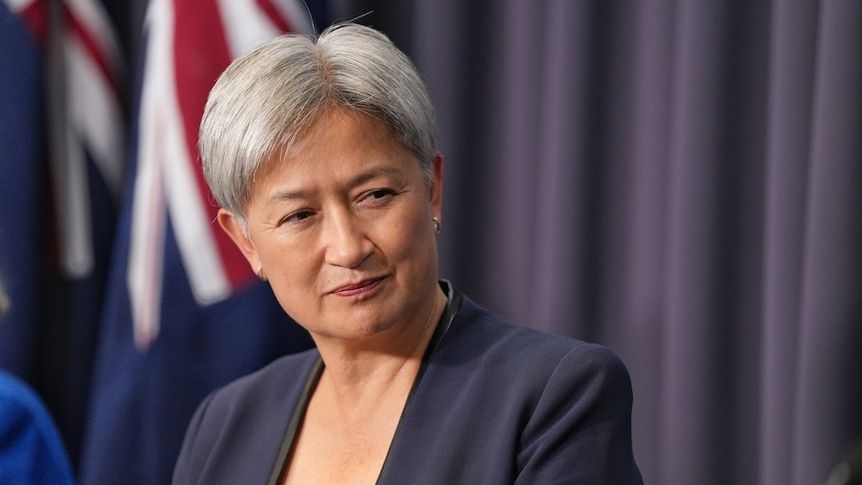
Australia's Foreign Minister Penny Wong is preparing to deliver a spirited defence of multiculturalism on Friday, positioning it as foundational to the nation's prosperity and strategic resilience in an address that directly challenges the rising political influence of the far-right One Nation party. Speaking at the Lowy Institute in Sydney, Wong — herself the first Asian-Australian to hold a federal ministerial position — will frame the multicultural character of Australian society not as a contemporary policy choice but as an immutable historical reality that has defined the nation since its earliest days.
The timing of Wong's intervention reflects deepening concerns within the Labor government about One Nation's unprecedented electoral momentum. Recent polling suggests Pauline Hanson's party has become Australia's most popular political force and could wield decisive kingmaker influence in the 2028 federal election, a possibility that would have seemed unthinkable just years earlier. This surge represents a significant shift in Australian politics, elevating anti-immigration and nationalist rhetoric to a prominence rarely seen in mainstream discourse, and prompting the government to directly engage with the ideological foundations of these challenges rather than simply dismissing them.
Wong's framing rests on demographic reality: half of all Australians were either born overseas or have at least one parent born outside the country, according to census data. Rather than treating this as a temporary phenomenon or a challenge to be managed, she positions it as the continuous thread running through Australian history, arguing that there has never existed an authentically monocultural Australia to which the nation could return. This historical argument carries particular weight because it undermines the nostalgic narrative that often accompanies far-right political movements globally, which typically invoke an imagined golden age of cultural homogeneity.
The Foreign Minister will go further by articulating security and economic consequences of pursuing a monoculture strategy. She plans to warn that retreating from Australia's multicultural foundation would damage crucial international relationships and trade networks upon which the nation's prosperity depends. In an era of intensifying strategic competition in the Indo-Pacific, where Australia faces pressure from multiple quarters, Wong's argument suggests that cultural insularity would translate directly into geopolitical vulnerability and reduced diplomatic flexibility.
One Nation's platform explicitly calls for Australia to reassess its participation in international organisations and dramatically scale back foreign aid, positions that align with broader nationalist movements challenging the liberal international order. The party has also drawn significant controversy this year by invoking Australia's historical "White Australia" policy, which formally restricted non-white immigration until the 1970s — a reference that generated widespread outrage but resonated with portions of the electorate concerned about rapid demographic change. By invoking this historical parallel, Hanson appears deliberately to be rehabilitating explicitly racial criteria for immigration policy, a move that would represent a dramatic departure from post-war Australian political consensus.
Wong's message that "those who seek to divide us for clicks and votes should know that they make us weaker at home and more vulnerable in the world" addresses not only policy substance but also the mechanics of contemporary political mobilisation. She is explicitly linking far-right political tactics — the deliberate cultivation of division for electoral advantage — to concrete harm to Australian interests, whether through economic disruption, diplomatic isolation, or reduced strategic options in a contested region.
The government's approach signals recognition that immigration concerns have genuine roots in community anxiety about housing affordability, wage pressures, and rapid social change, challenges that have proven fertile ground for extremist parties across Western democracies. Prime Minister Anthony Albanese acknowledged these "legitimate concerns" while insisting that addressing them need not involve vilifying migrants or abandoning multiculturalism as an organising principle. Immigration levels have already begun declining from recent peaks, and the government is preparing additional policy adjustments, suggesting an attempt to address constituent concerns while maintaining the multicultural framework.
For Malaysia and other Southeast Asian nations, Wong's intervention carries particular significance given the interconnectedness of regional migration patterns and Australia's role as a destination for skilled workers, students, and professionals from across Asia. Australian policy toward immigration and multiculturalism directly affects citizens throughout the region, shaping opportunities for advancement and influencing perceptions of Australia as an economic and educational partner. A shift toward more restrictive or racially-inflected immigration policies could reverberate through regional labour markets and educational exchanges that have become economically important to many Southeast Asian families.
Furthermore, Australia's diplomatic posture toward multiculturalism has implications for regional stability and cooperation frameworks. As middle powers globally struggle to maintain strategic autonomy amid great power competition, the framework through which nations define themselves — whether as pluralistic, cosmopolitan societies or as ethnically or culturally defined entities — carries consequences for alliance-building, trade relationships, and conflict resolution mechanisms. Wong's emphasis on Australia's multicultural character as a source of strength rather than vulnerability offers a counternarrative to nationalist movements gaining ground across the democratic world.
The intellectual challenge Wong is mounting against One Nation's vision extends beyond electoral calculation into fundamental questions about how modern nations should conceptualise their identity and interests. By insisting that multiculturalism represents not a departure from Australian tradition but its truest expression, and that it serves national interests rather than undermining them, she is attempting to reframe the terms of political debate from cultural purity to practical efficacy. Whether this argument gains sufficient traction to check One Nation's momentum remains uncertain, particularly given the party's demonstrated ability to mobilise voter sentiment around demographic anxieties that transcend rational policy evaluation.

