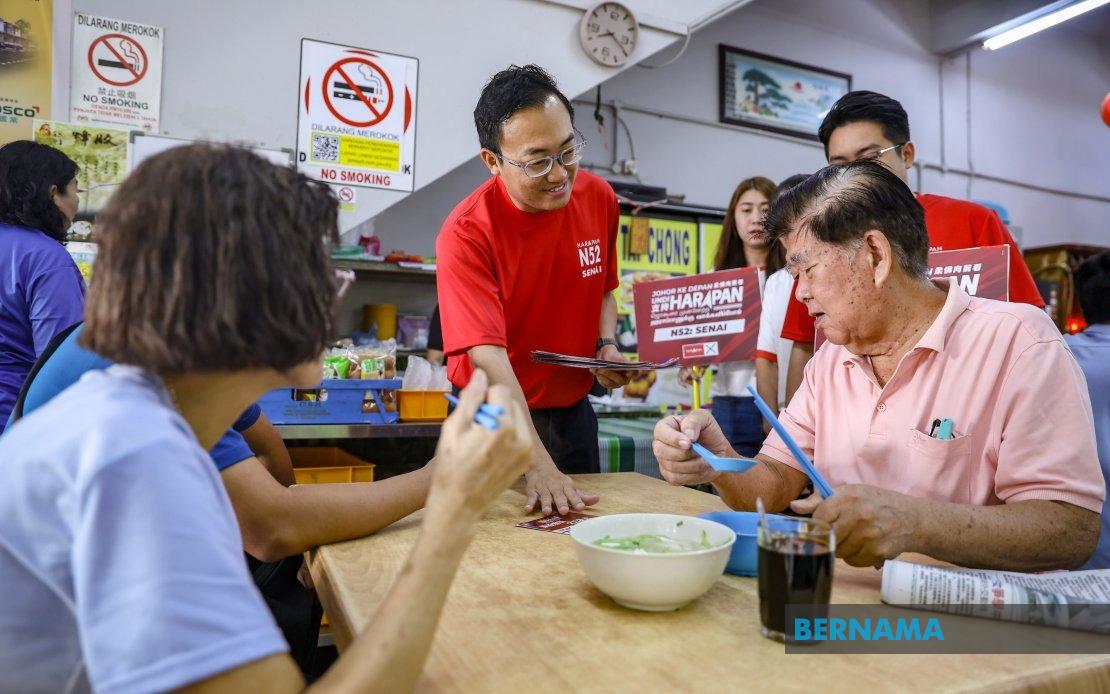
Wong Bor Yang, the current Senai state assemblyman, is banking on his demonstrated commitment to constituency development as Pakatan Harapan seeks to retain the seat in the 16th Johor state election scheduled for July 11. Speaking in Kulai, Wong outlined his accomplishments during his previous term, emphasizing how persistent advocacy for flood mitigation and public facility upgrades has strengthened his credential as a dedicated representative of the 66,635 registered voters in his constituency.
The former journalist's political journey stretches across multiple phases of Malaysia's evolving political landscape, beginning with his appointment as a special officer at the Kulai MP's office in 2014. This foundation allowed him to build institutional knowledge of district governance while observing the country's political transitions firsthand. His progression from opposition-affiliated service to becoming a local councillor in 2018 and eventually a state assemblyman reflects the fluid nature of Johor's political alignment over the past decade, providing him with perspective from different vantage points within the system.
Wong's most substantive campaign claim centres on his success in addressing Senai's endemic flooding problems, which have long plagued several residential areas. Working with the state government, he secured RM1 million to upgrade the drainage infrastructure in Taman Aman, channelling stormwater more efficiently into Sungai Skudai. In collaboration with Kulai Member of Parliament Teo Nie Ching, he also obtained RM3 million for drainage improvements in Peladang Kulai Besar and Saleng, which were removed from the district's flood hotspot register as a result. These concrete achievements demonstrate the value of sustained advocacy within institutional frameworks, even when political circumstances shift.
Beyond basic infrastructure, Wong has positioned himself as a custodian of Senai's heritage and community spaces. His transformation of a defunct cinema into a community operations centre and renovation of a two-decade-old badminton court into a family recreational area called Tiny Lake under the Sejati MADANI programme exemplify his broader vision of revitalizing public spaces. These initiatives reflect the importance that residents in mature constituencies like Senai place on quality-of-life amenities beyond essential services, a consideration that appeals to voters across demographic groups.
Healthcare emerges as Wong's primary policy focus for a potential second term. He argues that Kulai Hospital's current 93-bed capacity is dangerously inadequate for a district projected to house 500,000 residents by 2030, a demographic shift that will strain existing medical infrastructure substantially. Wong has identified a stalled project to construct a new health clinic in Taman Mewah as a priority, pointing to unresolved land issues and state-level bureaucratic obstacles as impediments to progress. His emphasis on healthcare aligns with broader Malaysian voter concerns about service delivery and accessibility, particularly in rapidly developing districts experiencing population growth.
Wong's campaign narrative rests on the distinction between proven performance and untested promises. As an incumbent facing new challengers, he argues that Senai voters are sufficiently politically mature to evaluate candidates on measurable outcomes rather than rhetoric. This appeal to pragmatic assessment reflects confidence in his track record, though it also acknowledges the challenge posed by opponents who may offer fresh perspectives or represent different constituencies' interests.
The Senai contest has evolved into a three-way race, with Barisan Nasional candidate Tai Chee Chee and Bersama candidate Tew Chien How both competing for the seat. This fragmentation creates complex strategic dynamics for all contestants. While Wong's tenure as assemblyman provides institutional advantage and documented achievements, the presence of multiple challengers could split the vote in unexpected ways. The July 7 early voting period will provide initial indicators of voter sentiment before the main polling date.
Wong's background as a journalism graduate of Shih Hsin University in Taiwan introduces an international dimension to his profile, potentially signalling openness to comparative policy learning. His career transition from media to public service mirrors broader trends of professional expertise entering electoral politics, though such backgrounds sometimes face voter skepticism regarding authenticity of commitment to constituency concerns.
The timing of the Johor election within Malaysia's political calendar carries significance for national coalition dynamics. As Pakatan Harapan seeks to consolidate state government control across different regions, retaining seats like Senai becomes crucial for maintaining legislative majorities and demonstrating electoral viability. Wong's campaign therefore operates within this larger strategic context, where local performance metrics serve as indicators of broader coalition strength and public confidence.
Senai's electoral character as a mature, fairly developed constituency with established administrative infrastructure differs notably from rural or newly urbanizing seats elsewhere in Johor. Voters here typically prioritize incremental improvements in service quality and efficient administration over grand development promises. Wong's emphasis on resolving specific, long-standing problems like drainage and healthcare capacity speaks directly to these preferences, positioning him as responsive to constituent feedback rather than pursuing ideologically driven agendas.
The assemblyman's ability to work collaboratively with the Kulai MP across partisan lines, particularly visible in the drainage upgrade projects, demonstrates pragmatic governance approaches that transcend strict coalition boundaries. This practical cooperation, if maintained, could appeal to voters fatigued by hyperpartisan conflict and eager for representatives who prioritize problem-solving over point-scoring. Such collaborative instincts, however, also raise questions about how Wong would navigate potential tensions between state and federal government priorities should political alignments shift further.

