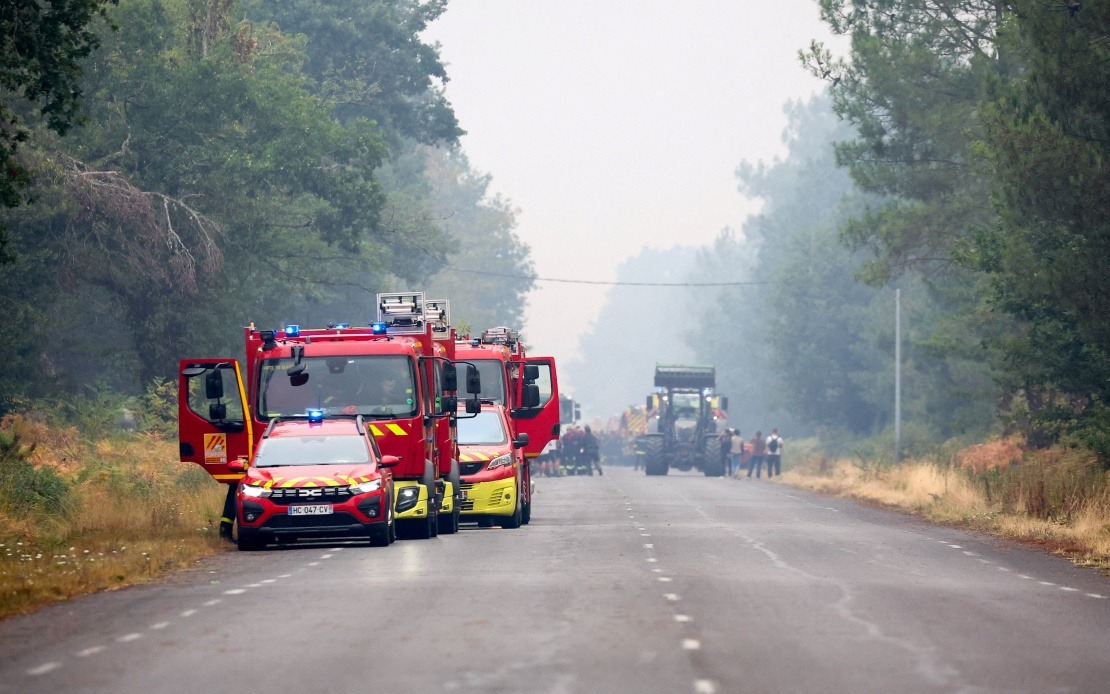
The major wildfires that have devastated southwestern France and eastern Spain over recent days are showing initial signs of containment, though authorities remain on high alert as another dangerous heat wave approaches the region. The fires, which have consumed vast tracts of forest and prompted the displacement of tens of thousands of residents, entered a more stable phase by Wednesday, but firefighting operations continue at full intensity across both nations as officials brace for potentially worse conditions ahead.
In Gironde, the southwestern French department that has borne much of the brunt of the crisis, local authorities confirmed that the principal wildfire stabilized through the morning hours despite sporadic flare-ups that erupted overnight. The prefecture's assessment suggested that conditions had grown calmer during the night, yet the assessment underscores the precarious nature of containment efforts. Over 2,000 firefighters remain actively stationed around the perimeter to suppress remaining hotspots and prevent the fire from reigniting across areas thought to be secure. The human cost has already mounted significantly, with 126 firefighters sustaining injuries during firefighting operations in Gironde alone since the outbreak began.
Other affected French departments have achieved more decisive progress. The fire that swept through the Var region in southeastern France was successfully contained by Tuesday, though not before consuming nearly 4,800 hectares of forestland. The Landes department, also in the southwest, saw its major fire brought under control by Monday after destroying 3,600 hectares, though approximately 350 firefighters remained deployed to maintain the containment. The scale of deployment across multiple departments reflects the unprecedented coordination required to manage simultaneous large-scale fire emergencies. Gironde and Var form part of a larger group of 65 departments across France that remain under orange alert status, signaling a sustained high risk of forest fires throughout Wednesday and potentially beyond.
The meteorological forecast compounds the anxiety among French officials. The National Weather Service Meteo-France has issued orange alert warnings across 16 additional departments in anticipation of a new heat wave sweeping across the region. The timing of extreme heat conditions following days of intensive firefighting presents a serious challenge to containment efforts, as elevated temperatures, low humidity, and potentially strong winds create ideal conditions for fire propagation. This cyclical pattern of fire followed by heat represents an increasingly familiar challenge in southern European summers.
Across the border in Spain, firefighting efforts have similarly entered a stabilization phase, though multiple active fires continue to demand intensive resource deployment. The forest fire in Madrid's Sierra Oeste region remained stable overnight without experiencing the sudden flare-ups that have complicated containment in France. However, firefighting operations continue across Madrid, Avila, Toledo, Castellon, and Almeria as Spain simultaneously prepares for another incoming heat wave. The coordination of firefighting activities across multiple regions while anticipating deteriorating meteorological conditions illustrates the stretched capacity of Spanish emergency services.
Evacuation orders have begun lifting in several regions as fires stabilize, allowing residents to assess damage to their properties and communities. Late Tuesday saw the return of residents from 15 municipalities spanning the Madrid and Avila regions. Additionally, 9,000 residents from Castellon and 6,000 residents from 11 municipalities in Toledo received authorization to return to their homes. These phased returns, though necessary for public morale and economic function, proceed cautiously given the unstable conditions and the threat of renewed fire activity.
The Vall d'Uixo wildfire in Castellon presents the most serious ongoing challenge in the Spanish context. This fire, which ignited Saturday and continues to defy full containment, has incinerated approximately 10,000 hectares and forced the evacuation of 10,000 people from surrounding communities. The fire's persistence despite extensive firefighting efforts underscores both the challenging terrain and the formidable scale of the disaster. While evacuation numbers have declined as some fires are brought under control, the continued closure of 30 roads across Avila, Castellon, Madrid, Toledo, and Leon demonstrates the lingering impact on regional infrastructure and mobility.
The crisis unfolding across France and Spain carries implications that extend beyond the immediate pyrotech emergency. Mediterranean wildfires of this magnitude increasingly reflect broader patterns of climate change affecting Southern Europe, with longer fire seasons, higher peak temperatures, and more volatile weather patterns becoming the norm rather than the exception. For Malaysia and Southeast Asian observers, the experience of France and Spain offers instructive lessons about disaster preparedness and cross-regional coordination during environmental crises. The capacity mobilization demonstrated by both nations—deploying thousands of firefighters, coordinating multiple jurisdictions, and maintaining public communication throughout—provides a framework for considering how tropical nations might enhance their own emergency response capabilities.
The economic and social costs of these fires extend beyond the immediate destruction. Communities face weeks or months of recovery as burned forests take years to regenerate, agricultural output declines, and tourism infrastructure sustains damage. The displacement of residents, even temporarily, disrupts local economies and imposes psychological stress on populations. For European policymakers, the recurring nature of these crises increasingly drives investment in prevention infrastructure, early warning systems, and climate adaptation strategies.
Looking ahead, the arrival of the predicted heat wave represents a critical test of containment successes achieved thus far. Meteorological forecasts will be closely monitored by authorities and fire commanders who must prepare for possible reactivation of supposedly contained fires. International firefighting assistance, including personnel and equipment from neighboring nations, may become necessary if conditions deteriorate. The coming days will likely determine whether current stabilization efforts hold or whether the region faces escalation toward an even more severe crisis phase.

