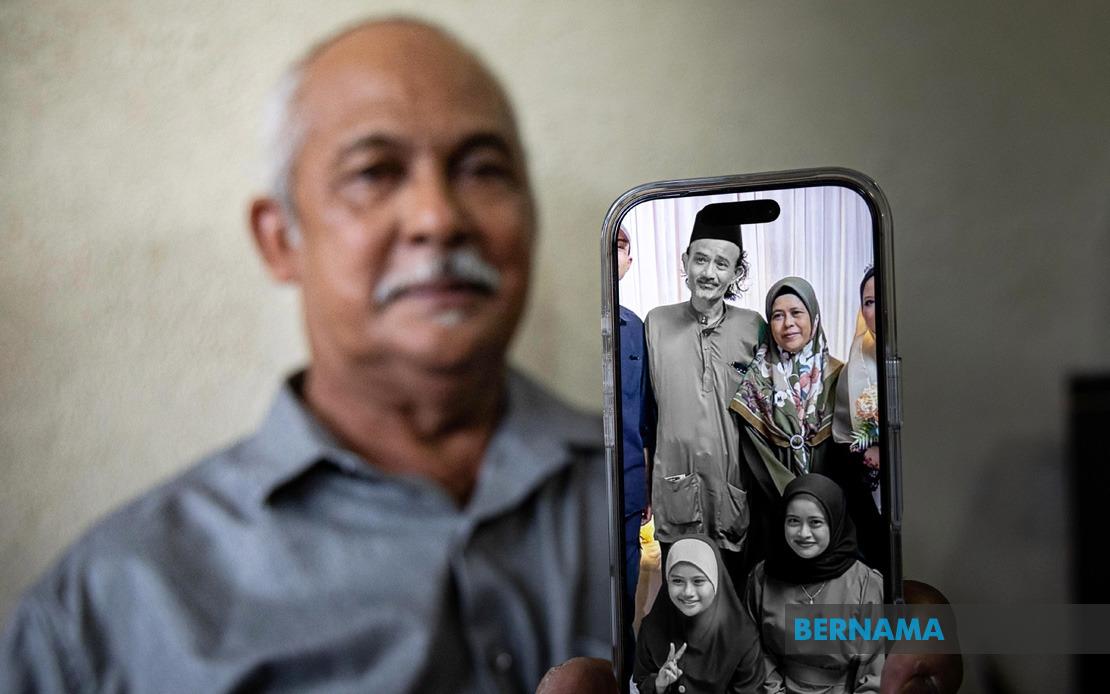
Norhayati Razali is fighting a double battle—against her injuries and against the cruel confusion wrought by trauma. The 55-year-old is among the few who survived the devastating collision on Jalan Sultan Ismail in Kuala Lumpur on Wednesday, but she paid the heaviest price imaginable: her husband and two of her children perished in the accident. Now, from her hospital bed in Kuala Lumpur Hospital's Intensive Care Unit, she grapples with memory lapses that make her loss feel both immediate and incomprehensible.
The trajectory of Norhayati's condition reveals how far she has come since the initial impact. Transferred recently from intensive care to a standard ward, she has regained the ability to consume food and beverages independently—a milestone that signals genuine physiological recovery. Her brother, Mohd Nadzri Razali, 69, has become her advocate and voice to the outside world, providing updates on her condition while navigating the practical and emotional complexities of family tragedy. According to Mohd Nadzri, his sister sustained a constellation of injuries: damage to both hands, her torso, knees, and legs, compounded by significant head trauma that demands careful medical oversight.
Yet physical healing progresses faster than cognitive restoration. Mohd Nadzri recounted a heartbreaking detail that underscores the psychological toll: family members brought Norhayati to view the bodies of her deceased loved ones and explained what had transpired. She absorbed the information mutely, acknowledging only with a nod. The next day, however, she asked after her husband and children's whereabouts—suggesting that either the memory failed to consolidate or the emotional weight made acceptance impossible. The family remains uncertain whether her mind is genuinely blank or whether grief has created a protective barrier that temporarily obscures understanding.
The uncertainty surrounding Norhayati's medical future adds another dimension to her family's struggle. Physicians have not yet determined whether she can be transferred to a facility closer to her home, such as hospitals in Ipoh or Teluk Intan. Mohd Nadzri expressed hope that such a transfer might ease the burden on family members managing her recovery from a distance. Perak-based relatives face logistical challenges in providing consistent support; Mohd Nadzri himself has not yet visited because he lacks reliable transport to Kuala Lumpur and fears navigating the capital's unfamiliar roads. He is attempting to arrange transport from Perak for this weekend—a modest goal that illustrates how far grief and distance now extend.
The accident itself unfolds as a cautionary tale about split-second decisions with catastrophic consequences. On August 19, a Malaysian Immigration Department (JIM) Black Maria truck was en route to Chow Kit for an immigration enforcement operation targeting undocumented migrants. The truck, empty at the time, was traveling with its beacon and siren activated—visual and auditory warnings meant to clear the path. However, at the intersection on Jalan Sultan Ismail, the truck entered against a red traffic signal.
A Proton Saga sedan with the right of way struck the truck as it breached the intersection. The collision destabilized the heavier JIM vehicle, which then careened out of control, leaving the roadway and plowing into pedestrians and a second private vehicle—an Inokom Matrix. Three family members died at the scene; Norhayati became the sole adult survivor, while a fourth victim sustained serious injuries. The tragedy underscores tensions inherent in emergency vehicle operations: the balance between urgency and public safety, between the authority granted to government operators and the vulnerability of ordinary road users.
Mohd Nadzri's call for justice reflects a broader public concern about accountability. He has appealed for a thorough, impartial investigation, specifically invoking the potential utility of traffic camera footage at the intersection. His plea resonates because it implies doubts about whether official explanations will sufficiently illuminate causation—whether mechanical failure, human error, or systemic oversights contributed to the tragedy. He seeks transparency, evidence, and a process that honors all victims equally. Such demands are not uncommon following high-profile accidents involving government vehicles, where perceptions of institutional self-protection can undermine public confidence.
The accident raises substantive questions about operational protocols for immigration enforcement vehicles and whether pursuit or urgency justifies heightened risk to uninvolved civilians. Malaysia's road safety record has long concerned policymakers, and incidents involving official vehicles present opportunities to examine whether special privileges granted to emergency operators are consistently exercised responsibly. The siren and beacon activated on the JIM truck were meant to facilitate its mission; instead, they became harbingers of tragedy for a family whose primary connection to immigration was geographic accident.
Norhayati's cognitive struggles underscore the non-financial costs of such accidents. Medical science can address broken bones and organ damage; it cannot easily repair the neurological disruption caused by severe head trauma, nor can it restore the emotional architecture demolished when someone loses multiple immediate family members simultaneously. Her confusion, though temporary, reflects a deeper disorientation—the loss of the social and familial structures that give life meaning and continuity. Even if her memory eventually clarifies fully, the lives she remembers will include the three people no longer present to share them.
The family's situation also illuminates the broader support ecosystem for accident survivors in Malaysia. Beyond hospital treatment, victims and their relatives often confront fragmented resources: transport difficulties, financial strain, housing complications for those from outside the capital, and psychological counseling that remains underutilized. Mohd Nadzri's struggle to reach his sister, though temporary, hints at the infrastructure gaps that can compound trauma in the weeks and months following catastrophic incidents.

