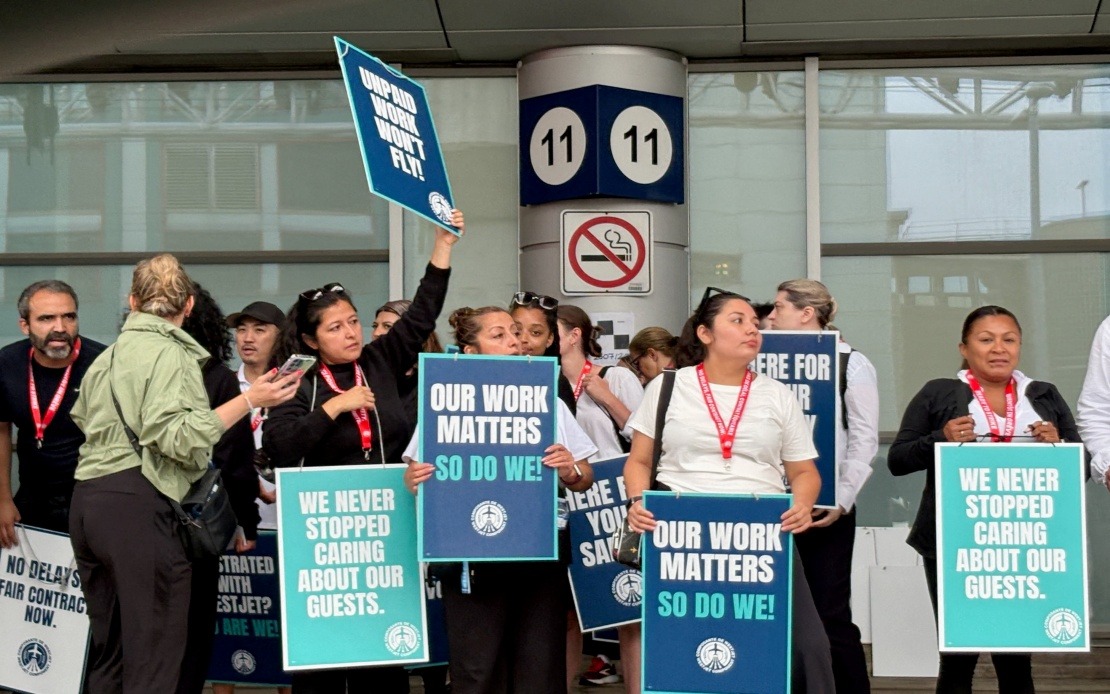
A labour standoff at WestJet has brought significant disruption to Canada's aviation sector, with more than 4,000 flight attendants walking off the job on Sunday in what marks a critical moment for airline industrial relations in North America. The action has immediately immobilised roughly 600 flights per day and upended travel schedules for approximately 250,000 passengers, creating a cascading effect across the country's transport network during one of the most congested travel periods of the year. The timing compounds the disruption, as Monday represents a civic holiday in Canada, transforming the weekend into one of the busiest travel windows annually and maximising the strike's economic and social impact.
The core disagreement centres on a seemingly straightforward but increasingly contentious issue: whether flight attendants should receive compensation for labour performed outside the cabin before departure and following landing. This fundamental dispute over ground work pay has become a watershed moment in Canadian aviation, reflecting broader tensions across the North American airline industry about how carriers value and remunerate their workforce. Flight attendants argue that considerable time spent preparing aircraft, boarding passengers, and conducting post-flight procedures remains unpaid despite being essential to daily operations, creating a significant gap between their actual working hours and their compensated time.
Industry precedent now exists for addressing this grievance. Delta Air Lines established the trajectory in 2022 by becoming the first major carrier to implement ground work compensation, demonstrating both commercial viability and willingness to recognise this labour category. Air Canada subsequently followed suit in February this year under the terms of a freshly negotiated contract, establishing that Canada's largest airline recognised the legitimacy of flight attendant demands. This institutional acknowledgment strengthens the bargaining position of WestJet's workforce and suggests that the carrier's resistance represents an outlier position rather than industry-wide practice.
The remuneration structure for WestJet flight attendants currently operates on a credit-hour basis, with staff earning between $28.88 and $53.61 per credit hour depending on seniority and experience levels. Air Canada's revised framework offers substantially improved terms, providing compensation equivalent to up to 70 per cent of hourly rates for the hour immediately preceding takeoff. This structural difference between existing WestJet compensation and the Air Canada benchmark illustrates the gap that negotiations have failed to bridge, with attendants seeking parity with their counterparts at the country's dominant airline.
The Canadian Union of Public Employees, the labour organisation representing WestJet flight attendants, has characterized the labour action as a response to managerial intransigence following nearly eleven months of collective bargaining. Union representative Alia Hussain articulated the frustration of the membership, asserting that the strike represents not a desire for disruption but rather a final recourse after extended negotiation attempts produced no substantive movement on core demands. The union's framing emphasises that attendants pursued dialogue extensively before resorting to industrial action, positioning the walkout as management's responsibility for failing to take workforce concerns seriously during the protracted bargaining period.
WestJet's leadership has acknowledged the severity of the operational crisis while defending the carrier's position. Chief Executive Officer Alexis von Hoensbroech expressed disappointment at the necessity of the strike, emphasising the collateral damage inflicted on passengers, employees, and the communities and businesses dependent on the airline's network. The airline announced that affected passengers would receive refunds, attempting to mitigate reputational damage and demonstrate corporate responsibility amid the disruption. However, the company's public statements have not indicated movement toward acceptance of ground work compensation, suggesting the conflict may persist beyond the immediate crisis phase.
Federal Jobs Minister Patty Hajdu weighed into the dispute through social media channels, expressing governmental disappointment that negotiating parties failed to achieve a resolution despite sustained efforts to broker an agreement on a new collective contract. The minister's intervention reflects Ottawa's interest in labour peace within critical economic infrastructure sectors and signals potential governmental concern about the strike's broader economic implications. Federal involvement, while typically limited in purely private sector disputes, occasionally materialises when consequences ripple across the economy at sufficient scale.
The financial stakes for WestJet are substantial, with industry analysts projecting millions of dollars in direct and indirect costs as the strike persists. Cancelling 600 daily flights represents enormous lost revenue alongside fixed costs for groundhandling, maintenance, and facility operations that continue regardless of flight schedules. These economic pressures typically intensify incentives for settlement but do not automatically guarantee movement if management perceives long-term concessions as establishing problematic precedents for labour relations across the carrier's entire workforce structure.
For Malaysian and Southeast Asian observers, the WestJet dispute offers instructive parallels to regional aviation labour dynamics. The emergence of ground work compensation as a major negotiating flashpoint reflects evolving global standards around what constitutes compensable labour within the airline industry. As carriers in Asia-Pacific markets expand and mature, comparable disputes regarding flight attendant remuneration and working conditions are likely to emerge, potentially influenced by the outcomes of labour struggles in North American carriers. The willingness of major airlines like Delta and Air Canada to accommodate ground work pay suggests that this represents an increasingly normalised expectation rather than an exceptional demand.
The strike also illuminates asymmetries in how aviation workers' contributions are valued and compensated across different regions and carriers. WestJet's resistance to ground work compensation, while Air Canada has already conceded the point, demonstrates that no uniform industry standard yet exists across Canada itself, much less globally. This fragmentation creates opportunities for workers in jurisdictions with stronger labour movements or more sympathetic regulatory environments to establish precedents that subsequent carriers must match to compete for talent. The WestJet situation will likely be monitored closely by airline management and labour representatives throughout North America and internationally.
Resolution timelines remain uncertain as the strike persists without announced negotiations toward settlement. The duration of the action will determine its ultimate economic toll and may influence how aggressively either party approaches future talks. Prolonged disruption increases both parties' incentives for compromise, though positions may also harden if either side believes holding firm will produce eventual capitulation from opponents. The Canadian aviation sector and its hundreds of thousands of dependent travellers now await developments in this labour conflict that has illuminated fundamental questions about how modern airlines value and compensate their essential but often underappreciated workforce.

