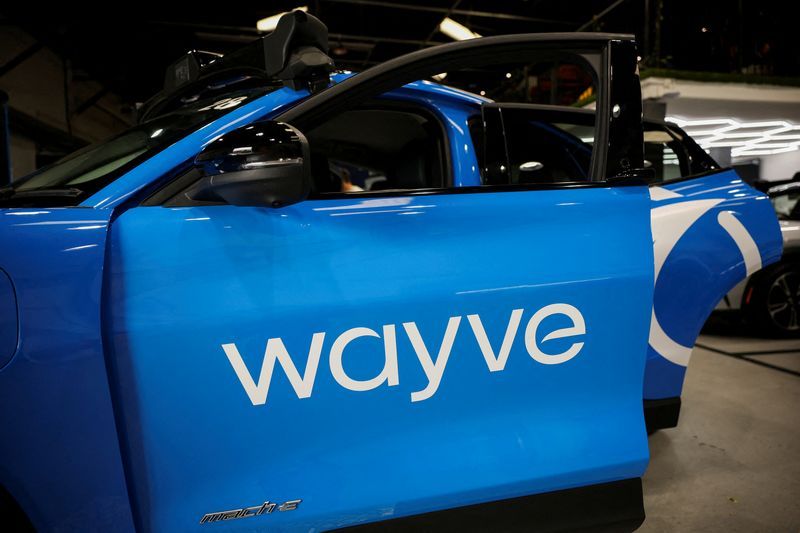
Wayve, a London-based autonomous vehicle startup, has emerged as a significant player in the rapidly evolving self-driving car sector, drawing investment commitments totalling $2.8 billion from an impressive array of technology titans and established automakers. The funding round reflects renewed confidence in the autonomous driving industry, with backing from companies spanning Nvidia to Mercedes-Benz and Nissan. Most notably, the company recently announced a partnership with Stellantis, the maker of Jeep vehicles, to integrate its technology into robotaxis destined for Uber's ride-hailing platform, signalling that Wayve's approach is gaining traction among both technology leaders and traditional automotive manufacturers seeking advanced mobility solutions.
At the heart of Wayve's competitive proposition lies its use of end-to-end machine learning, a fundamentally different approach to autonomous driving compared to conventional systems. Rather than relying on pre-programmed rules, software coding, and meticulously mapped high-definition road data to dictate vehicle behaviour in various scenarios, Wayve's technology mirrors how human drivers learn and adapt. The system processes sensor data in real time and translates this information directly into driving decisions, enabling the vehicle to respond dynamically to complex, unpredictable traffic situations in ways that traditional rule-based systems struggle to manage.
This technological philosophy places Wayve alongside Tesla in the autonomous vehicle landscape, though with a crucial distinction. While Tesla's pioneering end-to-end model relies exclusively on camera-based sensors, Wayve has designed its system to integrate seamlessly with diverse sensor suites and AI hardware configurations. This flexibility represents a significant commercial advantage, as it allows Wayve to license its technology to virtually any vehicle manufacturer or autonomous vehicle developer, regardless of their existing sensor infrastructure or computational platforms. CEO Alex Kendall, a 33-year-old New Zealand-born researcher who founded Wayve in 2017 following completion of his doctoral studies in AI deep learning at Cambridge University, has articulated an ambitious vision for the company's role in reshaping global mobility.
"We want to make full self-driving possible for any vehicle, any brand, and anywhere around the world," Kendall stated during an earlier interview conducted in San Francisco, where the company maintains a significant technical hub. Wayve demonstrated its technology operating a Ford Mustang Mach-E autonomously through Bay Area neighbourhoods, showcasing practical implementation of its learning-based system in real-world driving conditions that many consumers would recognise and find compelling.
The autonomous vehicle industry has experienced a dramatic shift in investor sentiment, particularly following Alphabet's Waymo achieving meaningful commercial expansion over the past two years. Having spent more than a decade perfecting its technology, Waymo now offers paid autonomous ride-hailing services across approximately a dozen cities, finally delivering on promises that many believed would never materialise. This sustained progress has reinvigorated confidence in driverless car development generally, creating a more receptive investment climate for companies like Wayve that are pursuing alternative technical approaches. End-to-end learning, which was once confined to academic research circles and experimental projects pursued by researchers such as Kendall himself roughly a decade ago, has now become mainstream within the autonomous vehicle development community, with numerous companies integrating aspects of this technology into their systems.
Yet this ascendancy of AI-centric autonomous driving methodologies has introduced a troubling paradox for industry stakeholders, particularly those responsible for vehicle safety and regulation. The inherent opacity of end-to-end learning systems, often characterised as "black boxes" by technical commentators, creates significant challenges in comprehending and validating why autonomous vehicles make particular driving decisions. Earlier generations of autonomous systems, which depended heavily on explicit software programming and digital mapping, offered greater transparency—engineers could readily understand and trace the logical pathway leading to specific vehicle manoeuvres. This interpretability proves invaluable when accident investigations occur or when safety regulators require explanations for vehicle behaviour.
Wayve's engineering team has developed sophisticated safety protocols to address these concerns, generating comprehensive safety maps that visualise evolving traffic scenarios and highlight secure pathways for vehicle navigation. The company's safety engineers, including vice president of AI Vijay Badrinarayanan, argue that conventional programming-intensive safety approaches contain inherent fragility when confronted with unusual or unpredictable traffic situations. Pre-programmed rule-based systems struggle because it proves impossible to anticipate and code responses for every conceivable edge case; conversely, humans navigate safely precisely because they maintain conservative, adaptive responses when encountering unfamiliar circumstances. This fundamental insight underpins Wayve's conviction that learning-based systems represent a genuinely superior safety paradigm than rigid rule-based alternatives.
Waymo, despite being a leading proponent of end-to-end learning, maintains a hybrid approach, complementing its AI systems with conventional rules-based programming and mapping technologies. The company has cautioned that "end-to-end models aren't enough to guarantee safety at scale," indicating that even the most successful autonomous vehicle developer believes layered, complementary safety architectures remain necessary. This position reflects the industry-wide nervousness about relying exclusively on machine learning systems for critical safety functions, a concern that remains prevalent among manufacturers and regulators alike.
Among Wayve's partnership roster, Japanese automaker Nissan exemplifies the measured enthusiasm tempered by safety concerns that characterises many traditional manufacturers' engagement with novel autonomous driving approaches. Nissan's technology leadership, including chief Eiichi Akashi, has acknowledged that Wayve's system represents "the most advanced" technology available, yet the company remains uncertain about its safety implications. Akashi noted the particular challenge that Wayve's methodology presents: "It is difficult to peer into it and see how it makes decisions." Nissan intends to deploy Wayve's technology within the Japanese market, specifically in an autonomous people-mover vehicle called the Elgrand, with deployment targeted for the fiscal year ending March 2028. This measured rollout reflects the automaker's intention to validate the technology's reliability and safety profile within a controlled, domestic context before broader implementation.
A significant strategic advantage differentiating Wayve from established autonomous vehicle platforms lies in its deployment flexibility. Because Wayve's learning-based system does not require exhaustive pre-mapping of roadways or labour-intensive local coding to accommodate regional driving patterns and road characteristics, the company claims it can expand into new geographic markets substantially faster than competing technologies. Wayve has successfully validated its AI driving system across hundreds of cities globally without requiring such preliminary infrastructure development—a capability that could prove economically transformative if sustained. With major operational centres in Tokyo, Stuttgart, and Vancouver, Wayve has positioned itself to address autonomous vehicle markets across multiple continents simultaneously.
Academic researchers have offered measured assessments of these competing methodologies. Siddartha Khastgir, a professor of safe autonomy at the University of Warwick, suggests that end-to-end learning models should enable faster commercial development and deployment cycles than traditional rule-based approaches, though he stops short of declaring either technology inherently safer. Phil Koopman, a respected Carnegie Mellon University computer engineering and autonomous systems expert, characterises Wayve's methodology for managing unusual traffic scenarios as one viable approach among several, though cautioning that meaningful differences may ultimately emerge between competing methodologies only through extended real-world operation. Koopman's sobering assessment suggests that deploying driverless systems safely across the United States alone will require at least another decade, plus potentially transformative innovations yet to be conceived.

