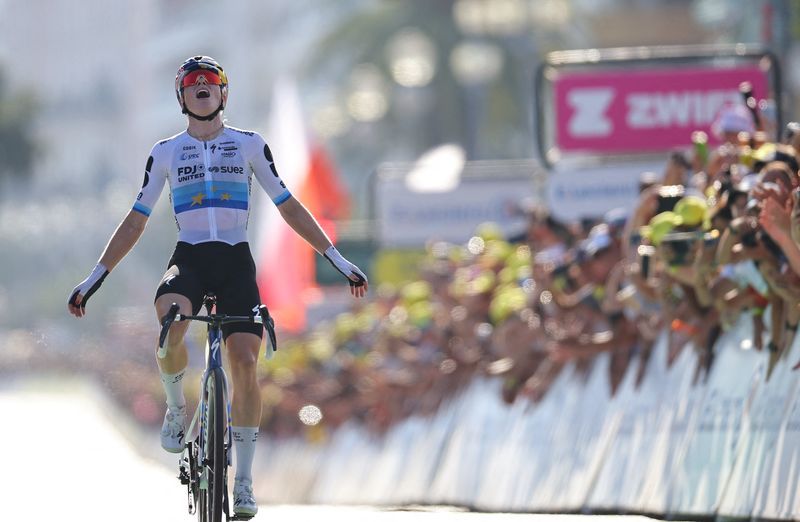
Demi Vollering of the Netherlands has thrust herself into pole position to claim overall victory in the Tour de France Femmes after a commanding performance on the race's penultimate stage. The 171.9-kilometre mountain route from Sisteron to Nice proved decisive, with Vollering executing a textbook assault on the steep Chemin de l'Arieta climb in the final six kilometres to dislodge Kasia Niewiadoma-Phinney from the yellow jersey. The FDJ United-Suez rider's victory marks a dramatic reversal of fortune following her one-minute and 16-second loss to Niewiadoma-Phinney on Mont Ventoux just one day earlier, demonstrating the volatile nature of elite cycling competition where momentum and mental resilience can shift dramatically over consecutive stages.
The drama surrounding stage eight extended beyond the race itself. Pauline Ferrand-Prevot, the defending champion representing Visma-Lease a Bike, withdrew before the start due to illness, depriving cycling fans of what would have been a compelling three-way battle for supremacy. This absence fundamentally altered the tactical landscape of the final two stages, removing one of the pre-race favourites from contention and simplifying the mathematics of victory for the remaining contenders. Ferrand-Prevot's withdrawal underscores the physical toll that the gruelling week-long event exerts on competitors and the unpredictability that can shape major sporting narratives.
Vollering's decisive moment came on a brutal climb where gradients tested every ounce of fitness and mental fortitude. Her acceleration carried her clear of both Niewiadoma-Phinney and Italy's Elisa Longo Borghini, two formidable competitors accustomed to the demands of world-class cycling. The subsequent descent into Nice proved equally important, with Vollering extending her advantage on technical terrain where superior bike handling and confidence can yield substantial time gains. This combination of explosive power on the climb and technical mastery on the descent represents the complete skillset demanded of modern grand tour cyclists.
Longo Borghini of UAE Team ADQ secured second place with a superior sprint finish against Niewiadoma-Phinney, who surrendered the race lead but remained only eight seconds adrift. The Polish-Canadian rider's frustration manifested immediately after crossing the finish line, with her comments directing sharp criticism towards FDJ United-Suez's tactical approach. Niewiadoma-Phinney alleged that team-mate Celia Gery deliberately blocked her into barriers near the climb's base, forcing her to interrupt her pedalling rhythm at a critical juncture. Such tactical intensity, whilst commonplace in professional cycling, provoked a notably emotional response from the former leader, who expressed disappointment with what she characterised as unsporting conduct.
Vollering's ascent to the yellow jersey marks her fifth time wearing professional cycling's most prestigious jersey, a reflection of her competitive credentials across multiple tour events. More broadly, her emergence as race leader represents the fifth different rider to lead this edition, illustrating how the Tour de France Femmes has evolved into a genuinely open competition where multiple contenders possess realistic prospects of overall victory. This competitive depth stands in sharp contrast to earlier iterations of the race and signals the sport's maturation and growing investment in women's professional cycling.
The psychological dimensions of Vollering's achievement warrant consideration alongside the physical performance. In cycling parlance, riders must compartmentalise disappointment and reset their mental approach with each new stage, a discipline Vollering articulated with candour in post-stage remarks. She acknowledged the difficulty of recovering from the previous day's loss, noting that team-mates must consciously abandon disappointment and approach each morning with renewed tactical clarity. This capacity to suppress frustration and execute a premeditated game plan separates elite performers from capable competitors and often determines outcomes in closely contested races.
The mathematical simplicity of the standings—eight seconds separating Vollering and Niewiadoma-Phinney with a single stage remaining—suggests that Sunday's finale around Nice will likely prove decisive. The final stage traditionally features technical descents and urban terrain that amplifies the significance of individual rider skill and team coordination. Both contenders bring formidable supporting squads capable of influencing the outcome through tactical positioning, pacing decisions, and late-stage attacks. The compressed time gap ensures that any significant mechanical mishap, tactical miscalculation, or moment of individual brilliance could reverse the current hierarchy.
Vollering's current position, whilst commanding and the result of decisive action, remains vulnerable to the unpredictability that characterises the final day of grand tours. She has acknowledged this inherent uncertainty directly, recognising that the concluding stage presents opportunity for dramatic reversals. Her confidence in achieving victory stems not from certainty but from having positioned herself optimally, obtaining the advantage of wearing the yellow jersey and the psychological boost accompanying race leadership. These intangible factors, combined with the knowledge that she can deliver decisive performances under pressure, provide legitimate grounds for optimism about her finishing prospects.
For Southeast Asian cycling enthusiasts, the Tour de France Femmes represents a window into the highest standards of international sports competition and the growing prominence of women's professional cycling globally. The expanded television coverage and increased investment in the event reflect a broader shift in how cycling federations and sponsors prioritise competitive opportunities for female athletes. The dramatic narratives unfolding in southern France—tactical sophistication, physical courage, mental resilience—parallel the competitive dynamics emerging in cycling communities across the region, where rising participation rates and improved funding are generating increasingly capable athletes capable of competing at international levels.

