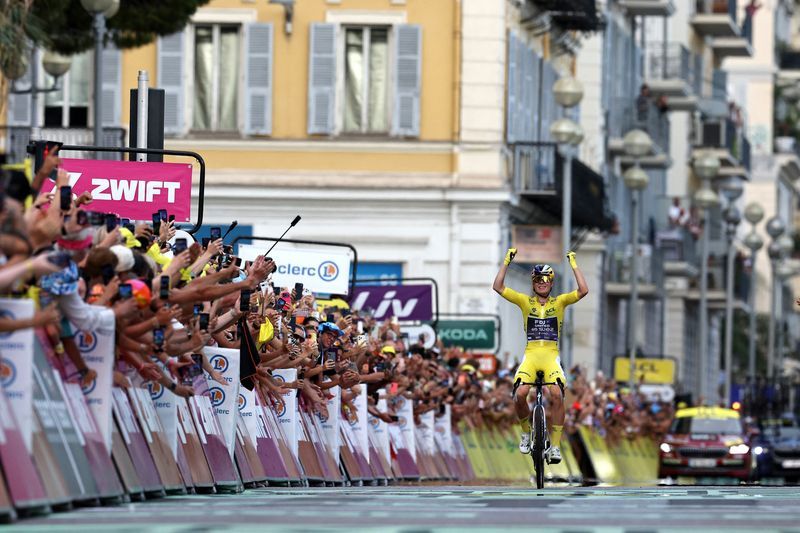
Demi Vollering of the Netherlands has added another significant chapter to her cycling legacy, capturing her second Tour de France Femmes title on Sunday with a decisive victory on the race's concluding stage near Nice. The 29-year-old FDJ-Suez cyclist demonstrated why she ranks among the sport's elite competitors today, executing a perfectly-timed attack on the race's final mountain climb to seal a commanding victory that reflected her dominance throughout the three-week competition.
Vollering's achievement caps a remarkable period of success that has established her as one of professional cycling's most consistent and accomplished performers. Beyond her Tour de France triumphs, the Dutch champion won the 2026 Giro d'Italia Women and claimed back-to-back victories in La Vuelta Femenina in 2024 and 2025, underlining her ability to perform at the sport's highest level across multiple grand tours. Her progression from her first Tour victory in 2023 to this second title demonstrates sustained excellence at an age when cyclists are typically operating at peak capability.
Entering the final 99.2-kilometre stage, Vollering carried a slender eight-second advantage over Poland's Katarzyna Niewiadoma-Phinney, the previous day's yellow jersey wearer. This slim margin meant the conclusion remained theoretically competitive, though Vollering's superior climbing ability and tactical positioning suggested she possessed the tools to defend her position. The stage route, finishing in Nice with multiple ascents of the Col d'Eze, offered multiple opportunities for the race to be decided on the road rather than through time calculations.
The decisive moment arrived during the fourth and final climb of the Col d'Eze, where Vollering launched a powerful attack that immediately distanced Niewiadoma-Phinney. Rather than engage in a potentially exhausting chase, the Polish-Canadian cyclist conceded the stage and allowed the Dutchwoman to extend her advantage decisively. Vollering's solo victory on this crucial climb secured not only the final stage but also the overall title, finishing one minute and eighteen seconds ahead of Niewiadoma-Phinney in the general classification. Italy's Elisa Longo Borghini rounded out the podium in third place, completing a competitive yet ultimately clear-cut conclusion.
In the stage itself, Spain's Paula Blasi finished second, trailing Vollering by just over a minute, with Niewiadoma-Phinney claiming third place honours. This strong finish by Blasi demonstrated the depth of talent in women's professional cycling today, though it proved insufficient to challenge Vollering's dominance. The victory marked Vollering's third stage win at this year's Tour de France Femmes and her sixth stage victory across all editions of the race, statistics that further underline her consistency on cycling's biggest women's stage.
Vollering's post-race reflections revealed the emotional significance of winning whilst wearing the yellow jersey. The cyclist acknowledged the historical weight of competing for cycling's most prestigious women's title, noting that she had never previously won a Tour de France while holding the yellow jersey. Her thoughts extended beyond personal achievement to encompass her support network, particularly mentioning teammate Celia Gery, who had experienced difficult circumstances during the race. This team-oriented perspective reflected the collective effort required to sustain a competitor through three demanding weeks of professional racing.
The Dutch cyclist's broader reflection on her achievement transcended the immediate victory, framing her success within the context of personal aspiration and shared endeavour. Vollering spoke of the importance of team cohesion and the collective passion required to deliver success at grand tour level. Her emphasis on approaching the victory "with humility and with pride" suggested a measured perspective on achievement, acknowledging both the privilege of competing at this level and the responsibility accompanying such prominence.
Vollering's tactical execution on the final climb demonstrated the attacking instinct she identified in her post-race commentary. Rather than simply managing her lead defensively, she chose to initiate the decisive move herself, forcing Niewiadoma-Phinney to respond to superior acceleration. This aggressive approach transformed a narrow advantage into a commanding margin and provided clear confirmation of the strongest competitor across the three-week competition.
The women's Tour de France Femmes continues to establish itself as a marquee event in professional cycling, attracting the sport's finest female competitors and generating compelling narratives around performance and achievement. Vollering's second title positions her alongside the sport's elite champions and establishes the Dutch cyclist as the definitive figure in contemporary women's grand tour racing. Her sustained success across multiple grand tours demonstrates consistency that transcends the variation in course design, elevation profiles, and competitive fields across different events.
Vollering's achievements arrive during a period of significant momentum in women's professional cycling, characterised by increased investment, media attention, and competitive depth. Her success contributes to the sport's growing profile and provides inspiration for emerging female cyclists aspiring to reach the sport's highest echelons. The Dutch champion's combination of tactical intelligence, climbing ability, and mental resilience offers a template for sustained excellence across demanding multi-week competitions.
For Malaysian and Southeast Asian cycling enthusiasts, Vollering's dominance underscores the global competitive standards now operating in professional cycling and the gap between elite European competitors and developing cycling nations. The sport's concentration of resources, infrastructure, and competitive opportunity remains heavily weighted toward Europe, particularly the Alpine and Pyrenean regions that provide natural training grounds for climbers. Vollering's sustained excellence reflects not only individual capability but also access to the professional infrastructure and support systems that European cycling provides.
The Dutch cyclist's second Tour victory establishes a benchmark for female cycling excellence whilst simultaneously raising questions about competitive balance within the sport. Niewiadoma-Phinney's consistent performances suggest a two-woman dynamic may characterise the next cycling season, though the depth of talent demonstrated by Longo Borghini and Blasi indicates that future editions could yet deliver more unpredictable competition. Vollering's achievement nonetheless represents a significant milestone in her career and contributes another chapter to the evolving history of professional women's cycling.

