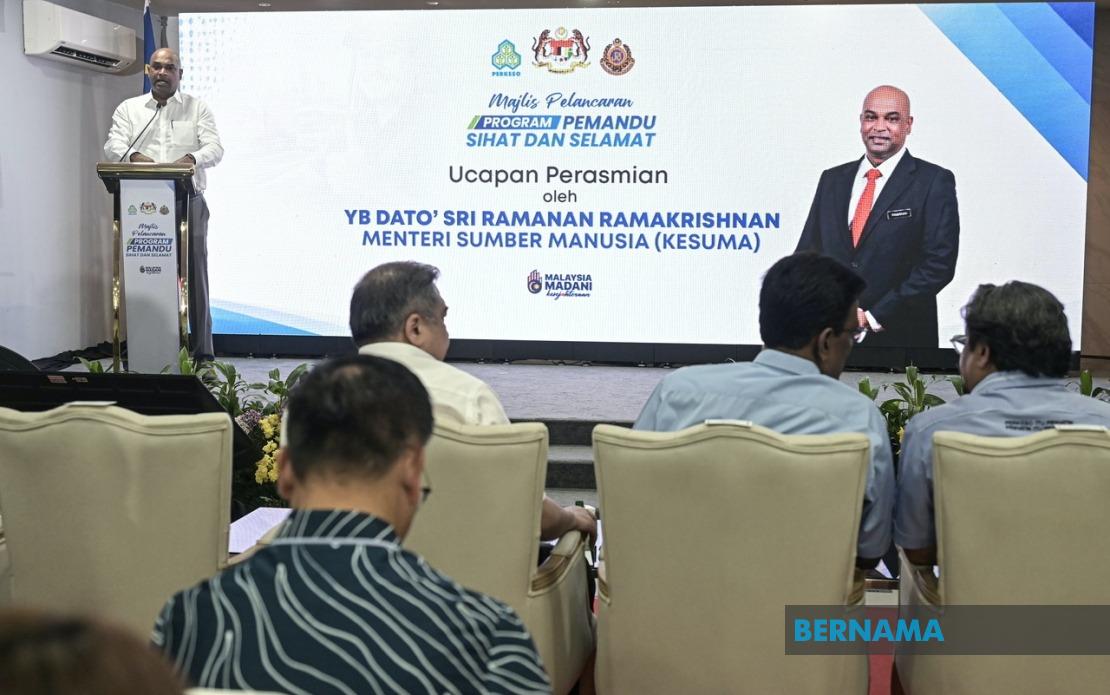
Professional drivers in Malaysia seeking to renew their vocational driving licences must now complete a comprehensive health screening programme as part of a fresh government initiative aimed at strengthening road safety and protecting worker welfare. Human Resources Minister Datuk Seri R. Ramanan announced the launch of the Healthy and Safe Driver Programme (PSS) on June 30, marking a significant shift in how the country evaluates the fitness of commercial drivers before allowing them to continue operating on the roads.
The screening protocol encompasses a broad range of medical assessments designed to identify health conditions that could compromise driving safety. Drivers will undergo standard physical examinations alongside specialised testing for vision and hearing acuity, both critical sensory functions for safe vehicle operation. The programme also screens for sleep disorders, particularly obstructive sleep apnea, a condition that has gained increasing attention among occupational health specialists as a significant risk factor in transport accidents. Beyond these checks, the assessment evaluates core bodily systems including cardiovascular health, respiratory function, and neurological status. For eligible drivers, the screening includes glycated haemoglobin blood tests to monitor long-term glucose control, particularly relevant given rising diabetes prevalence among working populations in the region.
Ramanan framed the initiative not as an administrative burden but as a proactive health intervention mechanism. By detecting medical conditions early through systematic screening, the government aims to facilitate timely treatment and prevent deterioration that could render drivers unsafe on the road. This preventive approach reflects a growing international emphasis on occupational health surveillance, particularly in sectors where worker fitness directly impacts public safety.
The financial structure of the programme reveals considerable government commitment to accessibility. Drivers pay only RM30 for the entire screening process, while the Social Security Organisation (Socso) absorbs the remaining RM55 in costs, effectively subsidising approximately 65 percent of the expense. This cost-sharing arrangement removes a significant barrier to participation that might otherwise discourage licence renewal, particularly among lower-income drivers who form a substantial proportion of Malaysia's commercial transport workforce.
The initial network of 500 participating panel clinics provides geographical coverage across the country, though the ministry has signalled ambitions for substantial expansion. Ramanan indicated that the programme will eventually extend to 3,000 panel clinics nationwide, a sixfold increase that would dramatically improve accessibility for drivers in remote and rural areas. This expansion timeline suggests a phased rollout approach, allowing health facilities time to develop capacity and train personnel in the screening protocols.
The collaborative framework underpinning the PSS demonstrates institutional coordination across transport and labour portfolios. Both the Ministry of Human Resources and the Ministry of Transport have endorsed the initiative, acknowledging that road safety transcends narrow sectoral interests and directly affects worker protection. Professional drivers, whose occupations require extended hours navigating challenging conditions, represent a vulnerable worker category whose health and safety deserve enhanced attention.
Statistical evidence supported the case for intervention. The ministry reported that 115 workers died in road accidents during 2025, an increase from 94 fatalities in the previous year, signalling a troubling upward trajectory. This aggregate figure encompasses diverse occupational groups depending on road transport for livelihood, including lorry drivers, bus operators, van drivers, car drivers, and motorcyclists. The breakdown revealed particular concentration among commercial truck operators, where 62 fatalities occurred—representing 21 percent of total work-related road deaths. This disproportionate impact on lorry drivers likely reflects the combination of long driving hours, heavy vehicle operation, exposure to fatigue, and economic pressure to meet tight delivery schedules.
For Malaysian readers, the PSS programme carries several layers of significance. It represents tangible government action on occupational health, addressing a sector that has historically received insufficient regulatory attention despite transport workers' centrality to the economy. The affordable access point—RM30 per screening—positions the initiative as inclusive, avoiding regressive cost structures that might penalise lower-earning drivers. The programme's emphasis on sleep disorders and metabolic screening reflects evidence-based occupational health practice, recognising that conditions like sleep apnea, which are prevalent but often undiagnosed in working populations, directly contribute to accidents.
From a regional perspective, Malaysia's approach aligns with emerging best practices in Southeast Asia regarding occupational health integration into regulatory frameworks. Singapore and Thailand have implemented comparable driver health screening programmes, though Malaysia's subsidised model demonstrates a more aggressive approach to removing financial barriers. The scale of planned expansion suggests genuine institutional commitment rather than pilot programme rhetoric.
The initiative also carries implications for insurance and liability frameworks. As documented health screening becomes routine, insurance companies gain better baseline health information, potentially enabling more refined risk assessment and premium structures. Simultaneously, drivers have formal health records demonstrating fitness for duty, which could support their position in accident litigation or workers' compensation claims.
Implementation challenges will inevitably emerge as the programme scales. Training sufficient clinic staff to conduct standardised screening, maintaining quality across 3,000 facilities, and managing the administrative burden of processing hundreds of thousands of renewal applications annually require robust backend systems. The success of the PSS will depend substantially on clinic compliance with screening protocols and government capacity to enforce consistent standards across the network.
The programme positions health screening as an integral component of professional driver licensing rather than an optional wellness initiative. This regulatory embedding signals that occupational fitness standards, not merely legal and vehicle compliance, define road safety qualifications. For drivers, this represents a recalibration of professional responsibility, embedding personal health monitoring into the cost of continuing to work in transport sectors. As rollout proceeds, outcomes data—particularly whether screened drivers show reduced accident rates—will determine whether the PSS becomes a model for other occupational safety regulations.

