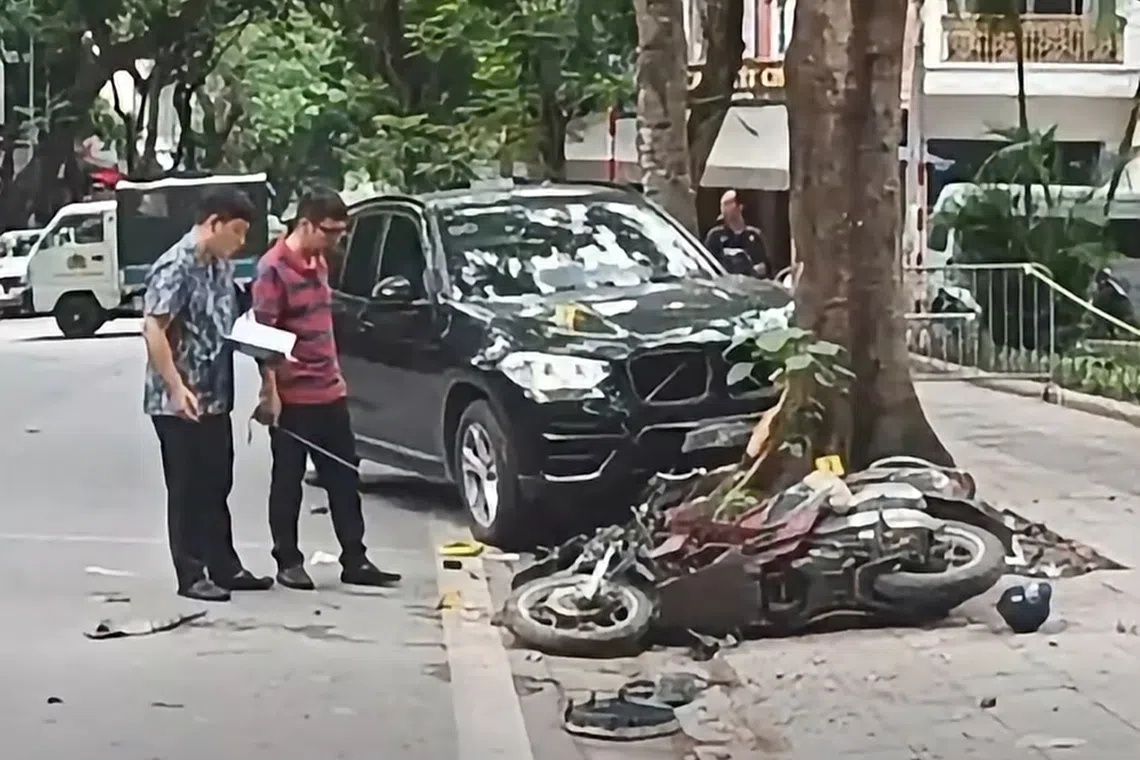
A rare six-minute television report on state broadcaster Vietnam Television (VTV) this week finally broke more than a year of silence surrounding the fatal collision that claimed the life of eighteen-year-old Do Ngoc Phuong Thuy, signalling how Vietnam's youth have successfully pressured authorities to explain a tragedy that had mysteriously vanished from public discourse. The case has become emblematic of broader frustrations among Generation Z regarding accountability and transparency, with young Vietnamese taking to multiple online platforms to demand justice despite facing potential government warnings about social unrest.
On May 30, 2025, the accident occurred in Hanoi when former National Assembly deputy Nguyen Sy Cuong, aged 64, lost control of his luxury BMW sedan, which crossed into the oncoming lane at high speed and collided head-on with a motorcycle carrying Do Ngoc Phuong Thuy and her father. The impact was catastrophic, severing the teenager's right leg and causing massive blood loss. She was rushed to hospital but succumbed to her injuries just ten days later, mere days before she was scheduled to sit her high school graduation examinations—a milestone her family would never see her reach.
What distinguishes this case from Vietnam's sobering annual toll of over 10,000 traffic fatalities is the involvement of a politically connected figure and the subsequent information blackout imposed by authorities. After a single media mention on May 31, the incident essentially disappeared from domestic news coverage, leaving the victim's family and the public in the dark about investigative findings or legal proceedings. This prolonged silence proved to be a critical miscalculation by officials, as it ultimately transformed a single tragedy into a symbol of systemic opacity that galvanised an entire generation.
More than a year after the collision, a grassroots social media movement erupted across multiple platforms, with millions of posts using hashtags such as #NguyenSyCuong and #BMW circulating among Vietnamese netizens, particularly those identifying as Generation Z or people in their late teens and twenties. Young people, many wearing masks to protect their identities, began laying flowers at the accident site—a location that quickly acquired coordinates on Google Maps and earned the symbolic designation "the Justice Tree." When authorities removed physical tributes, activists created a virtual memorial that accumulated hundreds of thousands of digital tributes, demonstrating the movement's resilience and sophistication in circumventing suppression attempts.
According to social activist and blogger Nguyen Hoang Vi, the campaign's emotional resonance stems from the victim's age and relatability. "The victim was an 18-year-old girl, a peer to many of the young people speaking out. This naturally fosters deep empathy, as they can easily put themselves in her shoes," she explained. Beyond emotional connection, however, observers point to a fundamental shift in how Vietnamese youth view institutional accountability. The prolonged absence of information became the breaking point, transforming frustration into action that circumvented traditional media gatekeeping through distributed social networking.
Lawyer Tran Dai Lam from Hanoi's ANVI law firm highlighted the structural problem underlying the government's approach: "An incident would not simply disappear just because it has dropped out of mainstream media while questions remain about it. The story can resurface very quickly at the slightest new detail or mention." This observation proved prescient, as the accumulated pressure from online activism eventually compelled official acknowledgment through the VTV broadcast, though the state framed the campaign itself as potentially dangerous.
The state broadcaster's report cited police and prosecution sources claiming that Nguyen Sy Cuong "sincerely confessed and actively and fully remedied the consequences of his actions," leading the victim's family to decline pressing criminal charges. Do Viet Hung, Do Ngoc Phuong Thuy's father, appeared on the programme to express gratitude for public sympathy while simultaneously requesting privacy for his family's grief and recovery. The official explanation effectively closed the investigative chapter, yet multiple indicators suggest this resolution may not satisfy the demands emerging from social media discourse.
Lawyer Tran Dai Lam expressed significant reservations about the adequacy of VTV's report, noting that while the broadcast addressed some legal technicalities, "I doubt this will fully put Gen Z at ease. The issue lies not only in the conclusion itself but also in the information vacuum that persisted for over a year." He emphasised that this generation expects granular transparency: specific legislative references, detailed decision-making processes, and explicit justifications rather than generic assurances about lawful conduct. Such demands reflect a generational expectation for institutional accountability that contrasts sharply with previous periods when deference to official narratives prevailed.
The government's response to the campaign reveals official anxieties about youth mobilisation and the destabilising potential of coordinated digital activism. Police statements quoted in the VTV report alleged that "hostile forces, reactionaries and bad actors" had exploited the tragedy to "incite unrest and cause disorder," invoking language typically reserved for subversive activities. Meanwhile, pro-government online influencers circulated warnings about "colour revolutions" and referenced instability in Bangladesh, attempting to reframe the memorial campaign as part of a broader destabilisation strategy rather than legitimate civic grievance.
Despite official efforts at containment, flowers continued appearing at the virtual Justice Tree following VTV's broadcast, though in diminished quantities. More significantly, numerous netizens published critical responses to the official explanation online, indicating that state media intervention alone will not resolve underlying tensions between youth expectations and institutional transparency. This sustained scepticism suggests that the campaign has fundamentally altered how Vietnamese Gen Z engages with official narratives, introducing greater demand for documentary evidence and logical consistency.
For activist Nguyen Hoang Vi, the movement has prompted personal reflection about generational stereotypes. She acknowledged previously dismissing Gen Z as self-indulgent and disengaged, but the campaign demonstrated that "Gen Z is not truly indifferent to society. Rather, they engage with issues in a way that differs vastly from my own generation." This observation carries implications beyond this single case, suggesting that Vietnamese youth possess distinct civic sensibilities that prioritise transparency, peer solidarity, and distributed resistance to institutional opacity—approaches that older generations may not immediately recognise as politically engaged.
The campaign's significance extends beyond Vietnam's borders, offering Southeast Asian policymakers a cautionary case study about how information vacuums combined with generational expectations for transparency can produce unexpected mobilisation through social media. As digital natives increasingly comprise crucial demographic segments throughout the region, governments managing high-profile cases involving influential figures face mounting pressure to provide timely, detailed explanations rather than strategic silence. Vietnam's experience suggests that opacity may temporarily obscure incidents from mainstream media but cannot prevent their resurrection through coordinated online activism, particularly when victims embody the demographic concerns of mobilised youth audiences demanding accountability from institutions they increasingly view with scepticism.

