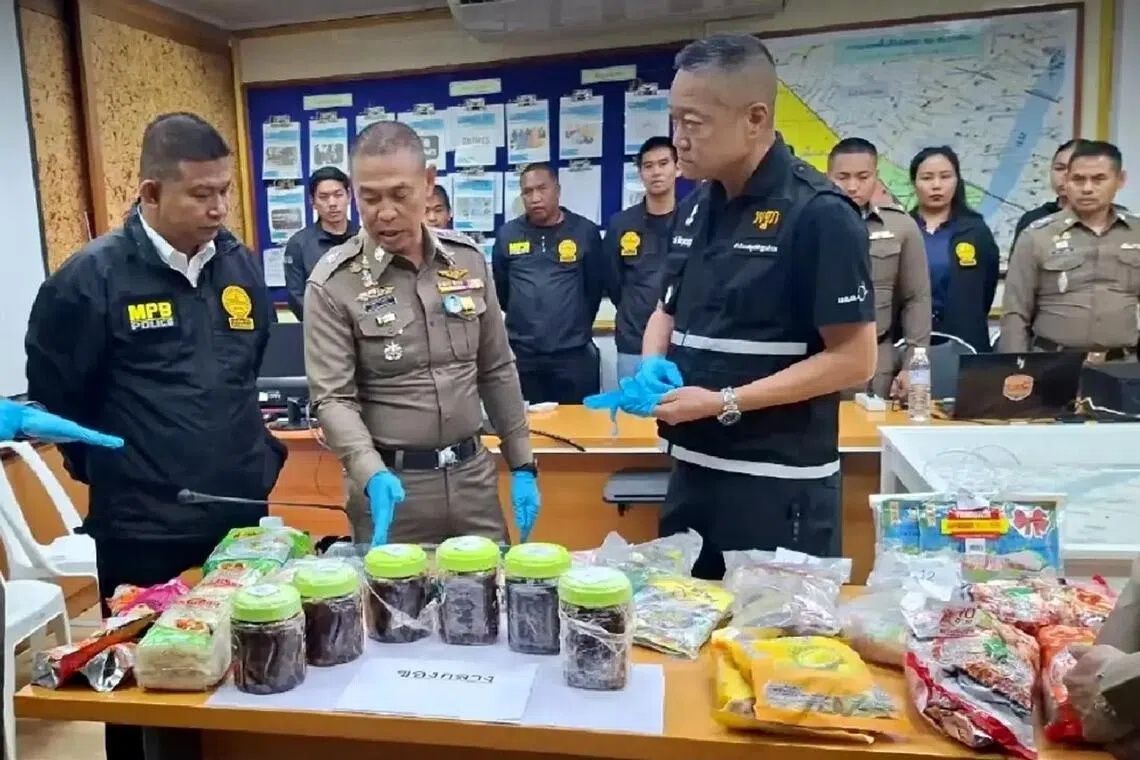
Bangkok police have dismantled a transnational drug trafficking scheme that exploited Thailand's position as a regional transit hub to move crystal methamphetamine to Japan. The operation, led by individuals based in Vietnam, involved hiding more than 2kg of the drug—commonly known as ice—inside jars of tamarind paste destined for Tokyo. Police lieutenant-general Siam Boonsom, the Metropolitan Police Bureau commissioner, disclosed the investigation's findings on July 17, alongside major general Chaiya Phetpanya from Metropolitan Police Division 7 and officers from Bang Yi Khan Police Station.
The breakthrough came through an unexpected channel: a courier hired to transport the goods became suspicious of the shipment's weight and alerted authorities on July 13. When investigators examined the jars, they discovered six foil-wrapped packages containing the crystalline substance, representing a significant narcotics seizure. The discovery followed the arrest of Sompong, a Thai national whose involvement in the network eventually led police to unravel the broader trafficking infrastructure. This case exemplifies a troubling trend across Southeast Asia where legitimate food products serve as concealment for illegal substances, exploiting the vast volume of regional commerce to slip drugs past customs screenings.
The network's operational structure reveals considerable sophistication in evading law enforcement detection. Vietnamese nationals based in Hanoi directed the enterprise, using anonymous Facebook accounts to recruit motorbike delivery riders throughout Thailand. These riders were tasked with collecting packages from residences occupied by Vietnamese expatriates and delivering them to Thai couriers who had been separately hired for international transport. By compartmentalizing the operation into distinct phases—recruitment, collection, handoff, and overseas delivery—the organisers created multiple buffer layers designed to obscure any direct connection between the command structure and the final shipment. This approach reflects lessons learned from previous enforcement actions and demonstrates how trafficking networks continuously adapt their methods.
Financial tracking proved instrumental in exposing the scheme's architecture. All payments, expenses, and operational costs flowed through a bank account registered to Sompong, the arrested Thai suspect. Vietnamese nationals working for the network made regular cash withdrawals ranging from 20,000 to 50,000 baht, then departed Thailand shortly after each transaction. Police believe this rotating pattern of withdrawals and departures was deliberate, designed to minimize the likelihood of any single individual being arrested and to complicate the financial audit trail that investigators typically follow. The strategy underscores how modern smuggling operations blend traditional cash-handling methods with digital money movement to frustrate law enforcement's investigative tools.
The investigation has expanded considerably beyond the initial arrest. Warrants have been issued for four individuals: Sompong and three Vietnamese nationals suspected of roles including money withdrawal, social media account management, and operational coordination. Police believe at least four additional people participated in the scheme, suggesting the network possessed considerable human resources. Sompong has contested his involvement, though the accumulating evidence—bank account access, courier testimonies, and communications records—presents significant challenges to his defence. Investigators are also scrutinizing the role of Sompong's girlfriend, who has not been named in warrants but may have possessed knowledge of the operation's activities.
Thailand's vulnerability as a transit corridor for Asian drug trafficking reflects broader regional realities. The country's geographic position, extensive transportation infrastructure, and significant expatriate Vietnamese community create conditions favourable to transnational criminal enterprises. Law enforcement agencies across Southeast Asia have reported increasing sophistication among trafficking networks operating through the region. The use of everyday products like tamarind paste—inexpensive, heavy enough to mask narcotics' weight, and commonly exported to Japanese markets—demonstrates how criminals conduct market research to identify ideal concealment methods. This particular technique likely emerged from experience with previous successful shipments or intelligence gathered through criminal networks.
The implications for Malaysia are considerable. As another major transit hub and regional trade centre, Malaysia faces similar vulnerabilities to drug trafficking operations exploiting commercial channels. The Vietnamese network's use of social media recruitment and compartmentalized operational cells represents tactics that could easily migrate to Malaysian trafficking networks. The involvement of willing couriers—individuals aware of potential illegality but motivated by financial incentives—identifies a persistent vulnerability in regional enforcement. Malaysian authorities may need to enhance cooperation with Thai and Japanese counterparts to identify whether similar networks have attempted to establish operations within Malaysian territory or used Malaysian routes and ports.
International cooperation proved essential to this investigation's success, with Thai police coordinating intelligence that ultimately identified the Vietnamese organisational structure. The case demonstrates why bilateral and multilateral arrangements for combating drug trafficking require sustained commitment. The ASEAN framework for drug enforcement, while useful, sometimes lacks the resource coordination and real-time intelligence sharing necessary to dismantle sophisticated networks. Japan's participation in the investigation chain—as the intended destination market—highlights how Southeast Asian drug enforcement must integrate with downstream enforcement in consumer nations.
The investigation also illuminates the role of unwitting participants in trafficking schemes. The courier who ultimately reported the suspicious jars may have been recruited without full knowledge of the shipment's contents, a common practice among trafficking networks seeking to manage liability and maintain operational security. This dynamic creates challenges for law enforcement, as distinguishing between truly innocent transporters and knowing participants requires intensive investigation. For Malaysia and the broader region, the case serves as a reminder that drug trafficking increasingly employs layers of insulation and exploitation to protect core organisational leadership while distributing risk among lower-level participants and front companies.

