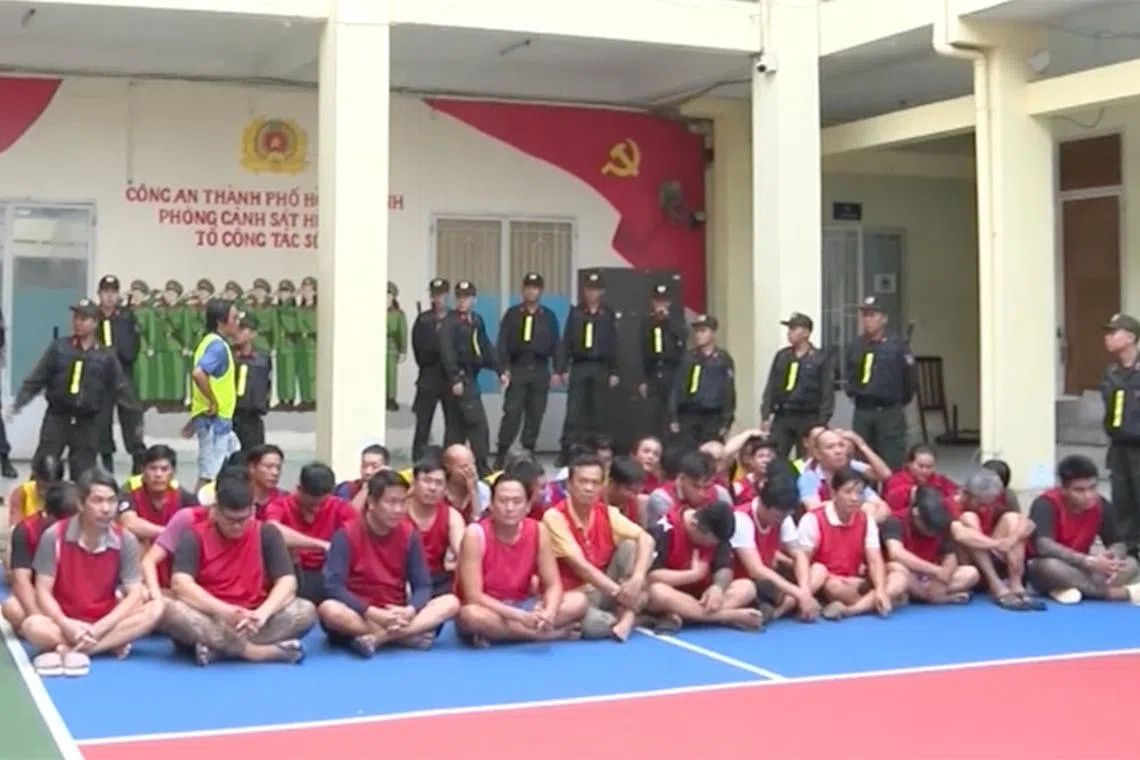
Vietnamese authorities have delivered a significant blow to the country's underground gambling ecosystem, announcing the arrest of 85 people involved in two exceptionally large-scale betting operations that collectively processed US$133 million in illegal wagers. The enforcement action, revealed on Tuesday following raids in late June, represents part of a broader government offensive against illicit sports betting that has intensified during the World Cup period, highlighting the persistent challenge posed by organised gambling networks in Southeast Asia.
The two dismantled rings operated with remarkable sophistication and structural complexity, according to police statements from Ho Chi Minh City. Investigators documented what they characterised as an exceptionally high level of operational hierarchy and centralised control, suggesting these were not loosely organised street-level gambling dens but rather meticulously coordinated enterprises with distinct management tiers and accountability structures. Since October 2025, the combined networks had facilitated an estimated US$133 million in illegal betting transactions, though authorities acknowledge the actual scale may be substantially larger given the clandestine nature of such operations and typical difficulties in quantifying underground financial flows.
Intelligence gathered during the investigation revealed a transnational dimension to the betting rings that underscores the regional interconnectedness of Southeast Asia's gambling underworld. Leadership figures within the syndicates confessed to obtaining what they termed "master-level betting accounts" originating from Cambodia, which they subsequently subdivided into numerous tiers of agent and member accounts for distribution to individual gamblers. This hierarchical distribution model transformed the Cambodian accounts into revenue-generating networks spanning Vietnam's population, demonstrating how porous borders and the digital nature of modern betting operations enable criminal syndicates to coordinate illegal activities across national boundaries with minimal friction.
The scale of Vietnam's broader enforcement response extends well beyond these two major operations. The public security ministry disclosed that across the entire country during the first three weeks of the World Cup period, police had dismantled 73 separate gambling operations and arrested 346 individuals implicated in illegal sports betting and football wagering. Colonel Bui Tuan Anh of the public security ministry characterised the financial magnitude of these confiscated operations as totalling thousands of billions of Vietnamese dong, equivalent to hundreds of millions of dollars in aggregate transaction volume. These figures illustrate the staggering economic scale at which illegal gambling persists in Vietnam despite ongoing prohibition and periodic enforcement campaigns.
The persistence and apparent growth of underground betting operations reflect fundamental structural factors within Vietnamese society and broader regional dynamics. Online gambling remains completely prohibited under Vietnamese law, a blanket ban rooted in the communist government's concerns about moral hazard, social disruption, and the financing of criminal organisations. Yet this prohibition has not eliminated gambling demand; instead, it has channelled enormous sums into unregulated, untaxed criminal networks that operate with minimal financial accountability and can finance additional illicit activities. The sophistication evident in these recent busts—including international account structures and multi-tier distribution networks—suggests that organised crime groups have substantially professionalised their gambling operations in recent years.
The timing and intensity of enforcement crackdowns around major sporting events like the World Cup reveal something crucial about how Vietnamese authorities approach illegal gambling. Rather than attempting sustained year-round suppression of betting networks, which would require enormous resources and political will, the government concentrates its enforcement capacity during periods when gambling activity predictably surges and financial flows become exponentially larger. World Cup tournaments particularly activate underground betting markets because football commands global attention, generates massive legitimate betting volumes in jurisdictions where gambling is legal, and creates psychological momentum that encourages even cautious bettors to place wagers they might otherwise avoid.
For Malaysian observers, Vietnam's experience offers instructive parallels and contrasts. Malaysia maintains legal gambling frameworks through licensed operators such as Sports Toto and licensed casinos, creating a regulated alternative that theoretically should reduce pressure on underground networks. However, illegal betting operations persist even in Malaysia's more permissive environment, suggesting that unregulated operations offer certain advantages—whether lower odds margins, credit facilities, or simply the appeal of avoiding tax liability—that continue to attract participants even where legal alternatives exist. Vietnam's stricter prohibition stance has not proven more effective at elimination; instead, it has arguably created richer profit margins for criminal operators, since the absence of legal competition means underground syndicates face no legitimate price pressure.
The international dimension highlighted by the Cambodia connection also reflects broader Southeast Asian realities that extend beyond Vietnam. Cambodia has become a significant hub for underground gambling operations partly because its regulatory environment is more permissive than Vietnam's, making it a natural source for the master accounts that Vietnamese syndicates distribute downward. Similar patterns likely exist elsewhere in the region, with Thailand, Myanmar, and Laos potentially serving comparable intermediary roles in cross-border gambling networks. This regional dimension suggests that effective enforcement requires cooperative intelligence-sharing and coordinated prosecution strategies, areas where Southeast Asian nations have historically struggled due to varying legal frameworks and inconsistent political will.
The economic dimensions of underground gambling operations deserve particular attention from policymakers across Southeast Asia. The US$133 million processed by these two Vietnamese rings during a relatively brief operational window represents capital that circulates entirely outside the formal economy, generating no tax revenue, creating no legitimate employment, and instead financing criminal enterprise and potentially other illicit activities. Multiplied across the entire region and across all clandestine gambling operations, these figures suggest that hundreds of millions or even billions of dollars annually flow through underground betting networks in Southeast Asia alone. This capital leakage represents opportunity costs for governments and contributes to the financing of broader criminal ecosystems.
Looking forward, Vietnam's enforcement approach faces a fundamental strategic challenge that applies equally to other Southeast Asian nations confronting similar gambling problems. Periodically dismantling large operations, while generating impressive statistics for reporting purposes, does not address underlying demand factors or the superior profitability margins that make illegal betting operations attractive to criminal entrepreneurs. Until governments either substantially increase the costs and risks associated with operating illegal gambling networks or create legal alternatives that satisfy consumer demand at competitive price points, underground operations will continue reforming and reorganising after enforcement actions. The question for Vietnamese policymakers, and for the broader Southeast Asian region, is whether prohibition combined with periodic enforcement represents a sustainable long-term strategy or whether more fundamental regulatory rethinking might ultimately prove more effective.

