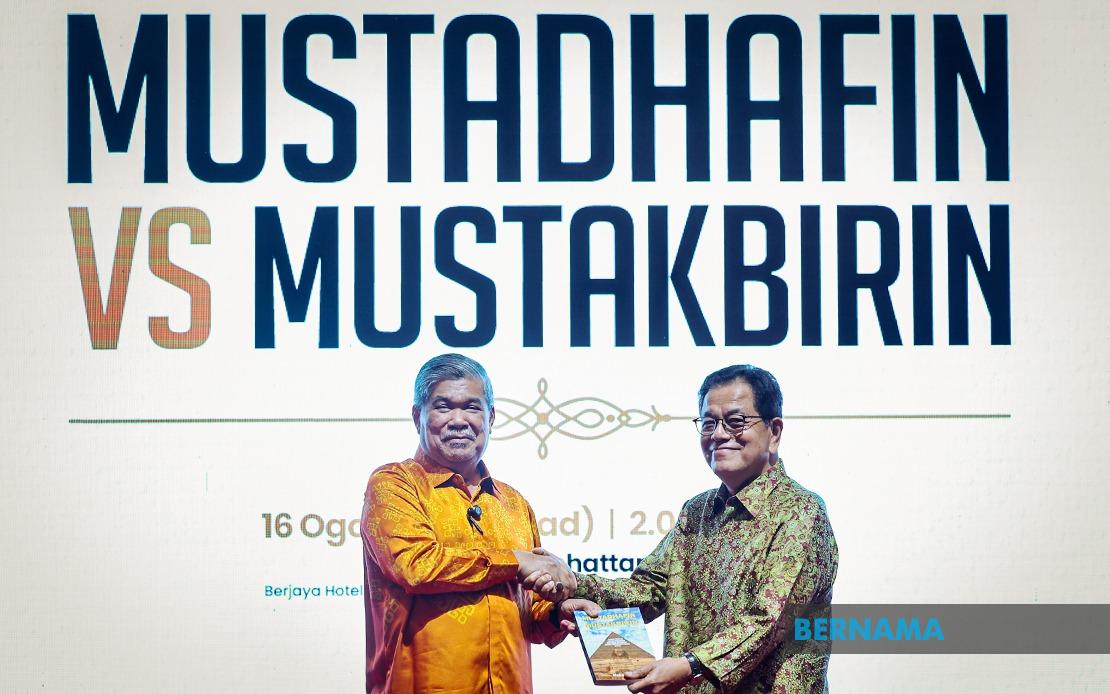
Datuk Seri Mohamad Sabu has issued a pointed warning to Malaysians about the dangers of accepting political allegations without proper verification, urging the public to adopt a more critical approach to information they encounter, particularly in an environment saturated with claims and counterclaims. The Amanah president made the remarks during the launch of his book in Kuala Lumpur, emphasising that uncritical acceptance of unverified claims feeds into what he called 'asabiyyah'—a psychological tendency to defend one's own group while simultaneously judging the actions of rival groups with harshness and suspicion.
The Agriculture and Food Security Minister stressed that this pattern of thinking, deeply rooted in human nature, has become increasingly prevalent in Malaysian politics and public discourse, particularly when divisive topics are involved. He argued that citizens bear a responsibility to move beyond passive consumption of information and instead engage in active fact-checking before forming opinions or taking public positions on contentious issues. This distinction between blind acceptance and informed assessment, he suggested, is fundamental to building a more rational and just society.
In addressing the mechanics of how misinformation spreads, Mohamad Sabu highlighted a troubling asymmetry in modern communication: accusations and suspicions travel far more rapidly and gain traction more easily than verifiable facts and substantive knowledge. This phenomenon has been particularly pronounced since the rise of social media platforms, where emotionally charged claims can reach millions within hours, while the slower process of fact-checking and contextualisation often fails to catch up. The speed and virality of unsubstantiated allegations mean that false narratives frequently become embedded in public consciousness before corrections can be made.
He illustrated his point by reference to recurring allegations in Malaysian politics, specifically citing longstanding claims that the Democratic Action Party is a communist organisation and that any political cooperation with the party therefore constitutes support for communism. Rather than simply dismissing such claims outright, Mohamad Sabu posed a direct question to the public: whether these assertions hold up under actual scrutiny and evidence-based examination. The implication is clear—that many Malaysians accept these talking points without having independently verified their accuracy or considered counterarguments.
The book launch, attended by National Journalism Laureate Tan Sri Johan Jaaffar, who also serves as a director of Star Media Group Berhad, provided Mohamad Sabu with a platform to discuss his personal methodology for approaching contentious political and geopolitical questions. He revealed that from his younger years, he made a deliberate choice not to accept information passively, instead preferring to investigate matters directly and form his own conclusions rather than becoming a conduit for propaganda circulating in his community or political circles.
This autobiographical foundation shapes the content of his book, which documents his experiences engaging with diverse political actors and studying contemporary issues by examining ground realities rather than relying solely on partisan narratives. By maintaining this investigative approach throughout his political career, Mohamad Sabu suggests he has been able to develop perspectives less clouded by partisan allegiance or sectarian loyalty. The book thus represents not merely a political memoir but an argument for epistemological rigor in public life.
Beyond domestic Malaysian politics, the book also ventures into broader geopolitical terrain, drawing on Mohamad Sabu's observations and reflections on global power dynamics and international relations. He explores themes including the legacies of colonialism, the evolution and influence of Islamic movements, the Israeli-Palestinian conflict, and the shifting balance of power among major global actors. These international dimensions appear designed to contextualise Malaysian political developments within a wider framework of global historical forces and contemporary geopolitical competition.
The timing of these remarks is significant given Malaysia's ongoing political volatility and the persistence of partisan narratives that often lack empirical foundation. Since the 2022 general election, Malaysian political discourse has been marked by frequent accusations and counter-accusations among competing coalitions, many of which circulate widely without undergoing rigorous fact-checking. The proliferation of such claims has contributed to deepening polarisation and declining public trust in political institutions, even as citizens struggle to distinguish reliable information from speculation.
Moreover, the phenomenon that Mohamad Sabu identifies resonates particularly strongly in the Southeast Asian context, where social media penetration is high but media literacy remains uneven across different demographic groups. Countries throughout the region have experienced the destabilising effects of viral misinformation campaigns that exploit existing social and political divisions. Malaysia, with its multicommunal and multi-religious composition, faces particular vulnerabilities to claims designed to inflame tensions along ethnic or religious lines, making the cultivation of critical information consumption habits a matter of national consequence.
The appeal for greater intellectual discipline in assessing political claims also carries implications for how opposition voices can challenge incumbent authorities. When public discourse is dominated by unverified allegations, the distinction between legitimate criticism and baseless attacks becomes blurred, potentially delegitimising genuine concerns about government performance or policy. This dynamic benefits those in power, who can dismiss all criticism as mere propaganda while critics lose credibility through association with more dubious claims circulating within their broader movement.
Moving forward, the challenge for Malaysian society lies in developing institutional and social mechanisms to encourage the kind of careful verification that Mohamad Sabu advocates. This requires not only individual media literacy but also strengthened journalism institutions capable of conducting investigative reporting that reaches mass audiences, education systems that teach critical thinking skills, and political leadership that models intellectual honesty rather than reflexive partisanship. Without such systemic support, individual exhortations to think critically will have limited impact against the powerful incentives driving the spread of divisive allegations.

