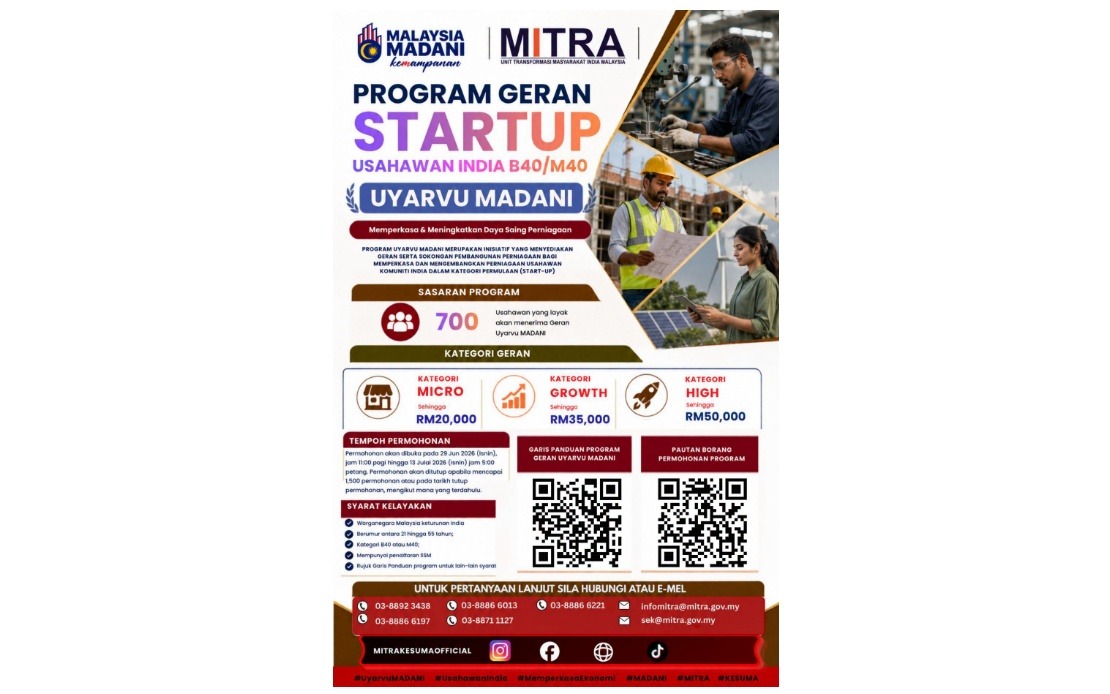
The Malaysian Indian Transformation Unit (MITRA) has opened applications for the Startup Accelerator Grant Assistance Programme, known as Uyarvu MADANI, with the application window running from today through July 13 at 5 pm. This initiative represents a targeted effort to support entrepreneurship within Malaysia's Indian community and address economic inequality within the demographic.
The programme specifically targets entrepreneurs from the Indian community who fall within the B40 and M40 income classifications, making it an explicitly inclusive initiative designed to support those with limited access to conventional financing channels. Eligible applicants can receive grants ranging from RM20,000 to RM50,000, amounts calibrated to provide meaningful capital for business establishment or expansion without creating dependency on government support. The financial thresholds reflect a recognition that startup costs vary considerably across different business sectors and scales of operation.
MITRA has set an ambitious target of disbursing grants to 700 entrepreneurs through this scheme, representing a substantial government commitment to developing entrepreneurial capacity within the Indian community. Beyond the direct financial assistance, successful applicants will gain access to business development support services, addressing a critical gap that many first-time entrepreneurs face. This holistic approach—combining capital with technical expertise—increases the likelihood of sustainable business success and long-term economic contribution from recipients.
The application intake mechanism includes an early closure provision, designed to manage administrative workload and ensure prompt processing of applications. Should the programme receive 1,500 applications before the July 13 deadline, the intake will close immediately rather than continuing to the stated deadline. This contingency reflects expectations of strong demand and enables MITRA to begin processing and assessing applications more rapidly, potentially accelerating the disbursement timeline for successful applicants who submit early.
Uyarvu MADANI functions as one component of a broader institutional expansion at MITRA for 2026. The unit is introducing six new initiatives simultaneously, backed by a combined allocation of RM65.5 million. This substantial funding commitment signals government recognition of persistent economic disparities affecting the Indian community and a determination to address structural barriers to business formation and wealth creation. The diversified portfolio of interventions suggests a multifaceted approach to community development rather than reliance on a single mechanism.
For Malaysian entrepreneurs from the Indian community currently operating in lower income brackets, this grant programme offers tangible opportunity to transition from employment dependence to business ownership. The removal of stringent collateral requirements that characterize conventional bank lending democratizes access to startup capital, historically a significant obstacle for informal sector entrepreneurs. By targeting B40 and M40 households specifically, the programme acknowledges that entrepreneurial talent exists across all income strata but that financial barriers have prevented its activation.
The timing of this programme assumes added significance within Malaysia's broader economic context. As the nation pursues higher-value economic activities and seeks to reduce income inequality, supporting entrepreneurship among underrepresented communities represents both an equitable policy objective and an economic efficiency measure. When capable entrepreneurs from marginalized communities gain access to capital, the resulting productivity gains extend beyond individual recipients to broader community and national economic indicators.
Prospective applicants should note that the submission deadline of July 13 at 5 pm is firm, with no extensions anticipated. Early submission would be prudent given the potential for early closure should the 1,500 application threshold be reached. Interested entrepreneurs are encouraged to gather necessary documentation and prepare applications promptly to secure their place within the cohort of supported businesses. The nature of business development support available to recipients remains unspecified in current guidance, suggesting applicants should seek clarification from MITRA regarding mentorship, training, and advisory services included.
The Uyarvu MADANI programme reflects a deliberate policy shift toward community-specific economic interventions rather than universal schemes. This targeted approach acknowledges that different communities face distinct barriers to economic participation and that effective policy must account for these particularities. The Indian community's historical economic positioning in Malaysia and recent demographic and socioeconomic trends have created legitimate grounds for targeted intervention designed to expand economic participation and opportunity within this demographic segment.
MITRA's implementation of this scheme also demonstrates institutional commitment to translating policy announcements into operational reality. The clearly defined timeline, explicit eligibility criteria, grant amounts, and application procedures contrast with vague or poorly executed initiatives that generate public cynicism about government programmes. Transparent, well-structured delivery builds community confidence and encourages participation from entrepreneurial individuals who might otherwise dismiss government support as inaccessible or bureaucratically intractable.
The broader Southeast Asian context provides perspective on this initiative. Across the region, governments increasingly recognize that inclusive growth requires targeted support for entrepreneurs from communities historically underrepresented in business ownership. Malaysia's Uyarvu MADANI programme aligns with global best practices in entrepreneurship support while remaining responsive to local demographic and economic circumstances. Success in implementation could serve as a model for similar interventions supporting other communities within Malaysia or be adapted by neighbouring countries pursuing more inclusive development strategies.

