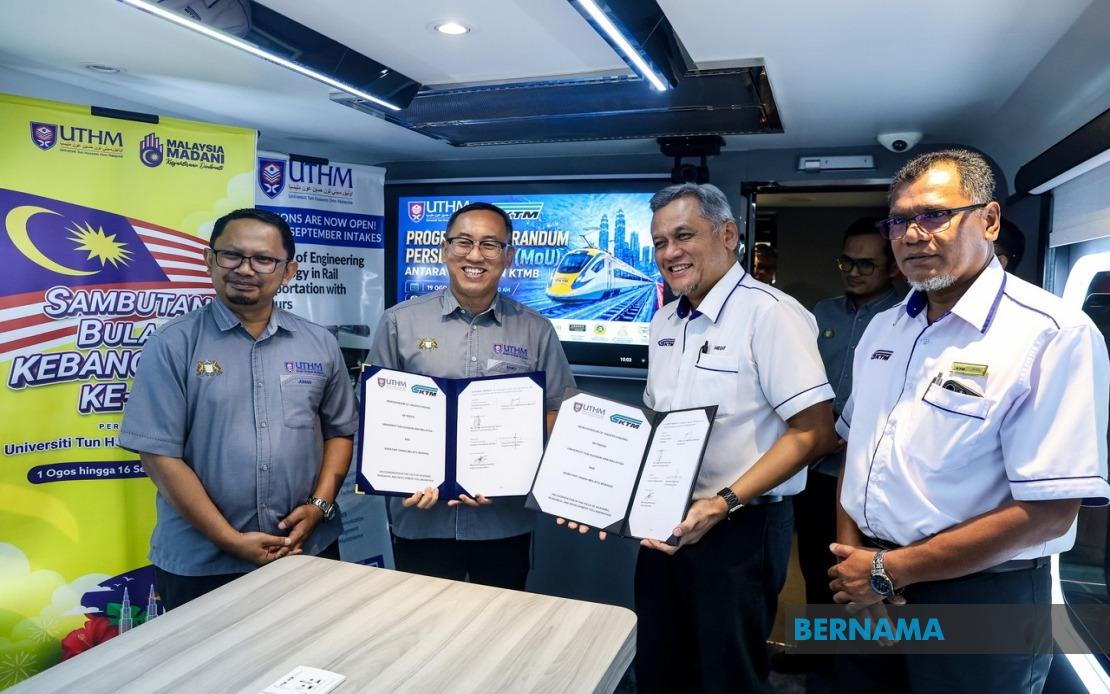
Universiti Tun Hussein Onn Malaysia (UTHM) and Keretapi Tanah Melayu Bhd (KTMB) have formalized an extended three-year strategic partnership running from October 2026 through July 2029, building on an earlier 2019 agreement to advance Malaysia's rail sector workforce. The collaboration framework encompasses work-based learning opportunities for students, joint research initiatives combining academic and operational expertise, structured competency development programmes, and systematic knowledge sharing between the institution and the national rail operator. Officials from both organisations exchanged partnership documents aboard a KTMB chartered train travelling between Kluang Station and KL Sentral, underscoring the symbolic integration of academic and railway operations.
UTHM Vice-Chancellor Prof Dr Mas Fawzi Mohd Ali emphasized that the renewed collaboration represents a significant step in bridging the traditional divide between higher education and industry practice. Through the work-based learning component, UTHM students enrolled in rail-related programmes gain direct, hands-on exposure to KTMB's operational environment, allowing them to observe how theoretical concepts translate into real-world railway management and technology deployment. This immersive educational approach equips students with practical understanding of the complexities inherent in maintaining and operating Malaysia's national rail network, from day-to-day logistics to emergency response protocols.
The partnership carries particular significance for UTHM's institutional trajectory toward becoming a Global Technopreneur University 2030. Rather than treating this designation as an abstract aspiration, the rail collaboration demonstrates how the university intends to operationalize its commitment to weaving together academic knowledge, cutting-edge technology, entrepreneurial thinking, and practical innovation. By embedding students within KTMB's operational framework, UTHM creates pathways for graduates to emerge not merely as credentialed professionals but as individuals capable of identifying problems, proposing solutions, and driving improvement within Malaysia's transport infrastructure.
Evidence of the existing partnership's effectiveness is substantial. Since the 2019 agreement, nearly 200 graduates from UTHM's Bachelor of Rail Transportation Engineering Technology with Honours programme have entered the workforce, with several securing positions not only domestically but also in Singapore and Saudi Arabia. This international placement success signals that Malaysian rail engineering education, when properly aligned with industry requirements, produces graduates meeting global standards. The programme's visibility across regional labour markets strengthens Malaysia's positioning as a source of specialized technical talent within Southeast Asia.
The expanded collaboration will intensify joint research and development activities, combining UTHM's research infrastructure and academic methodologies with KTMB's operational datasets and practical experience. This arrangement addresses a persistent disconnect in Malaysian higher education whereby research projects sometimes remain abstract exercises disconnected from industry application. By anchoring research efforts in real operational challenges faced by KTMB—whether related to track maintenance, signalling systems, safety protocols, or fleet management—the partnership creates conditions for generating practical solutions rather than merely publishable findings. The resulting innovations benefit not only KTMB but potentially the broader rail ecosystem across Malaysia and the region.
KTMB Chief Corporate Officer Megat Khairulazhar Khairodin articulated the operator's perspective on the arrangement, noting that the partnership provides direct access to UTHM's technological capabilities and research facilities to address pressing operational and technical challenges. For a national operator managing aging infrastructure alongside modernization pressures, this access to university expertise represents a valuable complement to in-house capability. The arrangement reflects growing recognition among Malaysian public sector organizations that strategic engagement with research institutions can enhance operational efficiency and support long-term sustainability.
The partnership extends beyond undergraduate programmes to encompass KTM Academy (MyRA), KTMB's dedicated training entity, where UTHM provides academic consultation and curriculum development support for diploma, bachelor's, and postgraduate-level rail transportation engineering technology courses. This multi-level engagement ensures that rail sector training across vocational, undergraduate, and graduate pathways maintains coherence and reflects current industry standards. The inclusion of postgraduate training reflects the partnership's ambition to develop not merely technical practitioners but future leaders and innovators within Malaysia's rail sector.
Competency development initiatives form another pillar of the renewed arrangement. Rather than relying on ad-hoc training sessions or external consultants, the partnership institutionalizes continuous skill enhancement through structured programmes that bring together academic expertise and operational insight. Industry forums and academic site visits create regular touchpoints where practitioners and scholars exchange perspectives, identify emerging challenges, and discuss potential solutions. This sustained dialogue differs markedly from transactional relationships where universities simply graduate students and industries simply hire them.
The commitment extended by KTMB in sponsoring five staff members to pursue master's degrees in rail-related fields at UTHM demonstrates institutional confidence in the partnership's value. These individuals, returning to KTMB with advanced academic credentials alongside their operational experience, become bridges capable of translating between worlds of practice and theory. Their presence within the organization reinforces the principle that continuous learning and professional development constitute essential elements of organizational culture, particularly in technical sectors where technological change accelerates.
For Malaysia's broader transportation policy context, this partnership signals constructive engagement between public sector operators and educational institutions at a moment when rail infrastructure modernization represents a stated national priority. The coordination between UTHM and KTMB demonstrates a pathway through which government-linked companies can leverage academic partnerships to strengthen human capital development and research capacity. As Southeast Asia's economies compete for infrastructure investment and operational excellence, nations whose rail sectors integrate effectively with technical education systems position themselves advantageously.
The timing of the partnership formalization, coinciding with Rel Merdeka 69 launch and the 69th National Month Celebration, embedded the announcement within broader celebrations of Malaysian national development. This symbolism underscores how investments in technical education and infrastructure capability constitute expressions of national aspiration. For observers across Southeast Asia monitoring Malaysia's development trajectory, partnerships like this between universities and essential infrastructure operators represent the granular mechanisms through which national capacity develops.

