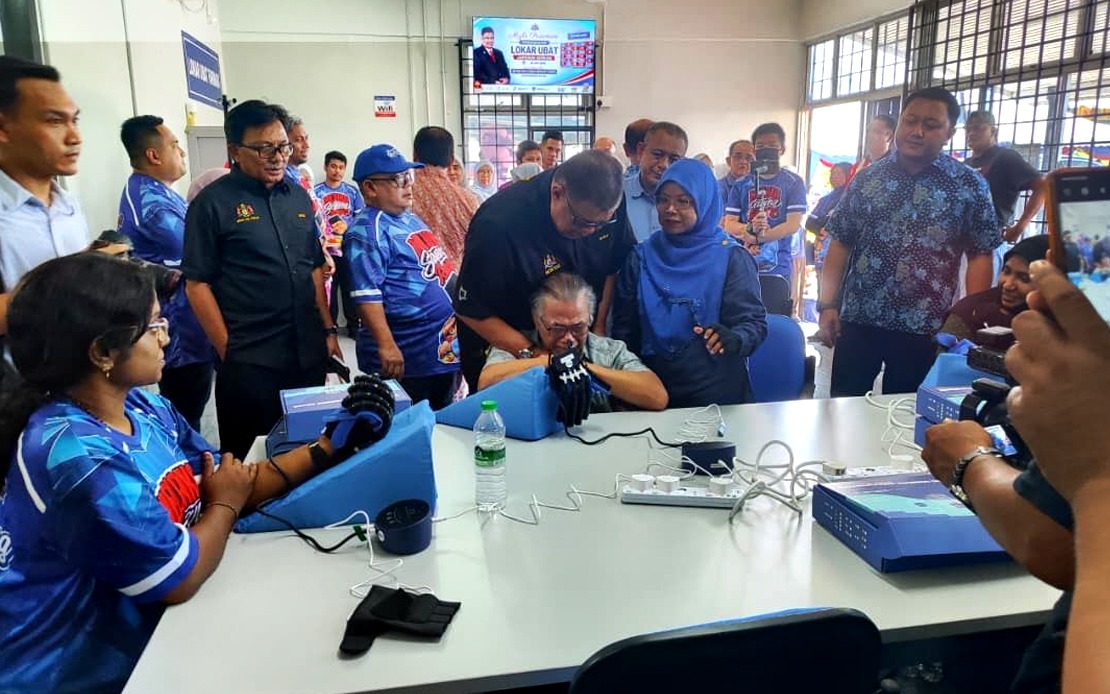
Universiti Teknikal Malaysia Melaka (UTeM) has opened a community-focused rehabilitation facility that marks a significant step forward in bringing university research directly to patients who need it most. The MADANI Community Rehabilitation Centre and Gymnasium in Serkam, Jasin, represents an innovative model where academic innovation intersects with practical healthcare delivery, offering stroke survivors, accident victims, and individuals with movement disorders access to technology previously confined to research laboratories and major urban hospitals.
The facility, inaugurated by Melaka Chief Minister Datuk Seri Ab Rauf Yusoh as part of the Public University Community Empowerment Programme, was established through funding from the Finance Ministry's UniMADANI 2024 Grant. This financing mechanism reflects a deliberate policy shift towards enabling public universities to translate their research capabilities into tangible community benefits, particularly in regions outside major metropolitan areas where specialised rehabilitation services remain scarce.
At the heart of the centre's offering are three proprietary technologies developed by UTeM researchers. The Roboglove system assists patients in relearning hand and finger movements through guided robotic support, addressing one of the most frustrating challenges faced by stroke survivors seeking to regain independence in daily tasks. The Assistive Lower Limb Chair (ALLC) automates lower limb exercise routines, allowing patients with mobility restrictions or leg weakness to undergo structured rehabilitation without constant supervision, while an exoskeleton system provides mechanical support to enhance the effectiveness of movement training and muscle recovery.
For Malaysia's healthcare system, which increasingly faces pressure from aging populations and rising rates of non-communicable diseases, such technological solutions offer particular promise. Stroke remains a leading cause of disability nationally, and rehabilitation services are chronically underfunded and geographically concentrated. Rural and semi-urban areas like Jasin have limited access to physiotherapy specialists and advanced recovery equipment. By establishing this centre in Serkam, UTeM has addressed a genuine gap in service provision while simultaneously creating a testing ground for how technology-enabled care can be scaled efficiently across the country.
The project development was led by Associate Professor Dr Mariam Md Ghazaly and involved collaboration across multiple stakeholders—the Serkam State Constituency Development and Coordination Committee (Japerun) Office, the Kampung Pulai Village Development and Security Committee, the Social Welfare Department, and the Social Security Organisation (PERKESO). This multi-agency approach underscores an important lesson about implementing university innovations: successful community deployment requires coordination between academic institutions, local government structures, social welfare authorities, and occupational safety bodies. Each partner brings distinct resources and expertise that neither could contribute alone.
UTeM Vice-Chancellor Prof Datuk Dr Massila Kamalrudin framed the centre's significance in terms of accessibility and quality of life improvements. She emphasised that the facility demonstrates how rehabilitation innovation and technology can enable patients to undertake continuous recovery training with greater ease and autonomy. This framing matters because it shifts the conversation beyond mere technological novelty toward patient-centred outcomes—whether patients can actually return to work, maintain household independence, and participate in their communities with dignity.
The centre's location in Serkam carries particular significance for understanding contemporary Malaysian development patterns. Jasin is in Melaka's hinterland, a region experiencing gradual urbanisation but lacking the specialist services automatically available in Kuala Lumpur or George Town. By positioning advanced rehabilitation technology in such areas, UTeM chips away at the healthcare disparity that typically forces rural and semi-urban patients to travel substantial distances for quality treatment—a burden that many cannot afford or sustain over the months required for meaningful recovery.
Looking beyond immediate patient services, the centre functions as a proof-of-concept for a replicable model. The university's commitment to expanding similar facilities signals that the UniMADANI framework may catalyse broader diffusion of research-backed healthcare innovation throughout Malaysia's public university system. Universiti Malaya, Universiti Sains Malaysia, and other research-intensive institutions possess comparable technological capabilities that remain largely inaccessible to ordinary citizens. If the Serkam model gains traction institutionally, it could reshape how Malaysian universities perceive their obligation to communities beyond campus boundaries.
The technology stack deployed at MADANI also reflects Malaysia's positioning within regional innovation hierarchies. Robotic rehabilitation systems remain expensive and concentrated in high-income countries; UTeM's locally developed alternatives represent genuine technological contribution relevant to Southeast Asian healthcare contexts where cost and practicality impose different constraints than in Western markets. This domestic innovation pathway deserves emphasis as Malaysian policymakers navigate tension between importing cutting-edge equipment and nurturing homegrown solutions.
For PERKESO, one of the centre's institutional partners, the facility offers operational value beyond immediate rehabilitation services. Occupational safety and social security organisations across Southeast Asia struggle with managing long-term disability cases within constrained budgets. Technology-enabled recovery that reduces hospitalisation duration and accelerates return-to-work timelines directly improves organisational sustainability. Early evidence from the Serkam centre regarding treatment outcomes and cost-effectiveness could influence how PERKESO structures future rehabilitation services nationally.
The implicit challenge embedded in the MADANI initiative concerns sustaining momentum and replication. Single exemplary projects often fail to generate systemic change without sustained institutional commitment and adequate resourcing. Whether this Jasin facility becomes the nucleus of a nationwide network or remains an isolated success depends on multiple factors: continued government funding, recruitment and retention of trained rehabilitation specialists, ongoing technology maintenance and upgrades, and institutional willingness among other universities to adopt similar models despite the administrative complexity involved.
For Malaysian healthcare planners contemplating the rehabilitation crisis ahead as chronic disease burden mounts, the UTeM centre offers both inspiration and practical lessons. Technology alone cannot substitute for clinical expertise and human care; rather, effectively deployed innovation amplifies what skilled practitioners can accomplish. The MADANI model suggests that Malaysia possesses the technological sophistication and institutional structures necessary to deliver world-class rehabilitation services to communities currently underserved—if stakeholders commit to translating academic capability into accessible community benefit.

