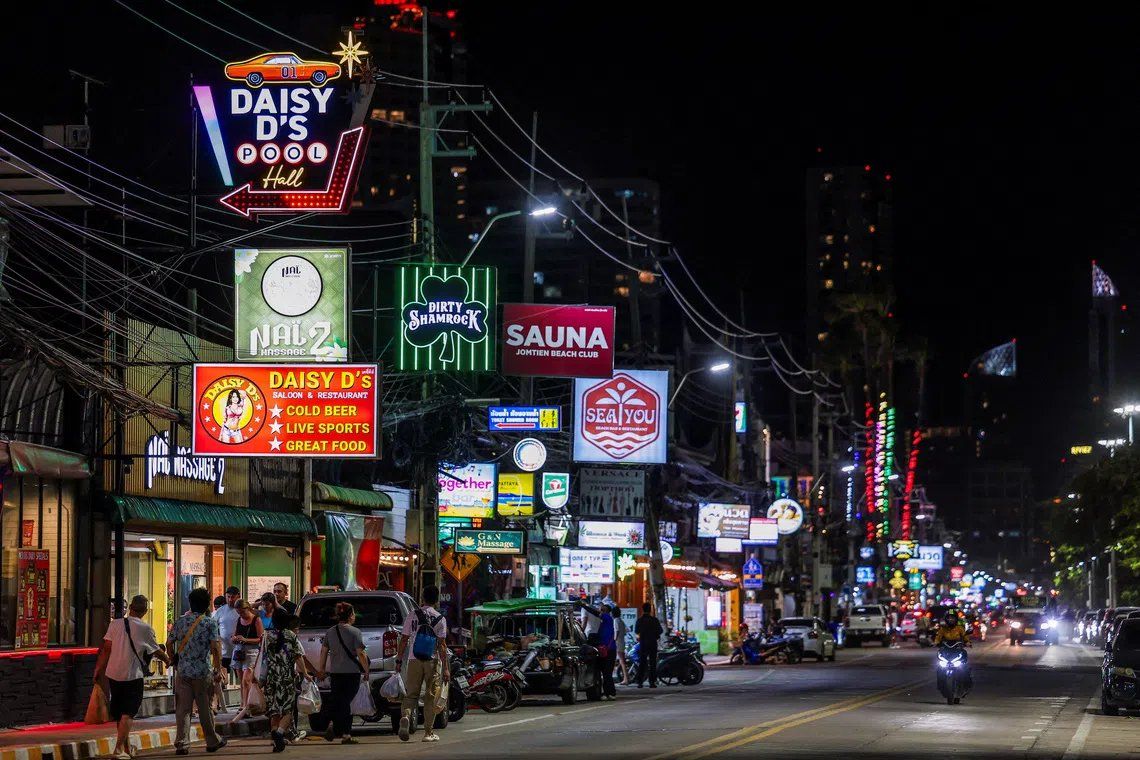
The USS Abraham Lincoln, accompanied by two Navy support vessels, is preparing to dock at Thailand's Laem Chabang port near Pattaya this week, marking a significant moment for a Southeast Asian resort town locked in the tension between economic necessity and social responsibility. The arrival brings nearly 5,000 sailors and Marines seeking rest after more than 200 days deployed across the Middle East, where the carrier group was redirected to support the U.S.-Israeli military operations against Iranian forces. For Pattaya, a city built on the back of American servicemen's shore leave during the Vietnam War, the docking represents a rare economic lifeline in what local business leaders describe as an extraordinarily depressed year.
The carrier's protracted deployment has already set modern records for consecutive days at sea, according to Democratic lawmakers monitoring operational demands on the Navy. However, this extended absence from home port has extracted a human toll. Military-focused publications have reported troubling mental health incidents aboard the Lincoln in recent weeks, including suicide attempts and sharply declining morale among the crew. These underlying issues among personnel now approaching Thai shores add a layer of complexity to what authorities are framing as a routine maintenance and recreation stop, raising questions about the psychological state of thousands of young military personnel about to have unsupervised shore leave in one of Asia's most permissive entertainment environments.
Pattaya's relationship with military tourism stretches back decades, transforming a fishing village into a destination synonymous with particular forms of entertainment that Thai law technically prohibits but tolerates within certain geographic and operational boundaries. The U.S. Federal Bureau of Investigation characterized the city a decade ago as one of the world's leading sex tourism destinations, a designation that remains largely accurate despite periodic crackdowns and official denials. The arrival of such a large group of young servicemen has prompted Thai authorities to mobilize additional police patrols along the beachfront and nightlife districts, with weekend raids already resulting in detention of 40 to 50 individuals suspected of involvement in prostitution. Yet Pattaya's police chief Anek Srathongyoo acknowledged the fundamental challenge: sex workers operate fluidly across public spaces, often evading detection through methods authorities struggle to counter effectively.
The economic arithmetic looks compelling at first glance. Pattaya's mayor Poramase Ngampiches calculated that individual servicemembers might spend between 1,000 and 3,000 baht daily—roughly $30 to $91—depending on whether they remain ashore overnight or take excursions elsewhere. Multiplied across 5,000 personnel with staggered shore leave schedules, the injection of foreign currency could provide meaningful relief to hotel operators, restaurant owners, and legitimate retailers who have endured severely depressed business conditions. Tourism industry representatives expressed genuine hope bordering on desperation. Lisa Hamilton, representing the Pattaya Nightlife Business Association, noted that current business conditions represent the slowest year she has witnessed during two decades of residence in the city, suggesting the carrier visit offers more than symbolic importance for struggling enterprises.
Yet the economic opportunity masks deeper structural concerns articulated by academic and social observers. Pipatpong Fakfare, an associate professor specializing in tourism management at Bangkok University, identified multiple interconnected risks accompanying such large military influxes. The surge in demand for commercial sexual services creates conditions for intensified exploitation of vulnerable workers, many operating under coercive circumstances. Beyond labor concerns, the concentration of young male servicemen seeking recreational outlets in a compact geographic area substantially increases epidemiological risk related to sexually transmitted infections, creating public health ramifications that extend far beyond immediate commercial transactions. The mental health vulnerabilities already documented aboard the Lincoln—suicide attempts and deteriorating morale—compound these concerns, as individuals in psychological distress may make decisions they would otherwise avoid.
Pattaya's geographic position within Chonburi province, coupled with its accessibility to Bangkok just two hours away, creates strategic uncertainty about actual economic distribution from the carrier visit. Thanet Supornsahasrungsi, leading the Chonburi Tourism Federation, emphasized that economic outcomes depend partly on personnel movement patterns. Servicemembers with more generous liberty budgets or greater initiative might travel to Thailand's capital, fragmenting the economic benefit across a wider region rather than concentrating expenditure in Pattaya proper. The approximately 300,000 hotel rooms across the city provide capacity for only a fraction of potential demand, meaning accommodation providers may see the greatest returns while other business categories experience more modest gains.
The Abraham Lincoln's journey to this point involved significant geopolitical repositioning. Originally deployed from its San Diego home port in November, the carrier group was subsequently redirected toward Middle Eastern waters to backstop U.S. and Israeli military posture during escalating tensions with Iran. This course change extended the deployment well beyond typical parameters, contributing to the record-setting consecutive days at sea that prompted Democratic congressional scrutiny. The redirection reflected evolving strategic priorities in a region increasingly central to American military planning, yet the operational demands it imposed on ships' crews—particularly psychological and physical tolls documented aboard the Lincoln—suggest costs that extend beyond logistical considerations.
Thailand's broader strategic relationship with the United States provides important context for why Pattaya authorities permit such visits despite associated complications. The country remains a central anchor of American military strategy throughout Southeast Asia and the Indo-Pacific, hosting significant U.S. military presence and serving as a staging ground for regional operations. Port calls by major naval vessels represent both practical necessities for fleet maintenance and symbolic affirmations of strategic partnership. For Thai officials, facilitating such visits reflects not only bilateral defense relationships but also the economic interdependencies that have evolved over decades of military engagement. Simultaneously, however, local authorities must navigate the tensions between welcoming American military visitors and managing the predictable social consequences.
The crackdown preparations underway in Pattaya reflect Thai authorities' awareness that they face sustained international scrutiny regarding trafficking and exploitation. Global rankings by organizations monitoring human trafficking consistently identify Thailand as a persistent concern, with particular attention to sexual exploitation of adults and children. High-profile military visits create opportunities for international media coverage that can either reinforce negative perceptions or, from an official Thai perspective, demonstrate active law enforcement efforts. The weekend detention raids ahead of the Lincoln's arrival signal to both international observers and domestic constituencies that authorities remain committed to addressing the industry's darker dimensions, even as they simultaneously facilitate the economic activity those same enforcement actions ostensibly target.
For Malaysia and other Southeast Asian nations, the USS Abraham Lincoln's Pattaya visit carries indirect significance. The carrier's extended Middle Eastern deployment and the strategic reorientation it represents reflect broader American military planning throughout the region. The documented mental health challenges aboard the Lincoln also foreshadow broader questions about sustainability and crew welfare in extended naval deployments that may affect U.S. military readiness and posture throughout Southeast Asia. Additionally, patterns of military tourism and associated exploitation in Thailand inform ongoing regional discussions about labor protections, trafficking prevention, and the social costs of development models oriented around American military presence. The visit thus operates on multiple levels—as a local economic opportunity, a symbol of strategic partnership, a public health and safety consideration, and a manifestation of larger regional dynamics that extend well beyond the shores of Pattaya.

