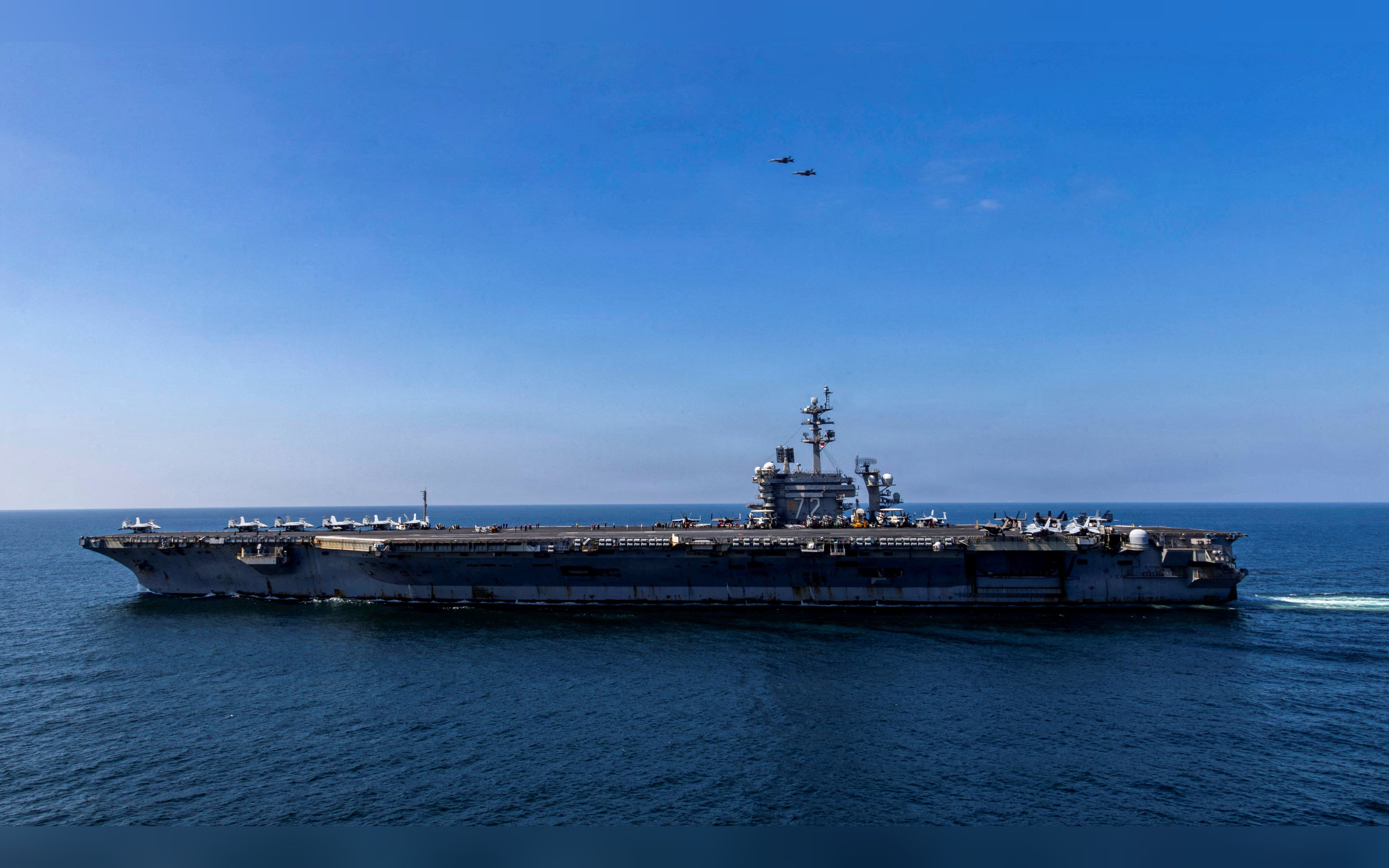
The USS Abraham Lincoln aircraft carrier will be withdrawn from West Asia and replaced by the USS George Washington as part of a scheduled rotation, US President Donald Trump confirmed on Friday. The decision comes after mounting concerns about the extended deployment and conditions aboard the vessel, where sailors have faced prolonged absence from home ports and reported difficulties with basic ship operations and crew welfare.
Trump told reporters that the USS Abraham Lincoln "is moving right now, or very shortly" and would be replaced with "another very similar ship." The announcement followed growing pressure from military families and members of Congress who had raised alarms about the carrier's unusually long deployment in the region. When asked whether the deployment had extended beyond acceptable limits, Trump dismissed the concern, stating the ship "has not nearly long enough" remained in position.
The USS Abraham Lincoln was first deployed in November before being redirected to West Asia in January in response to regional tensions and the broader US military posture in the area. The vessel spent more than 250 consecutive days at sea, with a particularly challenging 200-day stretch without making port calls—an exceptionally long interval for maintaining crew morale and conducting essential maintenance on complex naval systems.
Acting Navy Secretary Hung Cao announced the return in a statement emphasizing that "the safety and security of our Sailors and Marines always comes first." He acknowledged the arduous nature of the deployment, noting that combat operations place extraordinary demands on personnel and infrastructure. Cao attributed the extended mission to operational necessity, stating the ship's deployment was prolonged "because the mission demanded it." He stressed the interconnected priorities of "mission accomplishment" and "troop welfare" as core principles of military leadership.
According to official figures released by Cao, the USS Abraham Lincoln completed a 266-day deployment that included 200 days in a combat zone. During that period, the carrier's air wing conducted more than 10,000 sorties and delivered over 1.5 million pounds of ordnance in support of regional operations. These statistics underscore the intense operational tempo maintained by the vessel and its crew throughout the mission.
Senator Richard Blumenthal had previously written to Defence Secretary Pete Hegseth and Cao, detailing widespread problems aboard the carrier. His concerns encompassed shortages of essential supplies, contaminated drinking water, malfunctioning plumbing infrastructure, and concerning trends in sailor mental health. The senator also flagged safety risks on the flight deck and delays in mail delivery that prevented care packages from reaching service members for months—seemingly minor issues with significant psychological impact on personnel separated from families.
While Cao acknowledged that some sailors and Marines received mental health treatment during the extended deployment, he emphasized that no deaths occurred in connection with those cases. This disclosure reflects the psychological toll that prolonged, high-stress military operations place on personnel, even as command structures work to identify and address emerging problems. The availability of mental health resources aboard the vessel appears to have helped mitigate more serious outcomes, though the underlying stressors remain significant.
The rotation of carrier strike groups through West Asia represents a core element of US naval strategy in a region of strategic importance spanning energy infrastructure, major shipping lanes, and geopolitical competition. The replacement by USS George Washington signals continuity in the American military commitment to maintaining presence and readiness, even as individual vessels and crews rotate through demanding deployment cycles. For regional observers in Southeast Asia and beyond, sustained American carrier presence in West Asia carries implications for broader security calculations and regional stability.
The decision to replace the Lincoln reflects broader debates within the US military about deployment cycles, crew welfare, and operational sustainability. Extended deployments can degrade readiness over time as equipment requires maintenance and personnel suffer fatigue. However, they also reflect the demand for American naval capability across multiple theaters simultaneously—a persistent challenge for military planners seeking to balance global commitments with the health and effectiveness of the force.
From a Malaysian and Southeast Asian perspective, carrier rotations in West Asia influence regional security dynamics indirectly. A robust and sustained American naval presence in the Middle East can affect global energy markets, maritime security, and the broader balance of power that shapes regional relationships. The technical challenges and welfare concerns highlighted by the Lincoln's deployment also illuminate the operational complexities underlying great-power competition and the human costs of maintaining global military posture.

