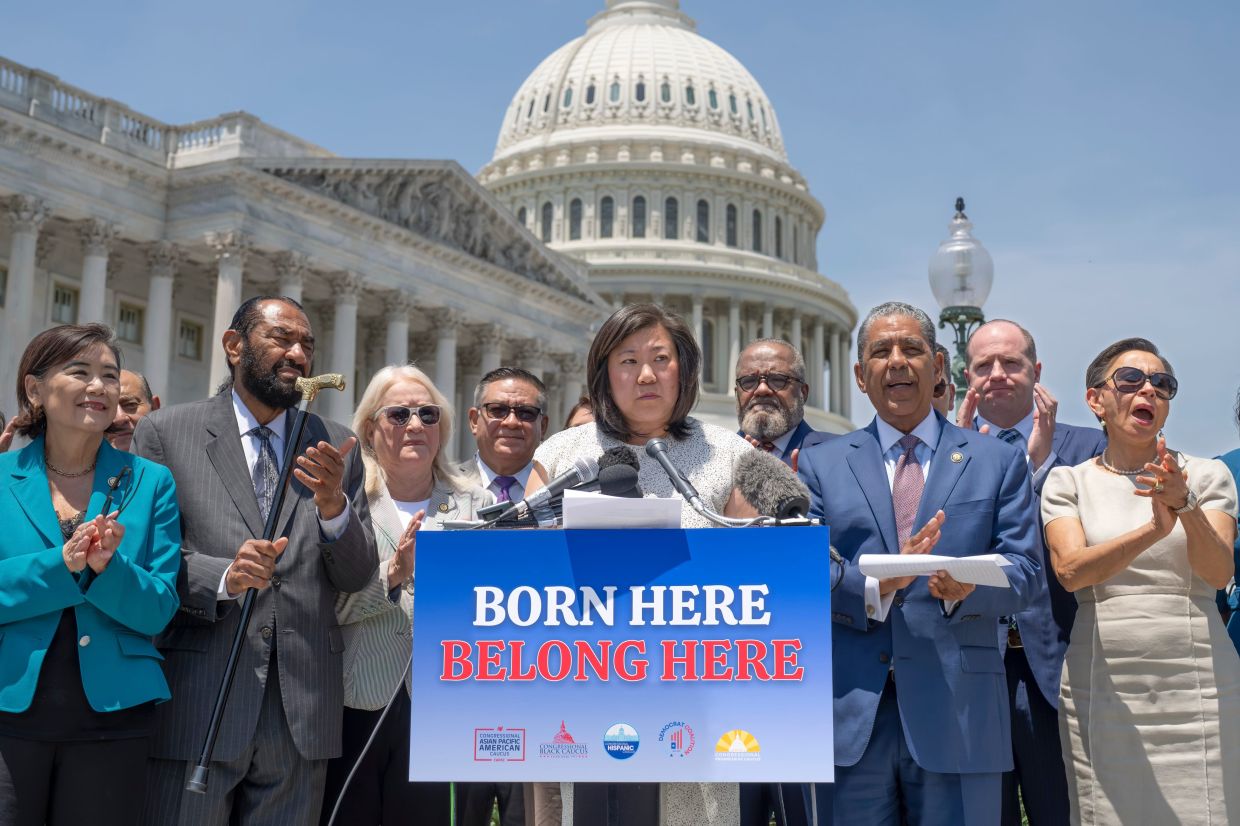
The US Supreme Court has delivered a significant blow to one of President Donald Trump's cornerstone immigration policies, voting 6-3 to strike down his executive order that would have revoked birthright citizenship for children born to undocumented parents or those on temporary visas. The decision in Trump vs Barbara reaffirms a constitutional principle rooted in American history and carries implications that extend far beyond the United States, particularly for Asian-American communities and immigrant groups across the globe.
Trump had signed the executive order early in 2025 as part of his broader second-term immigration agenda, with the policy scheduled to take effect the following month. The measure targeted not just unauthorised immigrants, but also lawfully present foreign nationals on the path to permanent legal status—including highly skilled professionals on H-1B and L-1 work visas, students, temporary labourers, and those on achievement visas classified as "lawful but temporary" by the US Citizenship and Immigration Services. The only exception would have been children with at least one US citizen parent, who would have retained their birthright citizenship claims under the order.
Chief Justice John Roberts articulated the majority's reasoning by returning to the foundational purpose of the 14th Amendment's Citizenship Clause, which was ratified in 1868, just three years after the Civil War ended. "Citizenship, then and now, was the right to have rights – to freely participate in our political community," Roberts wrote. "The Framers of the Fourteenth Amendment extended that promise to 'every free-born person in this land'. We keep that promise today." This clause has historically been understood to grant citizenship to nearly all children born on US soil regardless of parental immigration status, a safeguard originally designed to protect formerly enslaved people and other marginalised communities.
The legal foundation for this principle traces directly to an 1898 landmark case involving Wong Kim Ark, a Chinese-American whose descendants highlighted the ruling's contemporary relevance. Wong had been denied re-entry to the United States following a trip to China, with authorities claiming he was not a citizen under the Chinese Exclusion Act because of his parents' immigration status. The Supreme Court's decision in that case established that virtually all persons born on American soil are citizens regardless of their parents' nationality—a precedent that has now endured through Jim Crow segregation and survived Tuesday's constitutional challenge. Norman Wong, Wong Kim Ark's great-grandson, reflected on his ancestor's significance in a statement following the ruling: "He was one man, only a cook, and yet he stood up for what was right, and I believe that it has made a difference."
The decision carries particular resonance for Asian-American communities, whose historical struggles with immigration restrictions and discrimination have been intertwined with birthright citizenship rights. Stop AAPI Hate, an advocacy organisation monitoring anti-Asian discrimination, emphasised this connection in a statement, noting that "Because of this right, the Asian-American community and other communities of colour have been able to grow in size and political power – and that is precisely why the Trump administration attempted to end it." Krish O'Mara Vignarajah, president of Global Refuge, a non-profit organisation supporting refugees, characterised the ruling as a victory against an order that would have "essentially turned the maternity ward into a customs checkpoint."
Trump responded to the defeat with characteristic defiance, taking to social media to attack the Supreme Court's decision. He called the outcome "too bad" for the country while claiming that "we can easily make it up in Congress through Legislation" and that "no long and unwieldy Constitutional Amendment is necessary." In another post, Trump congratulated Chinese President Xi Jinping on what he sarcastically termed a "massive Birthright Citizenship WIN," reflecting the administration's repeated focus on so-called birth tourism as justification for the policy. Trump urged Congress to "start TODAY to work on ending expensive and unfair to our Country, Birthright Citizenship," promising his "Complete and Total Support."
The Trump administration's focus on birth tourism—the practice of foreign nationals travelling to the United States specifically to give birth and secure citizenship for their children—became increasingly central to the political debate surrounding birthright citizenship, even though undocumented immigration had historically dominated the discussion. Solicitor General D. John Sauer, Trump's top litigator, argued during April oral arguments that birthright citizenship "has spawned a sprawling industry of birth tourism," claiming that "uncounted thousands of foreigners from potentially hostile nations have flocked to give birth in the" United States. This framing, particularly with references to China, became a touchstone for Trump administration rhetoric.
Following the Supreme Court's decision, the Department of Justice signalled its intention to intensify enforcement against birth tourism schemes. In a memo released Tuesday afternoon, the department directed federal prosecutors to prioritise investigations of such operations, with Colin McDonald, a senior Justice Department official, stating that "The Department of Justice will zealously protect the sanctity of United States citizenship by investigating and prosecuting those who fraudulently exploit our immigration system." McDonald referenced a 2024 case in which Michael Wei Yueh Liu and Jing Dong were each sentenced to 41 months in prison for operating a birth tourism scheme, charging Chinese clients tens of thousands of dollars to facilitate American births for citizenship purposes.
The Supreme Court's decision represents a watershed moment in the ongoing debate over American immigration policy and national identity. While the court has reaffirmed the constitutional guarantee of birthright citizenship, the Trump administration and its allies have signalled their determination to pursue legislative alternatives to circumvent the ruling. The controversy reflects deeper questions about who belongs in America, what citizenship means, and how the nation balances immigration enforcement with constitutional commitments to equal protection and fundamental rights. For Malaysian and Southeast Asian observers, the case underscores how immigration policy and citizenship rights remain contentious battlegrounds in American politics, with implications that ripple across the globe wherever immigrant communities seek security and opportunity for their children.

