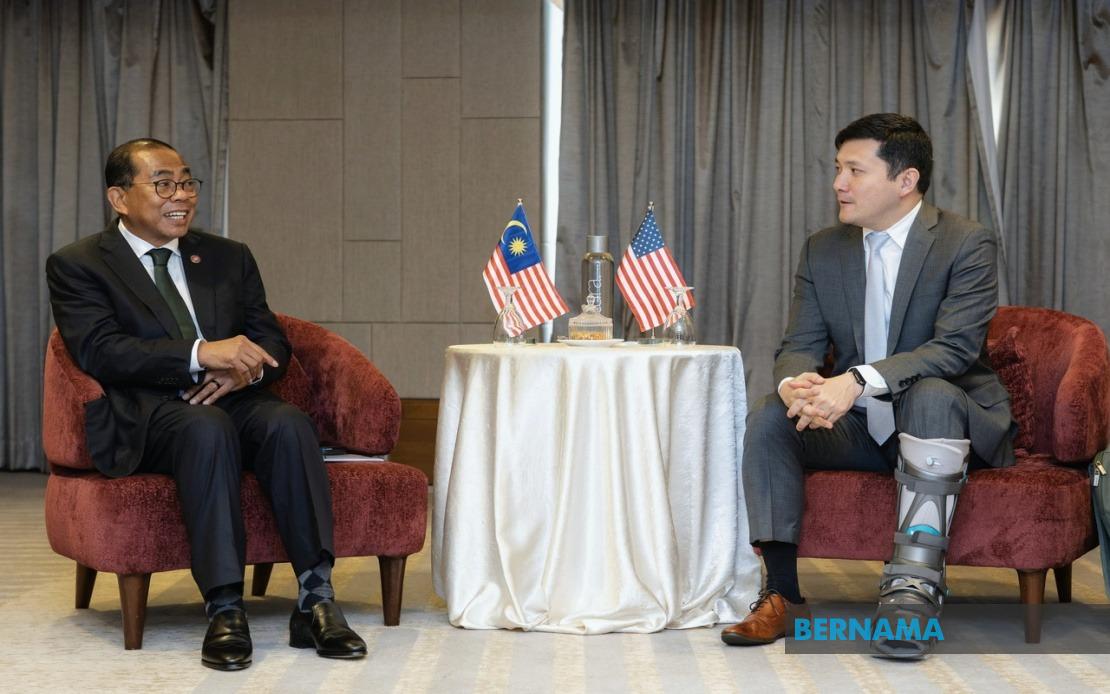
Defence Minister Datuk Seri Mohamed Khaled Nordin signalled a fresh round of defence partnership discussions with Washington on August 3, highlighting American commitment to strengthening military ties with Malaysia amid a complex security landscape in Southeast Asia. The undertaking emerged from a courtesy meeting with US Ambassador to ASEAN Kevin Kim, who visited Kuala Lumpur coinciding with the 37th Annual Military Law and Operations Conference gathering senior defence officials and military representatives from over 30 countries.
The bilateral engagement underscores the evolving security architecture in the Indo-Pacific region, where Malaysia occupies a strategic position along critical sea lanes and faces multifaceted challenges ranging from maritime security to terrorism. Mohamed Khaled characterised the exchange with Kim as a reaffirmation of existing defence bonds rather than a negotiation of new policy initiatives, suggesting continuity in proven cooperation frameworks. His comments reflect a measured approach to the relationship, one that prioritises institutional linkages while remaining pragmatic about the scope and pace of expansion.
Beyond the American engagement, Mohamed Khaled's schedule during the conference revealed the breadth of Malaysia's defence diplomacy. He received ASEAN Secretary-General Dr Kao Kim Hourn, with both officials discussing the region's security architecture and the defence sector's role in upholding ASEAN Centrality—a foundational principle asserting the bloc's leadership in regional affairs. This dialogue carries particular weight given persistent geopolitical tensions in the South China Sea and ongoing maritime disputes that touch Malaysia's interests directly.
The conversation with Kao also touched on how defence cooperation mechanisms can reinforce ASEAN unity on issues affecting collective peace and prosperity. Malaysia has long positioned itself as a bridge builder within ASEAN, and these discussions signal an intention to leverage defence cooperation as a stabilising force rather than as an instrument of strategic competition. The emphasis on multilateral frameworks reflects awareness among ASEAN defence establishments that regional challenges cannot be addressed through bilateral arrangements alone.
Simultaneously, Mohamed Khaled met Joseph Leong, Singapore's newly appointed Permanent Secretary for Defence. The appointment itself is significant—it signals continuity in Singapore's security relationships while potentially offering opportunities for refreshing bilateral cooperation. Leong's expressed commitment to deepening Malaysia-Singapore defence ties carries practical implications for joint operations, intelligence sharing, and maritime coordination in the congested waters around the Strait of Malacca, one of the world's most important shipping channels.
The discussion with Singapore notably extended beyond bilateral concerns to encompass the Five Power Defence Arrangements, a longstanding security pact binding Malaysia, Singapore, Australia, New Zealand, and the United Kingdom. FPDA cooperation provides a framework for maritime security operations, training exercises, and intelligence collaboration that benefits all participants. For Malaysia, FPDA engagement offers a counterbalance to regional power dynamics while maintaining alignment with traditional security partners without appearing to take sides in great power competition.
The timing of these diplomatic exchanges—all occurring during a major conference on military law and operations—reflects how defence establishments use formal gatherings to conduct relationship-building alongside substantive discussions on doctrine and procedure. The 37th MILOPS conference serves as both a platform for technical military engagement and a venue for strategic messaging. Countries use such forums to signal priorities, trial new approaches, and cement partnerships within an institutionalised setting that reduces misunderstanding.
Malaysia's participation in MILOPS and its hosting of the conference this year demonstrates its commitment to regional security infrastructure development. The gathering's focus on legal aspects of military operations is particularly relevant to Southeast Asia, where maritime disputes and competing territorial claims sometimes create ambiguity around permissible conduct. Establishing shared understandings of operational law helps prevent misunderstandings that could escalate tensions.
For Malaysian readers, these defence diplomacy developments carry several implications. First, they suggest Malaysia is actively managing relationships with major powers while maintaining its non-aligned credentials—a balancing act that has defined Malaysian foreign policy for decades. Second, they indicate that regional security challenges remain salient enough that defence establishments across multiple countries are investing diplomatic capital in dialogue. Third, the emphasis on multilateral frameworks and ASEAN Centrality reflects Malaysia's preference for rules-based approaches to managing regional disputes, even as power politics inevitably shape outcomes.
The defence partnerships Malaysia is cultivating represent insurance policies against uncertainty in an increasingly contested region. As the United States, China, and other powers compete for influence, countries like Malaysia seek to maintain positive relations with multiple partners while protecting their sovereign interests. Mohamed Khaled's measured comments about defence cooperation reflect this strategic posture—welcoming American engagement without appearing to target other powers and emphasizing ASEAN's central role in security arrangements.
The concentration of senior defence officials in Kuala Lumpur for the MILOPS conference creates an unusual opportunity for multilateral engagement beyond formal conference activities. Courtesy calls like those conducted by Mohamed Khaled represent the diplomatic rhythm that underpins security cooperation, where relationships are maintained and recalibrated through regular, high-level contact. These interactions build trust and create channels for crisis communication when tensions arise.
Looking forward, Malaysia's defence ministry appears positioned to deepen relationships across multiple dimensions—bilateral ties with traditional partners like the US and Singapore, multilateral engagement through ASEAN and FPDA, and the technical development of shared military doctrine and operational procedures. This layered approach provides flexibility and reduces Malaysia's dependence on any single security relationship while building redundancy into its defence architecture—a pragmatic strategy for a nation navigating geopolitical currents beyond its control.

