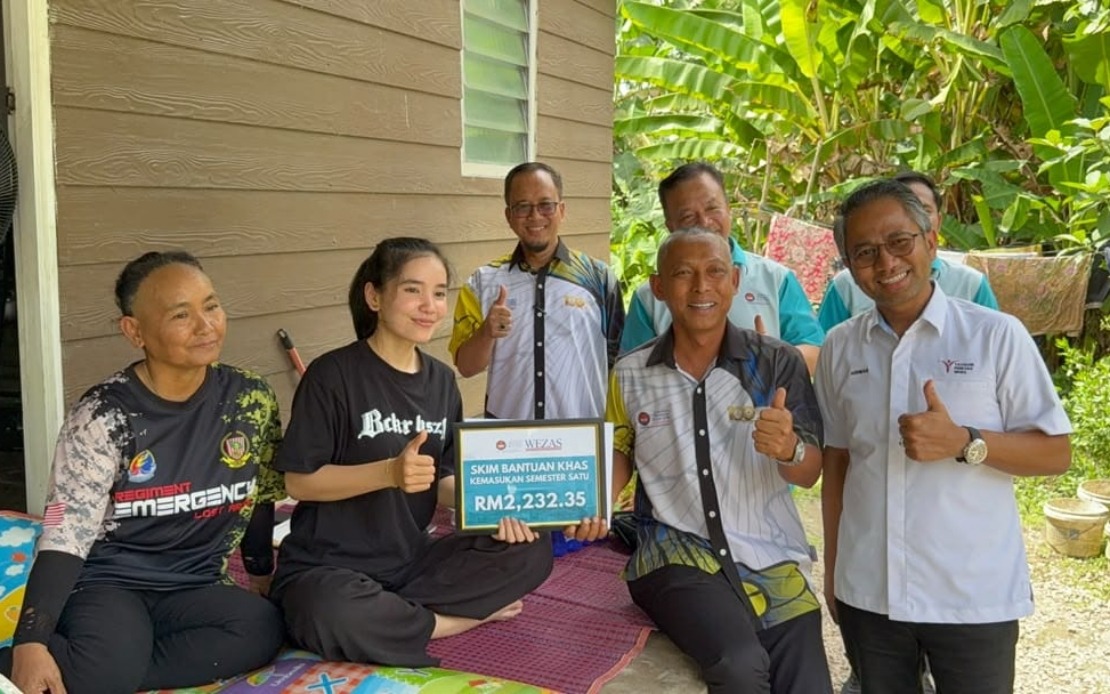
Lovely Sabana Augustine, a high-performing STPM graduate with significant family hardship, will now be able to pursue her academic ambitions at Universiti Pendidikan Sultan Idris (UPSI) after receiving timely financial support from the institution and Malaysia's Higher Education Ministry. The assistance programme has enabled Sabana and two other prospective students to overcome immediate financial obstacles that threatened to derail their university education before the 2026/2027 academic session begins.
Sabana's circumstances exemplify the hidden barriers many talented students from disadvantaged backgrounds face in Malaysia's higher education system. Living in Tumpat, Kelantan, with her mother Mek Kenui, who earns approximately RM800 monthly as a school cleaner while serving with the Malaysian Volunteer Corps Department, Sabana represents thousands of Malaysians whose academic potential might otherwise go unrealised due to poverty. Her father, a former soldier, passed away in 2017, leaving her mother as the sole provider for four children. The prospect of covering registration fees and purchasing essential study materials created an insurmountable barrier despite her academic credentials.
The viral nature of Sabana's appeal on social media highlighted the critical gap between academic merit and financial capacity that persists in Malaysia's education landscape. Her story resonated widely because it illustrated a systemic problem: qualified students frequently cannot access the higher education opportunities they have earned. UPSI's response demonstrated institutional awareness that removing such barriers requires proactive intervention rather than waiting for formal applications to navigate bureaucratic channels.
Under the collaborative assistance framework involving UPSI, Yayasan Perkasa Siswa (YPS), and the Department of Higher Education (JPT), each of the three selected students received RM1,500 in direct support. The allocation combined contributions from two sources: RM500 derived from UPSI's Centre for Waqf, Endowment, Zakat, Khairat, and Sadaqah, which mobilises Islamic charitable principles within the university structure, and RM1,000 provided through YPS's student welfare initiatives. This combination of institutional funding and foundation support demonstrates how multiple stakeholders can collaborate to address student vulnerability.
The two additional beneficiaries share similarly challenging circumstances. Siti Nurdianis Nordin, preparing to enrol in the Faculty of Management and Economics, comes from a household dependent on irregular daily wages earned by her mother, creating income instability that makes educational planning precarious. Muhamad Ilias Danish, destined for the Faculty of Languages and Communication, experienced the loss of his primary family breadwinner when his father passed away, compelling him to contribute toward household expenses while pursuing tertiary education. Their inclusion alongside Sabana demonstrates that financial hardship extends across different family situations and represents a widespread challenge rather than isolated cases.
Hirman Awang, director of the Department of Higher Education's Student Affairs Division, articulated the Ministry's strategic commitment to ensuring financial constraint does not become a filter that screens out talented individuals from lower-income families. He framed the YPS contribution not merely as monetary transfer but as a confidence-building signal that university systems actively support student welfare from the moment students are admitted. This messaging recognises that financial anxiety during the pre-enrolment period can psychologically discourage students, regardless of the absolute magnitude of assistance provided.
UPSI's institutional positioning through this initiative reveals how universities can operate as advocates for equity within their sphere of influence. Deputy Vice-Chancellor Prof Dr Norkhalid Salimin emphasised that the university views proactive identification of struggling students as an institutional responsibility, not merely a charitable gesture. The integration of the Student Affairs and Alumni Department with WEZAS creates structural mechanisms for early intervention, identifying financial barriers before they become insurmountable obstacles that force students to defer or abandon their studies.
The timing of this assistance programme carries particular significance for Southeast Asian context. Malaysia's commitment to expanding higher education access while maintaining quality necessitates retaining talented students whose family circumstances might otherwise limit their participation. As tertiary education becomes increasingly essential for economic competitiveness, countries throughout the region confront similar questions about how to translate admission success into actual enrolment and completion, particularly among disadvantaged cohorts.
The strategic framing emphasises collaboration between educational institutions, government agencies, and philanthropic foundations as a model for addressing access challenges. Rather than positioning student support solely as government responsibility, this approach distributes responsibility across multiple actors, each contributing according to their capacity and mission. UPSI's WEZAS structure specifically mobilises Islamic charitable giving mechanisms, creating sustainable funding streams rooted in community values that extend beyond annual budget allocations.
This initiative operates within broader international recognition that financial aid targeted at the enrolment phase produces disproportionate returns. The RM1,500 provided addresses immediate obstacles—registration fees, textbooks, accommodation deposits, and essential equipment—that often determine whether marginal students actually enrol. By removing these threshold obstacles, the programme increases the likelihood that all three students complete their first semester, when institutional integration becomes crucial for retention and academic success.
For Malaysian policymakers monitoring higher education equity, this case study illustrates that institutional agility and inter-agency coordination can compensate for systemic resource constraints. Individual universities implementing proactive identification systems, combined with foundation willingness to supplement government funding, create space for compassionate responses to merit-based need. The programme suggests that Malaysia's higher education system possesses mechanisms and willing participants to address financial barriers more comprehensively than formal government schemes alone might achieve.
The implications extend beyond these three individual students. Such visible institutional support signals to other students from disadvantaged backgrounds that pursuing university education remains viable despite financial obstacles. This reputational effect, though difficult to quantify, potentially encourages applications from capable students who might otherwise assume higher education lies beyond their family's capacity, thereby expanding the talent pool institutions can recruit from across Malaysia's diverse socioeconomic landscape.
As these three students prepare to register at UPSI in September, their success will likely influence institutional practice moving forward. Demonstrable positive outcomes from early financial intervention may encourage similar programmes at other Malaysian universities, gradually shifting higher education culture toward proactive support rather than reactive assistance. This cultural evolution represents an investment in Malaysia's human capital development, ensuring that merit rather than poverty determines access to university education.

