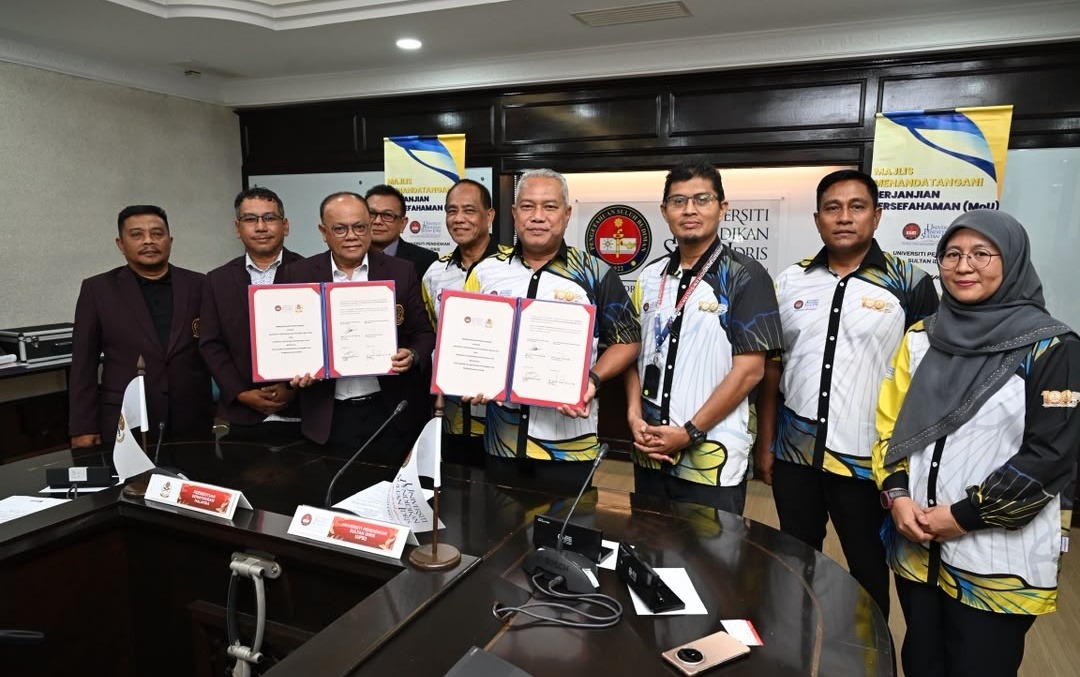
A strategic alliance between Malaysia's leading teacher training institution and the national sepak takraw governing body marks a significant step toward professionalising the sport through formal education channels. Universiti Pendidikan Sultan Idris (UPSI) and the Malaysian Sepaktakraw Federation (PSM) inked their Memorandum of Understanding at the Sultan Abdul Jalil Shah Campus in Tanjong Malim, establishing a framework that binds educational opportunity with athletic excellence across the next three years.
The agreement addresses a structural gap long evident in Malaysian sport: the difficulty athletes face balancing rigorous training schedules with pursuing tertiary qualifications. UPSI Vice-Chancellor Prof Datuk Dr Md Amin Md Taff emphasised that the partnership would move beyond ceremonial gestures, translating instead into actionable initiatives that serve both the university's mission and the federation's competitive ambitions. The university pledged to accommodate flexible academic schedules tailored to the demands of national and state-level competitors, removing a traditional barrier that has historically forced athletes to choose between sport and further education.
Beyond admissions flexibility, UPSI commits substantial institutional resources to sepak takraw's technical advancement. The university will deploy expertise in coaching methodology, sports science, officiating standards, and emerging sports technology—areas where Malaysian institutions hold genuine competitive advantage regionally. This knowledge transfer addresses a critical need in sepak takraw development, where the sport's rapid evolution at international level has outpaced the training infrastructure available to domestic athletes and coaches. The arrangement also encompasses provision of facilities and monitoring mechanisms to ensure commitments translate into measurable outcomes rather than remaining aspirational.
The partnership's infrastructure ambitions extend to establishing a dedicated national training centre for sepak takraw, a centralised facility that could substantially improve player conditioning, tactical preparation, and injury prevention protocols. Malaysia's sepak takraw teams have competed successfully internationally, yet systematic support infrastructure remains fragmented compared to resources available to athletes in rival nations. A purpose-built training environment, anchored within UPSI's established sports facilities and academic framework, would represent a tangible upgrade to the sport's organisational backbone.
For PSM Vice-President Tengku Zaihan Che Ku Abdul Rahman, the collaboration addresses recruitment and development pathways that currently fragment Malaysia's talent pipeline. By formalising pathways for athletes from Malaysian Sports Schools and State Sports Schools to transition smoothly into university study, the agreement reduces discontinuity that often derails promising players when their school careers conclude. The federation anticipates that combining UPSI's sports science rigour with PSM's technical knowledge will accelerate the pipeline producing not merely elite players, but qualified coaches and certified officials—addressing persistent shortages in these support roles that constrain competitive development.
The three-year term, with provisions for mutual renewal, reflects pragmatic recognition that institutional partnerships require time to mature and demonstrate measurable results. Both parties have signalled intention to negotiate a more detailed Memorandum of Agreement, suggesting this initial framework serves exploratory purposes while stakeholders develop specific operational protocols. This staged approach mitigates risk for both institutions whilst creating space for refinement based on early implementation experience.
The significance of this arrangement extends beyond sepak takraw itself. Tengku Zaihan's stated hope that the partnership serve as a replicable model for other national sports bodies and higher education institutions identifies a broader systemic challenge across Malaysian sport. Few federations have successfully embedded athlete education into formal university structures; most operate parallel to the higher education sector, creating friction and redundancy. Should this UPSI-PSM model prove sustainable and demonstrate tangible improvements in athlete welfare and competitive outcomes, the template could reshape how Malaysia integrates sport and education more broadly.
From a Southeast Asian competitive perspective, Malaysia's sepak takraw teams operate in a region where Thailand and Indonesia maintain deeply institutionalised development systems. Thailand's approach, particularly, weaves sport into national identity frameworks supported by state infrastructure. The UPSI-PSM partnership represents Malaysia's attempt to strengthen institutional coherence without requiring wholesale government reorganisation, leveraging existing university capacity and federation expertise. Success would position Malaysian sepak takraw competitively whilst generating a sustainable model less dependent on annual budget allocations.
The timing reflects broader Malaysian policy emphasis on leveraging higher education institutions beyond traditional teaching roles. Universities increasingly function as innovation hubs, research engines, and community development partners. Expanding this mandate to encompass athlete development represents natural institutional evolution, particularly for UPSI, whose teacher training mission encompasses sports education. The partnership validates an approach where universities serve national development imperatives through sport, creating mutual benefit where athlete welfare improves whilst institutions build applied research capability in sports science and coaching science.
For athletes currently navigating the system, the practical implications prove immediately relevant. Sepak takraw players entering or contemplating higher education now have formal pathways accommodating their competitive commitments, removing a calculus that previously favoured abandoning sport in pursuit of qualifications. This structural change alone may shift participation patterns, particularly among athletes from lower-income backgrounds for whom educational credentials carry outsized importance in securing post-athletic employment.
The MoU's emphasis on talent development across multiple career pathways—players, coaches, officials—signals recognition that sport sustainability depends on more than winning matches. The federation and university jointly commit to professionalising roles traditionally filled through informal apprenticeship or volunteer contribution. This modernisation aligns Malaysian sepak takraw with international standards where sports roles increasingly require formal qualification and continuing education. The arrangement thus positions sepak takraw within global sports governance trends, improving Malaysia's alignment with international federation expectations and technical standards.

