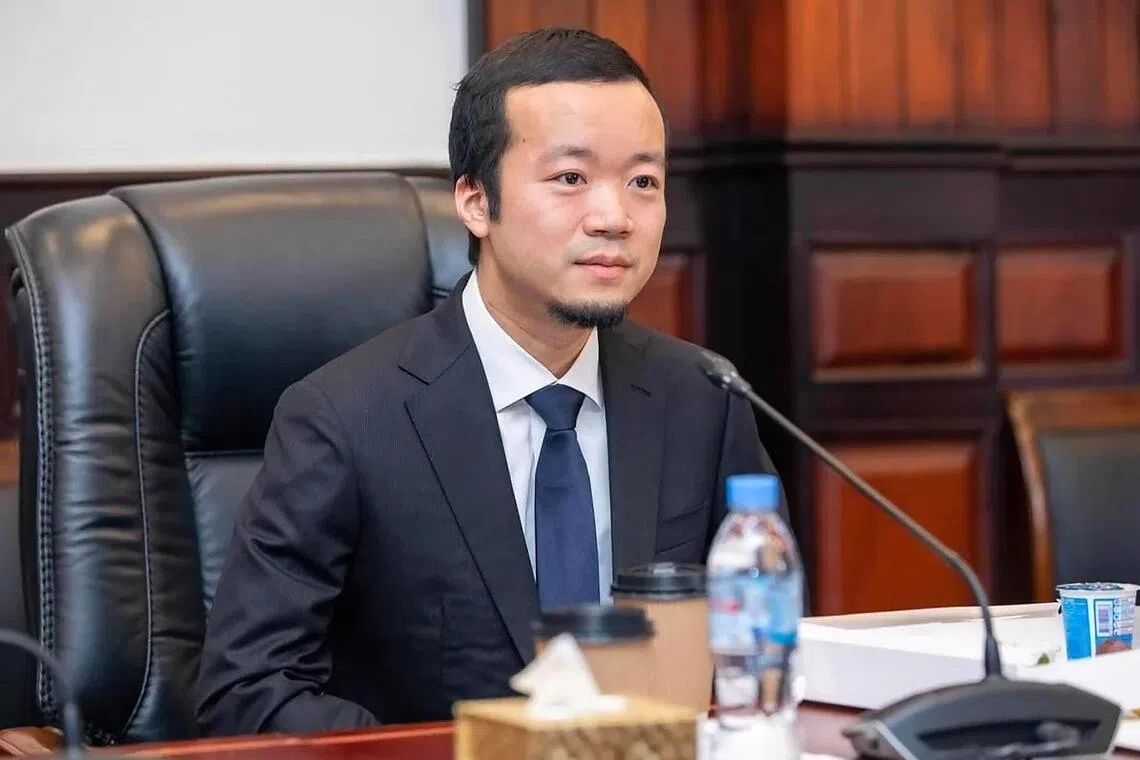
Chen Sokly, the Shanghai-born associate of disgraced scam kingpin Chen Zhi, maintained a carefully constructed facade of legitimacy across three continents, operating under multiple identities while orchestrating bribery schemes and violence on behalf of a multi-billion dollar criminal enterprise. Identified this month as co-conspirator number two in a US federal indictment filed in October 2025, Sokly's story emerged from a six-month investigation by The Straits Times and the Organised Crime and Corruption Reporting Project that examined hundreds of official records to pierce the secrecy surrounding the Prince Holding Group's international operations. The discovery of Sokly's elaborate asset holdings and corporate structures in Singapore, California and beyond illustrates how sophisticated transnational crime syndicates exploit the opacity of financial systems and the mobility of modern wealth to conceal illicit proceeds.
Born Chen Xing in Shanghai in 1986, Sokly obtained Cambodian citizenship in late 2017 and subsequently acquired Cypriot nationality as well, creating a patchwork of identities suited to different jurisdictions and business purposes. In Singapore's business circles, he cultivated the persona of Martin Chen, a wealthy entrepreneur, while simultaneously establishing himself as a trusted lieutenant to Chen Zhi, who prosecutors say orchestrated a global investment fraud and money laundering operation centred on the exploitation of migrant workers trapped in scam compounds throughout Cambodia. This compartmentalisation of identity served multiple strategic functions: it allowed Sokly to operate with apparent legitimacy in regulated financial centres while maintaining deniability regarding his criminal associations. The indictment describes Sokly's primary role as managing the syndicate's risk control function, a euphemism for monitoring law enforcement investigations and engaging in corrupt dealings with foreign officials to shield the organisation from prosecution.
Sokly's relationship with Chen Zhi was characterised by a dynamic of loyalty and shared criminal enterprise that extended to sensitive conversations about the breadth of official corruption the group had cultivated. Documents obtained by US authorities revealed that the two men would extensively discuss how many government officials Sokly had successfully compromised or placed on the payroll, suggesting a well-documented system of bribery and influence-peddling. In May 2023, prosecutors alleged that Sokly orchestrated communications with a Chinese government official who offered to use his position to protect Prince Group associates from legal jeopardy in exchange for personal favours, including payments to the official's family members. The audacity of these arrangements speaks to the confidence Sokly possessed regarding the depth of official protection the syndicate enjoyed, particularly in Cambodia, where he dismissed concerns about crackdowns on illegal scam operations by asserting that nothing would befall the Prince Group regardless of external pressure.
Bribery was not merely incidental to Sokly's operational mandate but rather central to maintaining the syndicate's dominance and impunity. A ledger of bribe payments allegedly maintained by Chen Zhi and recovered by US authorities documented an instance in 2019 when Sokly purchased a yacht valued at more than US$3 million for a foreign government official, underscoring the scale of monetary inducements deployed to secure protective relationships. Beyond financial corruption, Sokly also wielded violence as an instrument of control and internal discipline within the organisation. When a member of the Prince Group embezzled funds in mid-2024, Chen Zhi specifically directed another associate to contact Sokly to handle the matter, positioning him as the syndicate's enforcer and problem-solver. His own words further illuminate his role: during a discussion with associates, Sokly boasted that the global criminal network was generating approximately US$30 million daily through its various illicit enterprises, a figure that captures the extraordinary financial scale of the operation and Sokly's pride in his contribution to its success.
Sokly's accumulation of real estate and luxury assets across the United States reveals how proceeds from the scam enterprise were systematised into tangible wealth in jurisdictions perceived as offering stability and discretion. Property records from California obtained by investigators show that in 2019, Sokly purchased a residential property from Fang Zhizhen, a member of the Knight Attack Group, a Chinese cybercriminal organisation that predated and influenced the Prince Group's formation. This transaction underscores the interconnected nature of transnational criminal networks and how assets flow between different criminal enterprises. Sokly subsequently sold the California property in 2024 for approximately US$4.5 million, realising substantial profit. More significantly, on November 4, 2025—just weeks after the US announced sweeping sanctions against Chen Zhi and the Prince Group—Sokly transferred ownership of a separate property valued at US$4 million to his wife, an apparent effort to shield assets from potential government seizure by placing them in a family member's name. In December 2025, that property was further obscured through placement in a trust controlled by his wife, a common legal manoeuvre employed to complicate asset tracing and forfeiture.
Singapore became Sokly's entry point into legitimacy and wealth accumulation within Southeast Asia, offering a sophisticated financial centre where he could establish corporate structures and acquire high-value real estate under the veneer of a successful businessman. In 2017, he announced his presence in the city-state with the purchase of a luxurious five-thousand-square-foot apartment at 10 Leedon Heights for S$11 million, equivalent to approximately US$8.61 million at that time. This prestigious address in Singapore's upscale residential enclave served as his base of operations and lifestyle anchor. Shortly thereafter, Sokly incorporated M Capital Global Holdings, his first Singapore company, into which he and his wife invested just over S$5 million in equal shares, with both remaining shareholders to the present day. The couple's continued co-ownership suggests a deliberate strategy of intertwining family finances to complicate tracing and potential asset seizure by authorities.
During the subsequent two years, Sokly embedded himself deeply within Singapore's corporate landscape by serving as a director across at least sixteen different firms, positioning himself as an active and legitimate participant in the local business ecosystem. However, his directorial roles began a systematic withdrawal between 2020 and 2023, a period coinciding with increased scrutiny of transnational criminal networks and potential investigations into his activities. The firms listing Sokly as director operated from shared office space at a Shenton Way address, the central business district location lending further credibility to their apparent legitimacy. When investigators visited the building and checked the directory, they found that only two companies occupied the office space on the twelfth floor, with no discernible connection to Sokly or his stated enterprises, suggesting that some of his directorial positions may have been nominal or designed primarily for money laundering or corporate opacity rather than genuine business operations.
Former employees who interacted with Sokly during his Singapore tenure, while declining public identification for safety reasons, provided insights into his operational patterns and lifestyle. They characterised his presence in Singapore as seasonal rather than permanent, noting that he typically spent between two and three months annually in the city-state, suggesting that his Singapore base served primarily as a financial and corporate nexus rather than his principal residence. During his time in Singapore, Sokly cultivated a specific social profile centred on leisure and informal business networking, spending evenings socialising with associates over alcohol, a practice that reinforced bonds within the criminal enterprise while maintaining superficial normalcy. His material possessions reflected both his criminal wealth and his desire to project an image of successful entrepreneurship: he maintained a fleet of luxury vehicles at his Leedon Heights residence, including a Bentley and a high-end seven-seater sports utility vehicle, visible symbols of unearned affluence that would not trigger suspicion from casual observers or less sophisticated authorities.
The sanctions announced by the United States Office of Foreign Assets Control in October 2025 resulted in the forfeiture of 127,271 bitcoins, valued at approximately US$15 billion at the time of seizure, representing one of the largest financial fraud takedowns in history. Six days after that action, the US unexpectedly lifted sanctions against Chen Zhi, the Prince Holding Group and affiliated entities, a dramatic reversal that raised questions about diplomatic negotiations, intelligence sharing or other considerations that motivated the policy shift. Sokly's current whereabouts are believed to be within the United States, though his precise location and legal status remain undisclosed. The timing of his November 2025 property transfer to his wife suggests awareness of impending enforcement actions and efforts to restructure assets to evade government seizure.
The unmasking of Sokly's operations carries significant implications for Southeast Asian financial systems and regulatory frameworks. His ability to establish legitimate corporate structures, acquire premium real estate and maintain a respectable business persona while simultaneously orchestrating international bribery, violence and money laundering demonstrates vulnerabilities in cross-border asset transparency and beneficial ownership verification. Singapore's reputation as a financial hub makes it particularly attractive to criminals seeking to legitimise illicit wealth, and Sokly's case illustrates how determined operators can exploit gaps between corporate registration requirements and actual beneficial ownership scrutiny. The involvement of multiple jurisdictions—Cambodia as the site of scam operations, Singapore as the financial and corporate base, the United States as the ultimate destination for illicit wealth—underscores how transnational criminal enterprises exploit regulatory fragmentation and the limitations of bilateral cooperation in detecting and disrupting complex money laundering schemes. For Malaysian authorities and financial regulators, the Sokly case serves as a cautionary example of the sophistication required to identify predatory international criminal organisations that may be operating within or through the region's financial system.

