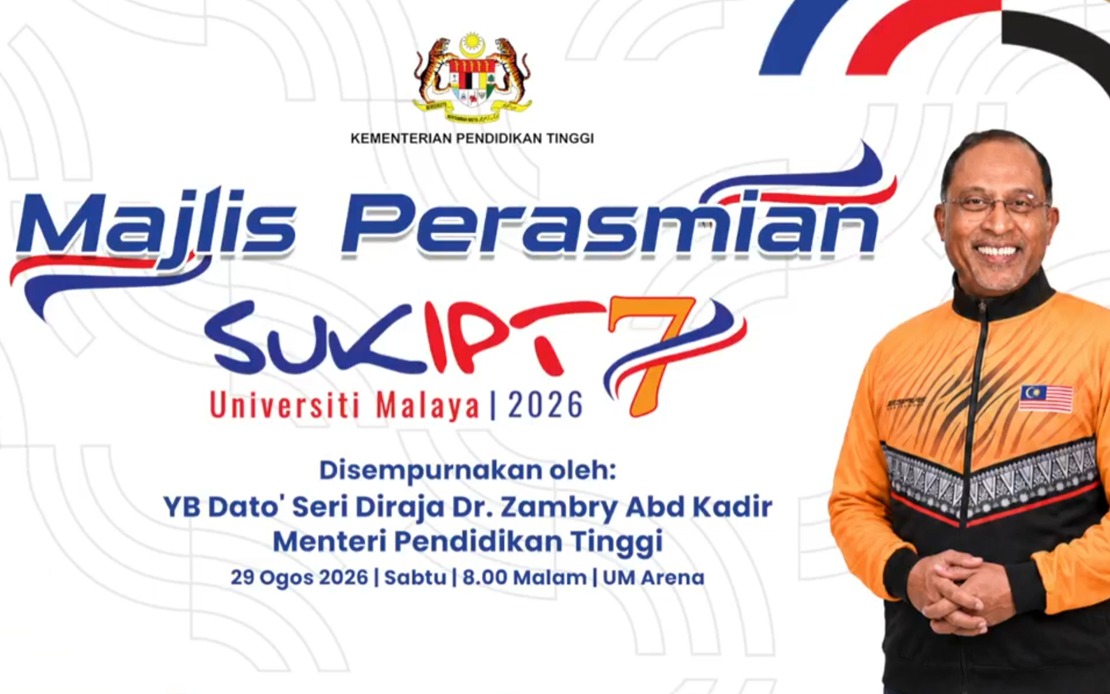
The nation's university sports ecosystem is proving itself as a genuine incubator for elite athletic talent capable of competing on the global stage, according to Higher Education Minister Datuk Seri Dr Zambry Abdul Kadir. Speaking at the opening of the Higher Education Institution Games (SUKIPT) 2026 at Universiti Malaya Arena, Zambry underscored how achievements by institutional athletes in international competitions demonstrate the substantial capacity within Malaysia's student population to reach the pinnacle of sporting performance.
Recent performances at the Glasgow 2026 Commonwealth Games have provided compelling validation for this assessment. Muhammad Erry Hidayat of Universiti Putra Malaysia captured gold in the men's 79-kilogramme weightlifting category, while his counterpart Muhammad Aniq Kasdan from Universiti Teknologi MARA secured top honours in the 60kg division. These dual victories in weightlifting underscore the strength of Malaysia's institutional training programmes in developing technically proficient competitors in strength sports, a discipline requiring sustained investment in coaching expertise and facility infrastructure.
The success extends beyond weightlifting into traditionally under-represented sporting disciplines for Malaysian athletes. Amir Daniel Abdul Majid from Universiti Sains Malaysia made historical headway by claiming gold in judo at the Commonwealth Games, becoming the first Malaysian to capture Commonwealth gold in this sport. This breakthrough represents not merely an individual achievement but signals the emergence of competitive judo as a viable pathway for Malaysian success at major international competitions. Meanwhile, Amirul Daniel Abdul Rahim from Universiti Malaya contributed a bronze medal in lawn bowls, rounding out a diversified medal haul across multiple sporting domains.
Domestically, the institutional athletics system has simultaneously produced a succession of record-breaking performances that foreshadow future international competitiveness. The 400-metre circuit saw Omar Osman from Politeknik Sultan Ibrahim set new national standards, whilst the short-sprint disciplines witnessed dual Malaysia Games (SUKMA) records shattered. Muhammad Fadwah from UiTM and Danish Iftikhar Muhammad Rosli from Universiti Pendidikan Sultan Idris collaborated to establish new benchmarks in the 200-metre and 4x100-metre relay events respectively, suggesting that institutional investment in track athletics continues yielding measurable returns.
The seventh edition of SUKIPT, designated with the theme "Creating a Legacy of Champions," operates on an expanded competitive framework that reflects the sector's institutional breadth. Sixty-four contingents are participating in the August 28 to September 6 championships at Universiti Malaya, encompassing twenty public universities, forty-two private higher education institutions, one polytechnic institution, and one community college. This broad participation matrix demonstrates how competitive sports infrastructure has become embedded across multiple tiers of Malaysia's post-secondary education landscape.
The scale of competition this year involves 8,244 athletes and officials competing across thirty sporting disciplines, with organisers distributing 227 gold medals. To incentivise peak performance, the organising committee has implemented an aggressive financial rewards structure: RM3,000 prizes for individual Sportsman and Sportswoman of the Games designations, RM7,000 for top-performing male and female teams, and notably RM20,000 for athletes who breach existing national records. This tiered incentive scheme explicitly encourages record-setting attempts, aligning financial rewards with the advancement of measurable sporting standards.
Zambry's emphasis on institutional sport as a pathway to national excellence reflects a strategic reorientation within Malaysian sports policy. Rather than viewing university athletics solely as developmental infrastructure feeding semi-professional or professional pipelines, the minister articulates a vision wherein institutions themselves function as primary competitive nodes capable of generating medal-winning performances. This represents a departure from traditional hierarchies that typically positioned institutional sport as subordinate to national team systems or club-based structures.
The minister's framing—that institutional sport should be "a face that dares to challenge records and is capable of elevating Malaysia's name on the world stage"—encapsulates an explicit mandate for universities to pursue excellence beyond domestic competition. This aspirational language suggests that institutional leadership has received clear directives to prioritise elite athlete development within broader educational missions. The concentration of recent Commonwealth Games medals among IPT athletes suggests these institutional efforts are gaining traction.
For Southeast Asian sporting contexts, Malaysia's institutional model offers instructive lessons regarding talent identification and development pathways. Unlike systems that rely heavily on national academies or centralised talent pipelines, the Malaysian approach disperses competitive resources across multiple institutions, potentially reducing dependency on single points of failure whilst broadening talent recruitment nets. The polyvalent success across weightlifting, judo, lawn bowls, and athletics indicates that different institutional environments can specialise in distinct sporting disciplines, creating a networked system of complementary expertise.
The economic implications of this institutional sports investment warrant consideration. Universities are simultaneously housing academic programmes and elite training facilities, potentially achieving efficiency through shared infrastructure utilisation whilst generating institutional prestige through athletic achievement. For smaller nations in the region with constrained capital budgets, this integrated model may prove more fiscally sustainable than establishing parallel national sports complexes.
Looking ahead, the performance benchmarks established by current IPT athletes will shape expectations for future cohorts. The record-breaking achievements in track events and the Commonwealth Games medals establish new baselines that subsequent institutional programmes must meet or exceed. Zambry's public endorsement of these achievements signals that government policy will likely continue supporting institutional sports development, though translating this political commitment into sustained funding and facility modernisation remains an ongoing operational challenge.
The SUKIPT 2026 championship itself functions simultaneously as competitive showcase and recruitment opportunity, with younger university-affiliated athletes witnessing elite performances across thirty disciplines. This demonstration effect—where aspiring competitors observe achievable excellence within their own institutional contexts—may prove as valuable as direct financial incentives in motivating the next generation of athletes to pursue world-class ambitions whilst remaining embedded within the university system.

