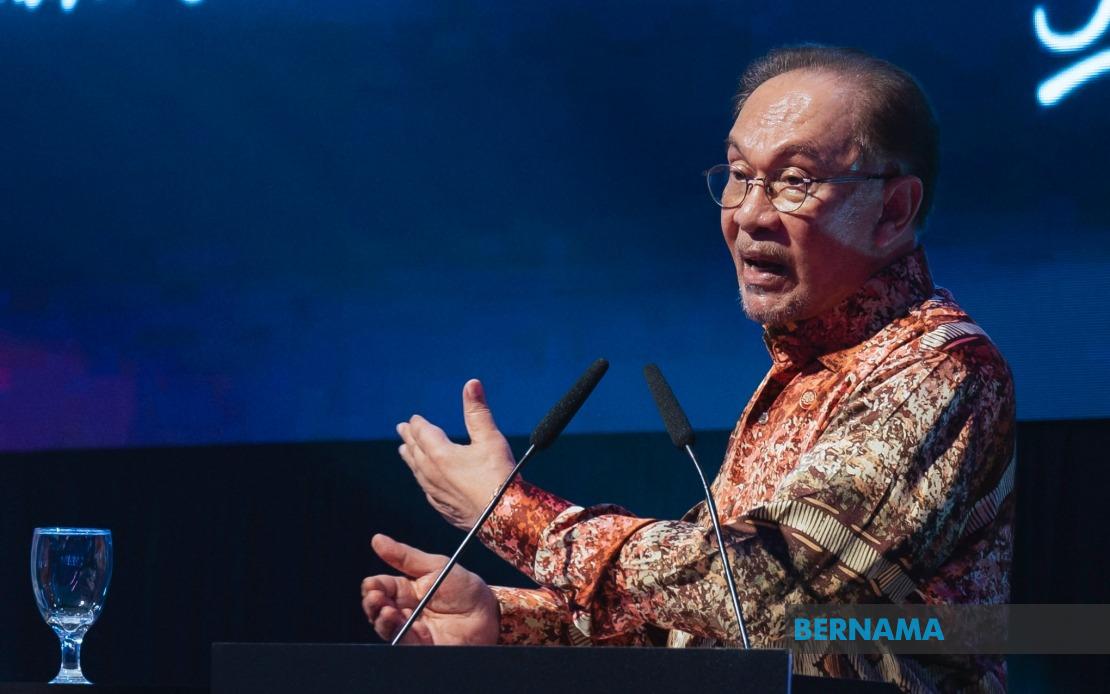
Prime Minister Datuk Seri Anwar Ibrahim's recent comments regarding Taiwan have drawn scrutiny, particularly his acknowledgment of China's position that force may become relevant should peaceful reunification efforts ultimately fail. Observers and international commentators have reacted with concern, yet his underlying argument warrants careful examination beyond the initial headlines. Rather than endorsing military action, Anwar advanced a perspective grounded in classical deterrence theory—the notion that a credible capacity to respond to aggression serves to prevent aggression from occurring in the first place. This distinction between capacity and intent forms the intellectual foundation of his remarks, and it reflects a sophisticated understanding of how states navigate geopolitical tensions while maintaining diplomatic flexibility.
To clarify his position, Anwar drew an analogy rooted in Malaysia's own constitutional and territorial context. He posed a straightforward question: would any Malaysian government genuinely accept the peaceful dissolution of the federation without attempting to preserve national unity? This rhetorical framing underscores that the principle of territorial integrity transcends ideological boundaries and applies universally across nations. Every state, regardless of its governance model or international alignment, maintains an implicit obligation to its citizens to resist dismemberment. From this lens, Anwar suggested that China's insistence on preserving territorial integrity with respect to Taiwan follows an identical logic—not an aberration in international relations, but a standard feature of state behaviour that most nations would readily endorse if their own territorial cohesion were at stake.
The deterrence framework Anwar invoked rests on a critical paradox: military capacity proves most effective when never actually deployed. Renouncing the theoretical possibility of force entirely can inadvertently invite challenges to the status quo, as adversaries may calculate that they face no serious consequences for aggressive action. Conversely, maintaining a credible option—even if it remains perpetually unused—generates uncertainty in an opponent's strategic calculations. This uncertainty itself becomes a restraint on destabilising behaviour. Throughout Cold War history and into the contemporary period, deterrence has functioned as a conflict-prevention mechanism precisely because both sides recognised the potential consequences of miscalculation. Anwar's framing places this classical doctrine into the Taiwan context, arguing that Beijing's refusal to renounce the use of force paradoxically reduces the likelihood that such force would ever become necessary, provided other parties respect the established boundaries and red lines.
Crucially, Anwar's argument distinguishes sharply between retaining the capacity for force and actively seeking conflict. The diplomatic record shows that states routinely employ tough rhetoric about military options while simultaneously pursuing exhaustive negotiation and political settlement. Peaceful resolution, legal frameworks, and inclusive dialogue always constitute the preferred pathway and should remain the primary focus of international engagement. The reservation of force functions as a backup mechanism—acknowledged but not advertised as the solution of choice. This ordering of preferences reflects the traditional hierarchy of conflict resolution: negotiation first, then mediation, then enforcement mechanisms, with military action appearing only when all peaceful avenues have been genuinely exhausted. Anwar's position aligns with this conventional wisdom rather than departing from it.
Within the specific context of Malaysia's established One China policy, Anwar's remarks acquire additional coherence and consistency. Malaysia formally recognises the People's Republic of China and does not afford diplomatic status to Taiwan as a separate sovereign state. Simultaneously, Malaysia maintains robust economic relationships and extensive people-to-people connections with Taiwan, reflecting the pragmatic reality that economic interdependence and cultural ties transcend official diplomatic categories. This balanced posture requires acknowledging the legitimacy of Beijing's concerns regarding national territory while avoiding any suggestion that Malaysia endorses coercive measures to resolve the dispute. Anwar's logic proceeds from this equilibrium: if Malaysia genuinely adheres to the One China framework, it cannot dismiss or delegitimise Chinese concerns about territorial integrity, even as it simultaneously advocates for peaceful and consensual resolution of differences.
Taiwan's own perspective presents a fundamentally different starting point. The island's democratically elected authorities and its substantial portion of the population view Taiwan as a sovereign state deserving recognition and self-determination. From this vantage point, any invocation of military options—regardless of whether presented as deterrence or as a last resort—risks normalising coercion and undermining Taiwan's democratic legitimacy. Taipei would contend that the dispute cannot be resolved through force but only through genuine agreement reflecting the will of Taiwan's inhabitants. This position possesses considerable moral force and reflects international norms concerning self-determination and human rights. The tension between Beijing's sovereignty concerns and Taipei's self-determination claims cannot be easily bridged through intellectual frameworks alone; both sides maintain fundamentally incompatible visions of Taiwan's future status and political identity.
Yet Anwar's fundamental argument operates at a different level than the disagreement between Beijing and Taipei. He contends that preserving deterrent capacity does not equate to advocating war or coercion. Rather, it reflects a realist assessment that states do not voluntarily pre-commit to accepting territorial diminishment or political collapse. This observation transcends any particular ideological framework; it describes how nations typically behave across vastly different political systems and cultural contexts. A unilateral renunciation of force as an absolute last resort might paradoxically encourage precisely the sort of miscalculation and instability that Malaysia wishes to prevent throughout the region. The intellectual coherence of this position does not require agreement with Beijing's political claims or dismissal of Taiwan's aspirations; it merely acknowledges the structural logic of how states navigate existential questions about territorial integrity.
For Malaysia and indeed all ASEAN member states, a military confrontation in the Taiwan Strait would constitute a catastrophic development with ramifications extending far beyond the parties directly involved. The region's extraordinary dependence on free transit through contested waters, the concentration of global semiconductor manufacturing and advanced technology production in the immediate vicinity, and the delicate balance of great-power relations upon which ASEAN prosperity depends would all face profound disruption. Malaysia's trading networks, supply chains for critical manufacturing inputs, and energy security would all come under severe stress in the aftermath of such conflict. Beyond these material considerations, any military escalation would shatter the diplomatic consensus that has enabled ASEAN to maintain relative autonomy and preserve what remains of the regional rules-based order. Malaysia therefore possesses compelling strategic interests in preventing escalation and promoting continuous dialogue among all parties, regardless of their fundamental disagreements about Taiwan's political status.
Given these stakes, Malaysia must persist in its consistent emphasis on restraint, open channels of communication, and commitment to peaceful resolution of disputes through established diplomatic and legal mechanisms. This position does not require Malaysia to abandon the One China policy, nor does it necessitate endorsing Beijing's security concerns as paramount over all other considerations. Rather, it reflects a clear-eyed recognition that ASEAN's stability and prosperity depend on preventing great-power conflict in its midst. Malaysia can simultaneously acknowledge the legitimacy of different perspectives on Taiwan's status while refusing to support any path toward military resolution. This balanced approach offers the possibility of maintaining working relationships with all parties while advocating consistently for the kind of restraint and dialogue that has, however imperfectly, prevented escalation thus far.
Returning to Anwar's original remarks, the crucial point involves recognising what he did not say as much as what he did. He did not advocate for Chinese military action against Taiwan, nor did he suggest that force represents the preferred or even a desirable outcome. Instead, he articulated the observation that states, as a general matter, maintain the capacity to defend their perceived territorial interests rather than submitting passively to dismemberment or external coercion. This represents an application of deterrence theory—a school of strategic thought with deep roots in international relations scholarship and diplomatic practice. Whether one finds this framework persuasive or concerning, it does not constitute an endorsement of violence, an abandonment of diplomacy, or a departure from Malaysia's careful balancing act on the Taiwan question.
Moving forward, Malaysia should continue building on its established diplomatic position: uphold the One China framework in formal state-to-state relations, actively encourage peaceful settlement of disputes, avoid lending support to coercive measures regardless of their source, and maintain the regional stability mechanisms that benefit all of Southeast Asia. This requires resisting pressure from any quarter to abandon neutrality or to adopt more explicitly aligned positions that might compromise Malaysia's ability to engage constructively with all parties. The principle of deterrence that Anwar referenced does not demand Malaysia's endorsement or implementation; it merely describes a structural reality that policymakers must acknowledge when thinking through scenarios involving fundamental questions of state security and territorial integrity. Malaysia's contribution to regional peace lies not in resolving this theoretical or philosophical debate but in maintaining its commitment to dialogue, restraint, and the kind of incremental problem-solving that has enabled coexistence despite profound disagreements about fundamental political questions.

