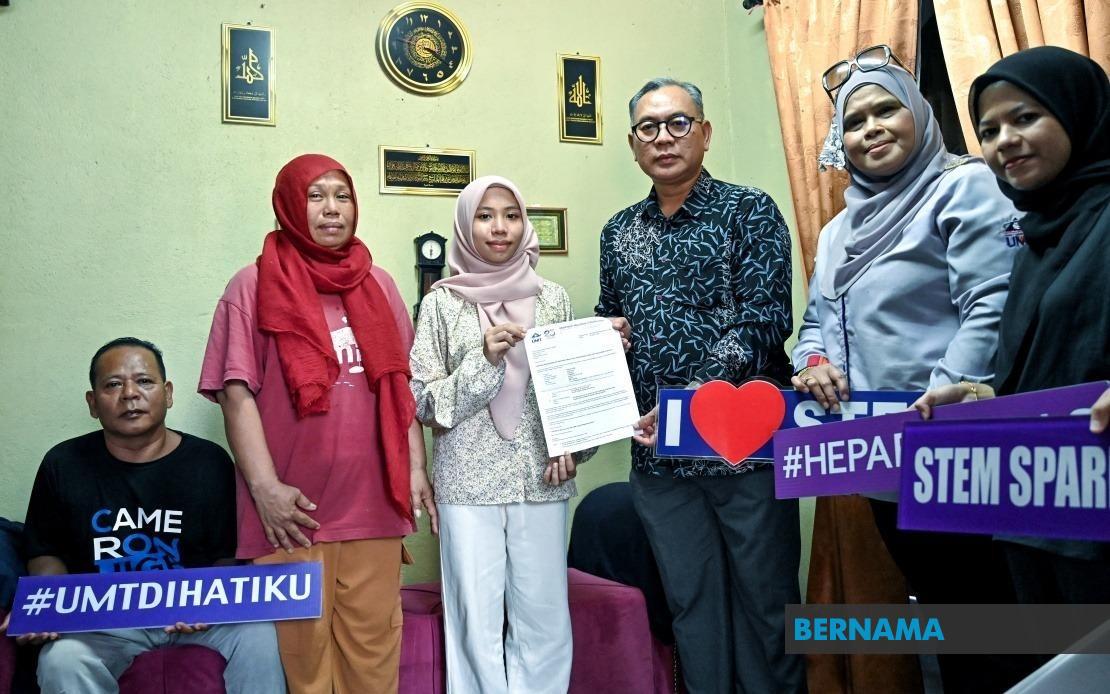
Universiti Malaysia Terengganu (UMT) has demonstrated its commitment to inclusive higher education by rescuing the dreams of Nurul Amira Abdul Hamid, 18, from Perak, whose aspirations to pursue university studies nearly collapsed under the weight of family financial hardship. The institution's intervention proved decisive in transforming what appeared to be an insurmountable obstacle into an opportunity, allowing the promising young scholar to enrol in the one-year Science, Technology, Engineering and Mathematics (STEM) Foundation programme with a pathway to a Bachelor's degree in Science (Nautical Science and Maritime Transportation).
Nurul Amira's circumstances reflect the real struggles faced by many Malaysian students from lower-income households. As the youngest of three siblings, she had initially resigned herself to abandoning her university offer after completing the Sijil Pelajaran Malaysia (SPM) examination, where she achieved a respectable three A grades. Her family situation had deteriorated significantly, with her father, Abdul Hamid Othman, 58, dealing with persistent health complications that limited his earning capacity, while her mother, Asmah Che Ros, 53, remained a housewife without independent income. The household burden fell squarely on Nurul Amira's shoulders; she took employment at a local goods store earning RM1,300 monthly to contribute to essential family expenses.
The turning point arrived when Nurul Amira made a pivotal decision to contact UMT directly and lay bare her circumstances. Rather than accepting rejection as inevitable, she communicated transparently about her family's financial constraints and explained why she could not proceed without institutional support. This initiative demonstrated maturity and determination that likely impressed the university's administrators, but more importantly, it triggered a genuine response from an institution that prioritises access and equity in higher education.
UMT's response went beyond mere gesture politics or token assistance. The university secured the Al-Ikhlas Scholarship worth RM500 for Nurul Amira and coordinated additional financial packages to substantially reduce her burden. More significantly, the institution took responsibility for paying RM400 of her associated registration and administrative fees directly, effectively removing a critical barrier that might have otherwise prevented her enrolment. This comprehensive approach acknowledges that financial hardship in Malaysia often operates on multiple fronts simultaneously—not just tuition fees, but also registration costs, campus accommodation, and living expenses that collectively create an impossible situation for families already struggling.
UMT Vice-Chancellor Prof Dr Mohd Zamri Ibrahim articulated a philosophically important stance on the university's role in society. Rather than viewing financial assistance as a peripheral charitable function, he framed it as a core institutional responsibility embedded in the university's mission. His statement that UMT takes a deliberate, hands-on approach to identifying and meeting with students and families experiencing financial difficulty signals a proactive rather than reactive stance—the institution actively seeks out struggling students rather than waiting passively for requests to arrive.
The support extended beyond financial assistance to encompass broader logistical support that directly enables academic success. Because Nurul Amira's family lacked the means to transport her from Perak to the Terengganu campus for enrolment and orientation, UMT provided transportation and campus access arranged directly with her. The institution also committed to providing living assistance throughout her study period, recognising that financial anxiety and material insecurity are significant obstacles to academic concentration and performance. This holistic support ecosystem—combining scholarships, fee remission, accommodation support, and transportation—reflects sophisticated understanding of how poverty functions as a barrier not merely to access but to genuine academic engagement.
The narrative of Nurul Amira's situation carries wider significance for higher education policy across Malaysia and Southeast Asia. As national economies face various pressures and family incomes stagnate or decline in real terms, the burden of education costs increasingly falls on vulnerable households. Many talented students undoubtedly abandon university aspirations annually simply because they lack knowledge of or access to support mechanisms. UMT's approach suggests that universities must move beyond publishing scholarship information passively and instead develop systematic outreach to identify struggling students early in the admissions process.
Prof Mohd Zamri's revelation that UMT had assisted more than ten students from underprivileged families during the current academic year indicates this is not an isolated intervention but part of an institutional pattern. This data point is encouraging, yet it also raises questions about saturation and sustainability. If demand for such assistance substantially exceeds the university's capacity to provide it, the institution may inadvertently create a system where only a fraction of eligible students benefit while others remain unaware of possibilities or fall through administrative gaps.
The case also illustrates the intersection between educational aspiration and economic reality that shapes life trajectories across Malaysia. Nurul Amira possessed the academic credentials—three A grades in SPM—that conventionally signal university readiness. Her aspiration to pursue maritime studies, a growth sector aligned with Malaysia's geographic and economic positioning, represented rational career planning. Yet without UMT's intervention, she would have remained trapped in precarious part-time employment, her potential unrealised and her nation deprived of a trained professional. This dynamic plays out thousands of times annually across Malaysian society, representing an enormous human capital loss.
The maritime education pathway Nurul Amira now pursues carries specific significance for Malaysia. As a nation with extensive coastlines, substantial maritime trade, and strategic positioning in one of the world's busiest shipping lanes, Malaysia's economic future depends partly on having sufficient professionals trained in nautical science, maritime logistics, and related fields. By supporting Nurul Amira's education, UMT simultaneously invests in an individual's future and in national capacity-building within a strategically important sector.
Looking forward, Nurul Amira's experience suggests a replicable model that other Malaysian universities might adopt or strengthen. Her success depends not on exceptional generosity but on relatively straightforward institutional mechanisms: proactive identification of struggling students, flexible scholarship systems that respond to individual circumstances, willingness to cover non-tuition costs, and provision of living support. These approaches require genuine commitment but no extraordinary expenditure, particularly if universities pool resources and coordinate with government funding bodies.
The broader message conveyed by UMT's intervention speaks to the continuing salience of education as a social mobility mechanism in Malaysia. Despite persistent questions about returns on education investment and changing labour market dynamics, access to university study remains a critical determinant of life outcomes and earning potential. Institutional commitment to removing financial barriers therefore functions as genuine commitment to equal opportunity—not equality of outcome, but equality of access to the mechanisms through which individuals can pursue their capabilities.
As Nurul Amira settles into her maritime studies, her journey will likely involve rigorous academic demands, professional networking opportunities, and exposure to career possibilities previously unimaginable to her while working in a goods store. Whether she ultimately pursues shipboard positions, port management, maritime law, or logistics management, her trajectory has been fundamentally altered by UMT's decision to intervene. The real measure of the university's success will emerge years from now, when Nurul Amira contributes professionally and economically to Malaysian society, her talents fully developed rather than tragically wasted.

