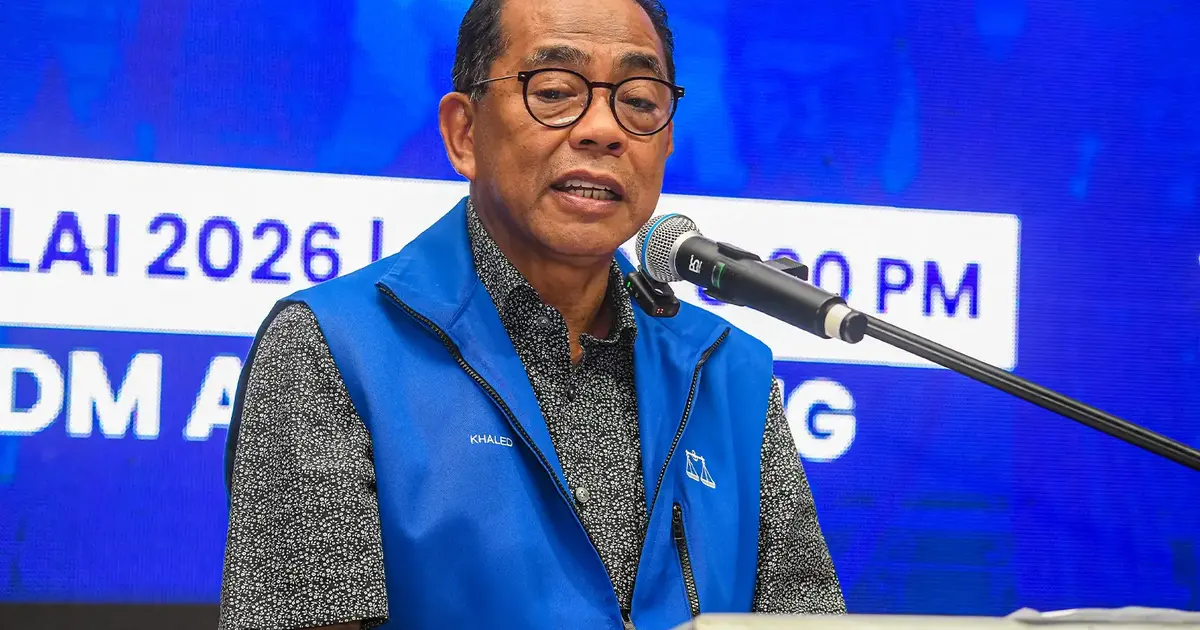
Umno vice-president Khaled Nordin has intensified calls for voters in Negeri Sembilan to deliver a crushing electoral blow to Bersatu, echoing the party's recent collapse in Johor and signalling deepening divisions within Malaysia's ruling coalition ahead of the next general election. Speaking to party supporters, Khaled argued that a comprehensive rejection of Bersatu would eliminate its political foothold and weaken its negotiating position before GE16, reflecting mounting tensions between the two Malay-majority parties that have dominated Malaysian politics for decades.
The statement underscores the deteriorating relationship between Umno and Bersatu, which have governed in an increasingly strained alliance since the 2022 elections. While both parties form the backbone of the current administration, their strategic divergences have surfaced repeatedly, particularly over ministerial posts, resource allocation, and competing claims to represent Malay and Muslim interests. Khaled's appeal suggests Umno is preparing for a more competitive electoral environment where it may challenge Bersatu directly rather than maintaining the comfortable coexistence that has characterised their recent partnership.
Bersatu's recent performance in Johor provides the template Khaled is invoking. The party, which once claimed to champion grassroots Malay interests under Tan Sri Muhyiddin Yassin's leadership, suffered significant electoral setbacks in the state, where it contested against better-organised Umno machinery. The disparity highlighted how local party structures, incumbent advantage, and consolidated opposition campaigns can overwhelm Bersatu's resources and organisational capacity. For Umno strategists like Khaled, replicating that outcome across key states would progressively marginalise Bersatu before voters head to the polls for the general election.
Negeri Sembilan holds particular strategic importance for this calculus. The state remains a bellwether for Peninsular Malaysian politics, with a mixed demographic profile that includes substantial urban, semi-rural, and agricultural constituencies. Bersatu's performance there would signal whether the party can maintain relevance beyond its Sabah and Sarawak strongholds, or whether it faces terminal decline across Peninsular Malaysia. A sweeping Umno victory would validate Khaled's assertion that voters are prepared to make clear choices about which Malay-based party deserves their support.
The timing of Khaled's remarks reflects broader calculations within Umno's leadership. As the party contemplates scenarios for GE16, senior figures are weighing whether the current coalition framework serves Umno's long-term interests or whether a more adversarial stance toward Bersatu would energise the Umno base and simplify political messaging. The party has historically derived legitimacy from its claim to be the paramount custodian of Malay-Muslim political interests, a position that becomes more defensible if Bersatu can be portrayed as a divisive splinter faction rather than a legitimate alternative.
For regional observers and Malaysian voters, this intra-coalition friction raises important questions about the stability of the current government. If Umno and Bersatu are openly competing rather than cooperating, the implications extend beyond electoral theatre to questions of cabinet cohesion, policy consistency, and whether the administration can effectively govern in the interim period before GE16. Recent months have already seen tensions over key appointments and resource distribution, suggesting that rhetorical warfare may soon translate into substantive policy disagreements.
Bersatu's response to such challenges will be crucial. The party, smaller and less institutionally entrenched than Umno, has limited capacity to resist a sustained electoral challenge from its more established coalition partner. Muhyiddin's subsequent moves—whether to deepen ties with opposition parties, consolidate strength in East Malaysia, or attempt reconciliation within the coalition—will shape the political landscape considerably. Any negotiation breakdown could force a significant realignment that affects which parties govern and how power is distributed across Malaysia's states and at federal level.
The broader context of Malaysian politics remains one of fragmentation and realignment. Unlike the stable two-coalition structure that prevailed for decades, contemporary Malaysian elections feature multiple parties competing within and across traditional alliance frameworks. Umno's willingness to directly contest Bersatu suggests it is adapting to this new environment, where maintaining exclusive coalition partnerships may be less valuable than securing the largest possible vote share and parliamentary seats. This shift carries implications for how Malaysians perceive political stability, democratic choice, and the viability of long-term governance arrangements.
For Negeri Sembilan specifically, Khaled's statement serves as a warning shot to Bersatu activists and a rallying call to Umno members and sympathisers. It establishes clear electoral terrain where neither party will hold back from aggressive campaigning. The state's voters will ultimately decide whether to endorse Umno's vision of consolidated Malay political power or maintain space for multiple parties representing such constituencies. Their choices in forthcoming electoral cycles will fundamentally shape both the composition of Negeri Sembilan's state government and the trajectory of Malaysian national politics as it moves toward GE16.

