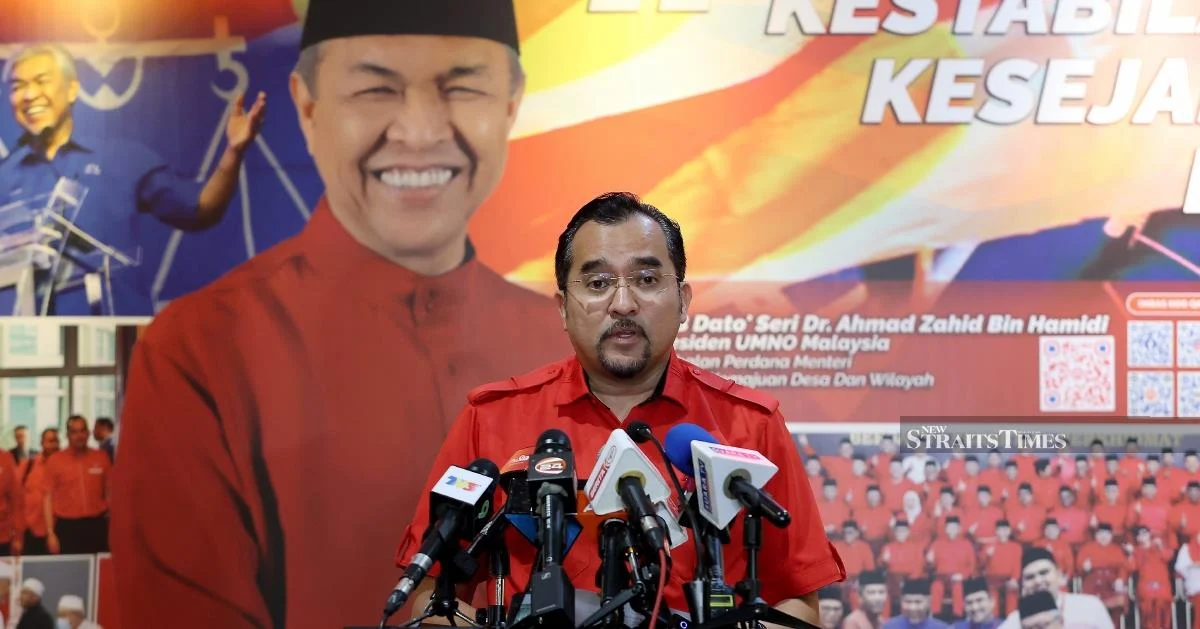
The upcoming state elections in Johor and Negri Sembilan will see Umno steering clear of character assassinations and personal attacks, according to party secretary-general Datuk Dr Asyraf Wajdi Dusuki. Instead, the party intends to centre its electoral messaging around concrete policy proposals and the tangible benefits these programmes could deliver to ordinary Malaysians, marking a strategic shift towards substantive political debate.
The commitment to a clean campaign reflects broader concerns within Malaysian politics about the corrosive effects of personal mudslinging and negative campaigning. By anchoring its strategy to policy content, Umno appears to be calculating that voters in both states will respond more favourably to candidates and manifestos focused on addressing their immediate concerns—economic pressures, infrastructure gaps, and service delivery—rather than becoming enmeshed in partisan character disputes that historically dominate regional electoral contests.
Johor and Negri Sembilan hold distinct political significance within the Malaysian federation. Johor, as the nation's southernmost state with a substantial population and developed economy centred on the Klang Valley's industrial fringe and its own commercial corridors, represents crucial electoral terrain for any coalition seeking federal dominance. Negri Sembilan, while smaller and less populous, occupies strategic value in peninsular politics and has traditionally been competitive between major parties. Control of either state translates into tangible political capital and administrative influence across several years.
The timing of these state elections arrives amid broader realignments within Malaysian coalition politics. The government structure that emerged from recent federal elections continues to navigate complex power-sharing arrangements, and state-level contests serve as crucial barometers of coalition durability and public sentiment. Strong performances in these contests could strengthen Umno's position within the government machinery, whilst disappointing results might force internal reassessments about strategy and messaging effectiveness.
Umno's emphasis on policy-oriented campaigning also addresses the party's own internal dynamics. After a period of considerable political turbulence involving leadership transitions, factional tensions, and questions about organisational coherence, the party has been rebuilding its appeal among middle-class and traditional constituencies. Focusing campaign energy on substantive offerings rather than adversarial attacks presents the party as constructive and forward-thinking, potentially repositioning Umno's public image after years of divisive internal contests.
The move towards clean campaigning carries particular resonance for Malaysian voters increasingly fatigued by the negativity that has characterised recent electoral cycles at both federal and state levels. Constituencies across the nation have grown weary of campaigns dominated by personality clashes, allegations of corruption, and thinly veiled insults dressed up as political commentary. A shift towards discussing infrastructure projects, economic initiatives, educational policies, and healthcare improvements could appeal to voters frustrated with the constant background noise of intra-elite conflict.
However, maintaining campaign discipline around such commitments presents real implementation challenges. Political operatives at the grassroots level, particularly in intensely competitive constituencies, frequently resort to informal networks and social media channels to circulate negative messages. Ensuring that all branches and affiliated organisations genuinely adhere to a clean campaign standard requires effective internal oversight and genuine penalties for violations. Previous iterations of similar pledges have often faltered when ambitious politicians sensed electoral advantage in crossing stated boundaries.
The campaign pledge also implicitly signals Umno's confidence in its policy platform and electoral prospects within these states. Parties typically gravitate towards negative campaigning when they perceive weakness in their own offerings or believe they cannot win on their own merits. By contrast, positioning oneself as the party elevating debate suggests internal conviction that the party's record of governance and policy ideas constitute a sufficiently compelling case to voters.
For Southeast Asian observers, Umno's approach reflects broader democratic trends across the region where voters in more developed economies and mature democracies increasingly punish politicians who rely excessively on character attacks and negative campaigning. Thailand's political contests, Indonesian regional elections, and Philippine campaigns have all demonstrated that electoral success increasingly correlates with credible policy platforms and demonstrated competence, rather than personality-driven contests dominated by accusations and controversies.
The implications extend beyond the immediate electoral contests. If Umno successfully executes a clean campaign that still achieves competitive results in Johor and Negri Sembilan, the model could influence broader patterns within Malaysian politics. Other parties might feel pressure to reciprocate, gradually shifting the character of electoral competition towards more substantive terrain. Conversely, if Umno finds itself disadvantaged by maintaining campaign discipline whilst opponents employ unrestricted tactics, the party may face internal pressure to abandon its stated principles, demonstrating the persistent tension between ethical aspiration and electoral pragmatism in Malaysian politics.