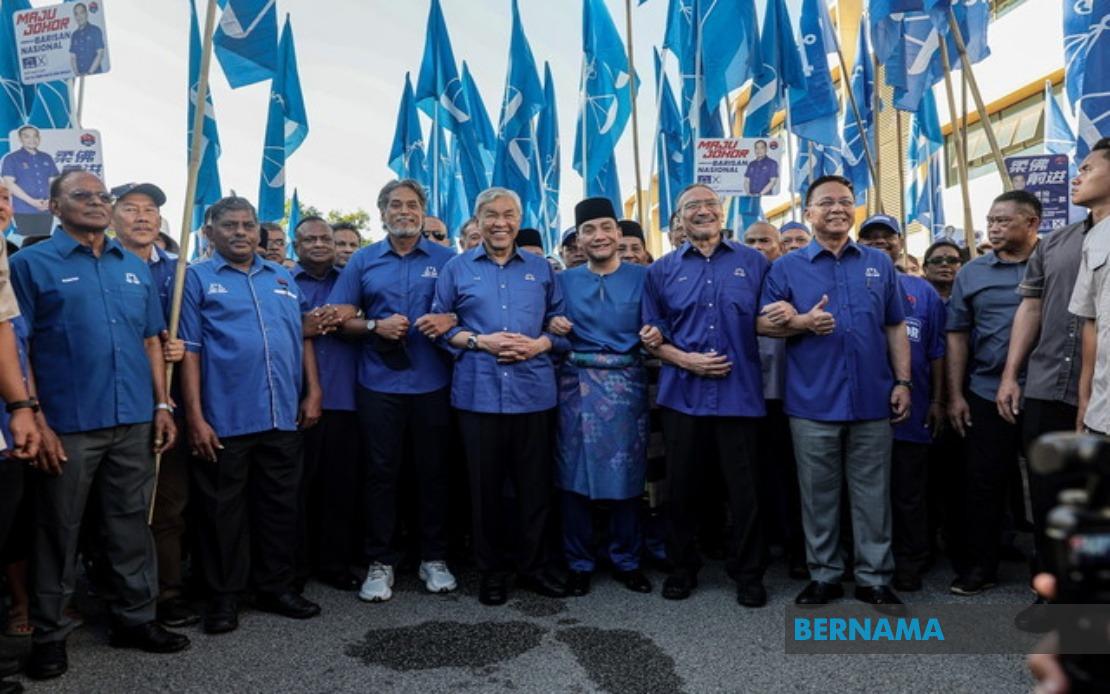
The Johor state election campaign entered a new phase on June 27 when Datuk Onn Hafiz Ghazi, chairman of Barisan Nasional in the state, formally submitted his nomination papers at the Muafakat Hall of the Simpang Renggam District Council at 9.10 am, signalling the beginning of what promises to be a closely watched electoral contest in Malaysia's second-largest state.
Onn Hafiz's filing was far from a routine administrative exercise. The incumbent Machap assemblyman arrived with substantial political firepower in tow, his nomination accompanied by UMNO president Datuk Seri Dr Ahmad Zahid Hamidi, Sembrong Member of Parliament Datuk Seri Hishammuddin Tun Hussein, and former cabinet minister Khairy Jamaluddin. The presence of these three senior party figures underscored the significance attached to Onn Hafiz's candidacy within UMNO's hierarchy and served as a visible declaration of united leadership ahead of the election.
Adding further weight to the occasion was the attendance of former Johor Menteri Besar Datuk Seri Hasni Mohammad, whose presence connected the moment to Johor's recent political history and provided continuity with the state's traditional power structures. The gathering at Simpang Renggam thus represented more than a single nomination filing—it functioned as a consolidated show of institutional support designed to project strength and cohesion within BN ranks during a period when such unity messaging carries significant strategic value.
The decision to deploy top-tier party leadership in this manner reflects UMNO's recognition that the Johor election carries implications beyond state boundaries. As Malaysia's traditionally most politically significant state and a BN stronghold, Johor's electoral outcome reverberates through national politics and influences calculations about federal power dynamics. A strong performance in the state reinforces BN's legitimacy as a governing coalition, while conversely, any erosion of support would pose questions about the coalition's broader electoral viability heading into future national contests.
On the ground at Simpang Renggam, the nomination centre became a focal point for grassroots mobilization. Supporters representing various BN component parties converged on the venue, visibly distinguishable by their party colours and armed with banners and flags to demonstrate backing for their respective candidates. This grassroots presence complemented the top-down display of leadership unity, creating a layered picture of organizational mobilization that extended from the highest party echelons down to rank-and-file supporters.
The timing and composition of those accompanying Onn Hafiz carries particular significance. Ahmad Zahid's presence as UMNO president represents the party's formal institutional endorsement, Hishammuddin's involvement as a federal Member of Parliament signals cross-level coordination between state and national politics, while Khairy's participation carries weight given his prominence in party modernization debates. Together, they embody different strands of UMNO thinking, suggesting an effort to present a unified front that transcends internal party factions.
For Malaysian and Southeast Asian observers tracking the region's democratic processes, the Johor election represents an important test case of coalition dynamics and voter sentiment in Malaysia's post-2020 political environment. The state has historically served as a testing ground for electoral strategies and demographic shifts that subsequently influence broader national trajectories. The manner in which BN mobilizes resources and support in Johor thus offers instructive lessons about coalition management and electoral competition in Malaysia's federal system.
The nomination filing also marks the formal commencement of a structured campaign period governed by electoral regulations. From this point forward, campaign activities, spending, and messaging become subject to official oversight, and the intensity of public campaigning typically escalates as candidates and parties vie for voter attention across media platforms and on-ground engagements. The presence of senior leadership at the nomination stage serves as an early signal to voters about which candidates and races BN considers priorities within its overall electoral strategy.
Onn Hafiz's position as a state-level leader elevated to carry the BN standard in a high-profile nomination context reflects confidence in his ability to deliver support in Machap and potentially influence the broader state election dynamics. Machap itself occupies a strategically important position within Johor's electoral map, and its result will form part of the aggregate picture determining overall state-level outcomes. The show of support directed toward Onn Hafiz at the nomination centre represented an investment in signalling the significance of this individual race within the larger electoral contest.
As the Johor state election unfolds, the scenes witnessed at Simpang Renggam will likely become a reference point for analyzing BN's organizational capacity and internal cohesion. The ability of the coalition to maintain the unity demonstrated at this nomination filing through to polling day will substantially influence whether BN's narrative of strength and stability resonates with voters or whether competing political forces can exploit any signs of underlying organizational strain.

