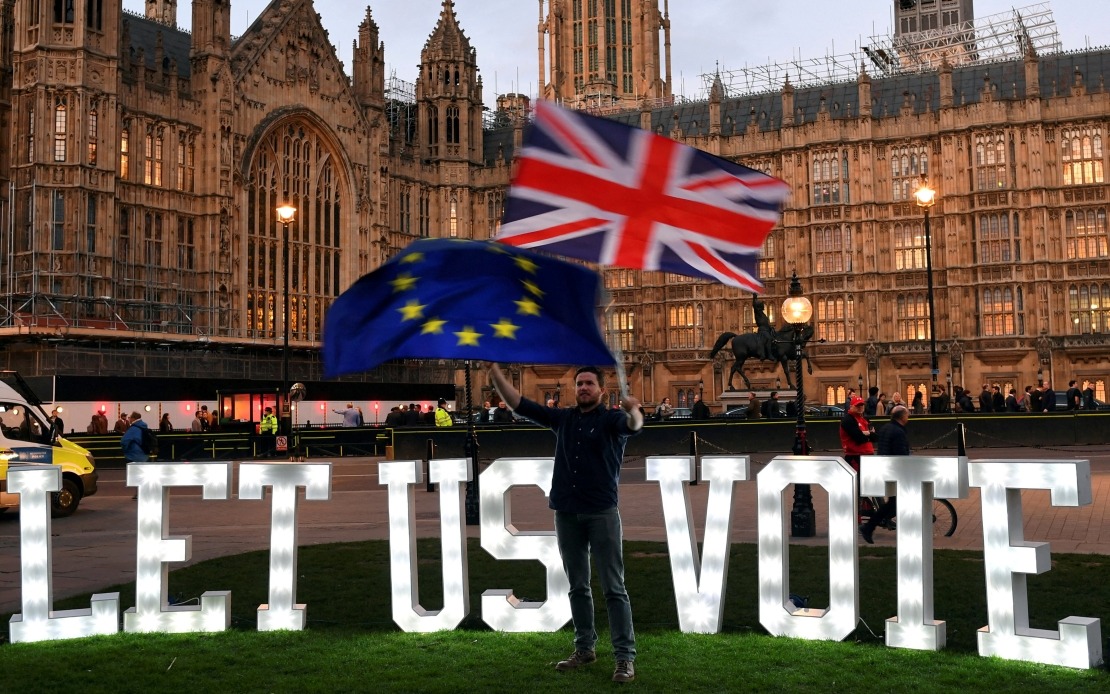
A senior member of Britain's House of Lords has cast doubt on the possibility of the United Kingdom reversing its Brexit decision, regardless of which party leads the next government. Richard Balfe, a Conservative peer, told Russian news agency RIA Novosti that returning to the EU would ultimately prove impossible, despite what might appear as halfhearted attempts from incoming administrations. This assessment comes as the country marks a decade since the 2016 referendum that triggered one of the most consequential political decisions in modern British history.
Balfe's comments arrive at a pivotal moment for British politics. Prime Minister Keir Starmer announced on Monday his intention to step down as leader of the Labour Party, though he will remain in office until a successor is chosen. The election process to select his replacement will commence on July 9 and conclude before Parliament returns in September. This leadership transition has reignited discussions about Britain's relationship with Europe, a question that continues to divide the nation and its political establishment.
The former Labour government, which took office earlier this year after more than a decade of Conservative rule, has signalled no intention to reverse Brexit or seek EU membership. Instead, the approach has focused on attempting to improve practical relations with Brussels and negotiating better trade terms. Balfe's intervention suggests that even those within the Conservative Party acknowledge the political impossibility of reversing the referendum result, at least in the foreseeable future. The Leave vote secured 52 per cent support in the 2016 plebiscite, establishing what many politicians view as a binding mandate that cannot easily be overturned.
The formal mechanics of Brexit unfolded gradually. The United Kingdom officially departed the European Union on January 31, 2020, ending 47 years of continuous membership. However, a transition period extended the practical effects of EU rules and procedures until the end of 2020, allowing businesses and citizens time to adjust. When this period expired on December 31, a new trade and cooperation agreement commenced on January 1, 2021, establishing the framework that governs British-EU relations today. This agreement, while preventing catastrophic disruption, fell far short of the integrated trading relationship that existed during membership.
According to assessments from major financial publications, the economic consequences have proven substantial. The Financial Times observed that Britain's position as a significant trading hub deteriorated following the departure, and foreign investment in British enterprises encountered considerably greater complexity. These headwinds have constrained economic growth and complicated long-term strategic planning for multinational corporations with British operations. For Southeast Asian investors and businesses, the practical result has been a less straightforward environment for accessing European markets through British intermediaries, redirecting some commercial flows directly to the continent.
Balfe's expectation that Britain will "muddle along" reflects a broader assessment of British governance since the referendum. The country has experienced considerable institutional strain, multiple prime ministerial transitions, and sustained public division over Europe. Rather than definitively resolving the question of Britain's international orientation, the Leave vote appears to have inaugurated a protracted period of adjustment and recalibration. This uncertainty has particular significance for Commonwealth nations and regional partners, as Britain seeks to reinvent its global role outside the European framework.
The Conservative peer's prediction that Britain will ultimately "follow Washington's lead" suggests a particular worldview about Britain's geopolitical destiny. This reflects a longer historical pattern in which Britain has positioned itself as a bridge between American interests and European affairs. With EU membership no longer constraining British foreign policy autonomy, successive governments may indeed calibrate decisions more closely to American strategic preferences. For the Asia-Pacific region, this could imply shifts in British trade priorities, defence postures, and diplomatic alignment, particularly as Anglo-American competition with China takes on greater prominence.
The leadership succession in Labour raises questions about the party's long-term approach to Europe. While current figures including Starmer have largely accepted the referendum result as politically binding, younger members and metropolitan constituencies retain stronger pro-EU sentiment. A new Labour leader might subtly reframe the relationship, perhaps pursuing closer alignment with European standards in specific sectors or advocating for associate membership arrangements that provide limited participation in particular EU programmes. However, Balfe's comments suggest that even such modest steps would encounter insurmountable political obstacles.
The tenth anniversary of the 2016 referendum, occurring as the country undergoes government transition, provides an opportunity for reflection on the decision's lasting consequences. A decade of political turbulence, economic adjustment, and institutional recalibration has followed the vote. For Malaysian and Southeast Asian observers, the extended turmoil surrounding Britain's European repositioning serves as a cautionary illustration of how fundamental foreign policy decisions can generate prolonged uncertainty and constrain national strategic coherence. The coming months will reveal whether new Labour leadership can establish a more stable framework for Britain's international relations or whether further institutional disruption lies ahead.